Warehouse-club print buying
A person who shops at a warehouse is not automatically buying on its behalf. Establish the transaction before treating a logo file or supplier inquiry as approval.
Before quoting warehouse-club materials, identify who will buy them, who will use them and whose identity will appear. A member buying supplies for their own group, a supplier offering merchandise to a club and a club purchasing its own operating materials are different transactions.
Start with that distinction. An attractive proof cannot answer who can place the order or authorize the artwork. A published supplier contact route does not supply a purchase order, and a logo request does not supply the resulting permission.
Identify the direction of the sale
The phrase “warehouse-club customer” can hide several roles. Ask which of the following is actually being proposed:
A member buys a retail item
The club sells an item to the member. Seeing a shopper purchase a bag does not establish that the club wants another supplier to print its operating materials.
A group buys its own supplies
The group buys materials for its own use, perhaps to organize purchases or identify its own storage assets. Confirm its actual buyer, intended use and rights to its own artwork.
A supplier offers merchandise to a club
The supplier seeks a commercial relationship to supply merchandise. An inquiry is a prospective step, rather than evidence of acceptance, an order or permission to reproduce club branding.
A club buys operating materials
The club is the proposed buyer. Identify its actual authorized purchasing process and the approved use. A member’s request or a local conversation cannot fill those gaps by inference.
Write the buyer and seller in a sentence before preparing the print configuration. If you cannot tell who would receive the quotation and who could accept it, the commercial brief is still incomplete.
Supplier inquiries and brand requests answer different questions
Costco’s Vendor Inquiries page, checked November 5, 2026, publishes contact routes for prospective vendors. It does not identify the authorized buyer for every local operating-material request, promise acceptance or establish an agreed price and quantity. We have not obtained an actual club purchase authorization.
Its separate Logo & Media Requests page states that using Costco logos, card artwork and photographs requires express written approval, and provides a logo-request route. Finding a downloadable image, receiving a logo file from a member or submitting a request is not the written approval described there.
Read any actual permission for its precise scope before carrying artwork into production. Do not assume it covers another product, organization or use. This guide reports those published entry points; it does not provide permission or determine anyone’s private approval hierarchy.
The original industry research also distinguishes ordinary member carrier preferences from warehouse purchasing intent. Costco’s explanation for not routinely providing checkout bags does not establish demand for a new custom-bag program.
Turn “labels for our warehouse-club boxes” into a usable brief
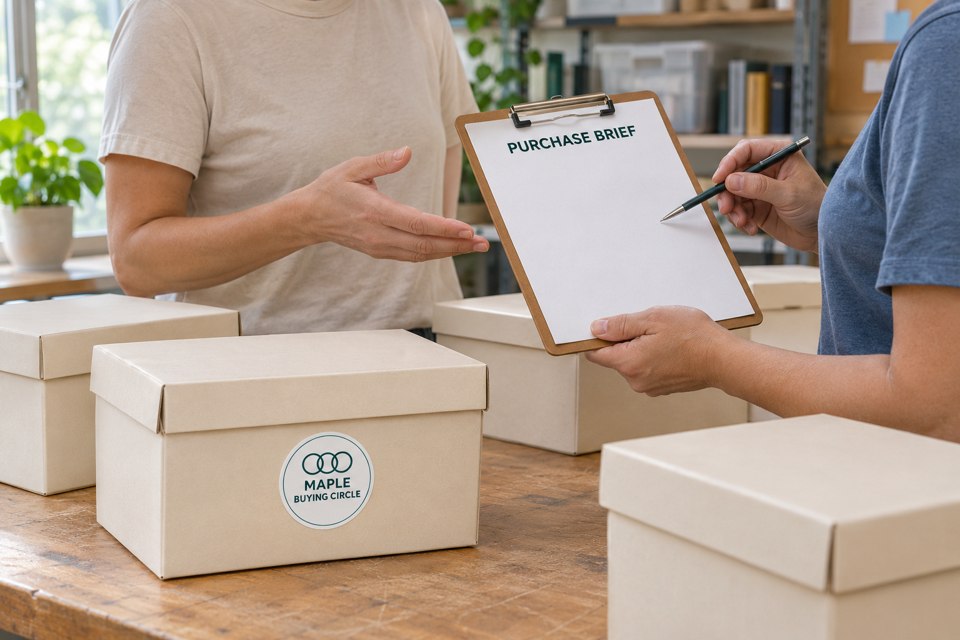
Fictional request: Maple Buying Circle asks for “warehouse-club box labels” and includes a retailer logo found online. That wording leaves both the buyer and the proposed brand use unclear. Hold that artwork while clarifying the actual task.
The group then explains that these are its own indoor storage cartons after a member-shopping trip. It is not selling goods to the club, ordering on the club’s behalf or asking the club to reimburse the purchase. A revised brief can now say:
- Proposed buyer and user
- Maple Buying Circle, for the group’s own storage organization. Confirm who is authorized to approve the final order and payment for the group.
- Location and purpose
- Stable group identification on its own suitable indoor cartons. No claim that the cartons or labels are supplied or approved by the warehouse retailer.
- Artwork direction
- Use the group’s proposed MAPLE-circle-v3 file, containing its own name and three-ring mark. Remove the retailer artwork from this version; retain the earlier draft as held and superseded for this task.
- What remains pending
- Confirm the group’s permission for its artwork, actual label configuration and surface, finished-label quantity, total price and purchasing approval. A revised brief is not itself an approved order.
The change is substantive: the proposed transaction is now a group buying its own supplies, rather than an assumed club purchase. Removing retailer artwork does not prove every remaining requirement is complete. It makes the actual scope clear enough to review.
If the brief also includes instructions for collecting orders, separate ordering channels from collection instructions before approving that wording. Buying authority does not verify a customer-facing service instruction.
A label shortfall is not automatically an ordering quantity
Continue the fictional group example with 20 intended label placements and 6 usable existing labels of the correct approved design. These are planning assumptions, not measured group inventory or the label count pictured.
Additional finished labels needed = 20 − 6 = 14 labels
That is a finished-label requirement. It does not mean “order 14 units” when the listing’s purchase unit refers to sheets and its finished yield is not yet known.
Keep the placement count, usable existing stock and finished requirement together. Then obtain the actual yield and configuration total before translating the shortfall into an order. If the current label design or surface is unsuitable, the usable-stock assumption also needs revisiting.
The exercise supports a limited decision: clarify the unit and keep the order pending. It does not authorize a new budget, establish a supplier quotation or make a custom version preferable to existing suitable identification.
Check the label as a material, separately from its identity
Existing suitable labels or a maintained paper insert may already do the job. If permanent group identification remains justified, compare custom labels and stickers for the actual surface and use.
custom product labels
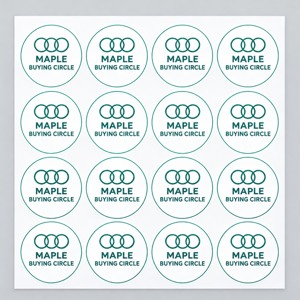
Current SKU decentcustom-st-000009 lists circular shapes and configurable materials and finishes. Its white-paper description is for indoor, dry use. Confirm dimensions and the actual surface rather than treating the AI carton scene as an adhesion test.
Quantity begins at 1 ordering unit; the package description refers to sheets without establishing finished labels per sheet. Confirm yield and the full configuration. No writable, removable, waterproof or food-contact performance is established here.
AI artwork concept with fictional Maple Buying Circle branding matching the scene. The sheet count is illustrative, not manufacturing yield. Click the small image for the exact product; no retailer permission or procurement relationship is implied.
Release a specific purchase, rather than a vague affiliation
For Maple’s revised brief, the next decision is to verify the group’s buyer and artwork, finish the material and quantity checks, and review the exact configuration total. The retailer-branded draft stays out of this group’s proposed order.
If a different request really comes from a club, establish that actual purchasing and brand scope separately. Do not reuse the group’s clarification as evidence of club authority or supplier acceptance.
When comparing a final configuration with DecentCustom, keep the buyer, intended use, approved file and finished-unit requirement together. A clear brief can support a purchase or a decision to keep existing materials. Neither outcome depends on inventing a warehouse relationship.