HOUSEHOLD REFILL OPERATIONS · EXISTING CONTAINER STOCK
A shelf full of containers is not the same as available supply. Match existing vessels to a defined need before adding another order.
Count what can serve the planned need
A refill shop can avoid ordering more containers when suitable, released and unallocated existing vessels cover its defined requirement by the time they are needed. Donated containers awaiting review, customers’ personal bottles and stock committed elsewhere do not automatically count toward that supply.
Start with the intended product, container type and actual service date. Then establish which existing items the responsible team has cleared for that use. Reuse is a purchasing option to evaluate, not a reason to skip acceptance or preparation.

Use the correct stock pool
Choose one container requirement that staff can recognize. “Containers for next week” is too broad if vessels have different closures, intended products or ownership. A count of jars cannot silently cover a need for a particular approved bottle-and-pump combination.
Clarify bottle-swap and donated-container rules first. A personal vessel belongs to its customer. A program bottle may have a defined return route. A donated item may be physically in the shop while still awaiting the operator’s inspection and preparation process.
Published policies show why a general “reuse stock” number is insufficient. Refillery on the Rogue conditions donation acceptance on space. Off the Bottle distinguishes permitted personal plastic-container use from its glass-container donation program. Neither example makes every vessel on a shelf interchangeable.
For your own review, record the required vessel and closure, intended use, ownership, release status, existing allocation and usable date. Where suitability or preparation is unresolved, keep it unresolved. Do not promote an item to available stock because it looks clean or has a new logo.
A complete fictional stock review
Suppose Aster Refill has an approved plan requiring six containers of one specified type at its next service date. This is a teaching example: the operator’s actual product, suitability criteria, preparation procedure and deadline would have to be documented. No real containers were inspected or released for this article.
The review finds 12 physical vessels in the relevant storage area. The following groups are mutually exclusive; no vessel is deducted twice.
| Status at review | Count | Count toward this need? |
|---|---|---|
| Suitable for this defined use, released, unallocated | 5 | Yes |
| Awaiting the operator’s review or preparation | 3 | No, not yet |
| Not the required type for this use | 2 | No |
| Already allocated to another confirmed use | 2 | No |
| Physical total | 12 | Only 5 currently available |
Available now: 12 − 3 − 2 − 2 = 5 containers.
Uncovered requirement: max(0, 6 − 5) = 1 container.
The result is a one-container gap for that specified need. It is not a finding that the shop needs 12 new bottles, that all three pending items will pass, or that the two differently specified items are unusable for every purpose.
Keep the review in containers of the same required type. Do not substitute liters of product, labels, sheets, supplier cases or total refill transactions as though they were the same unit.
What changes if one pending item is released?
If the responsible employee completes the actual process and releases one suitable pending vessel before the relevant deadline, available supply becomes 5 + 1 = 6. With the example’s requirement still six, the uncovered amount becomes max(0, 6 − 6) = 0. No new containers are needed for this defined requirement.
That is a conditional result, not a forecast. Until release and timing are confirmed, retain the original available count of five. An expected donation or an unresolved supplier delivery is not a confirmed addition.
Turn the count into a decision record
A completed record for the example, before the pending item is resolved, could read:
- Requirement
- Six containers of the specified type for the planned service date.
- Confirmed available supply
- Five suitable, released, unallocated containers. Three pending vessels excluded.
- Current gap
- One container. No unconfirmed incoming supply counted.
- Assigned next action
- Responsible employee checks whether one pending item can complete the actual process before the purchase decision deadline.
- Purchase status
- No order placed. Actual supplier lead time, order unit and latest decision time still need confirmation.
- Decision condition
- If one suitable item is released in time and the requirement is unchanged, use existing stock. Otherwise resolve the remaining requirement through an approved available alternative or a suitable purchase.
Set the real decision deadline from the service need and confirmed supplier or alternative preparation time. This example supplies no assumed delivery interval. If waiting for a pending vessel would leave no workable alternative, bring the decision forward rather than promising an on-time release.
A one-container gap is not automatically a one-unit order
A supplier may sell a case, a bottle separately from its closure or a configured assembly. Before ordering, confirm what the quoted unit contains, the minimum, availability, total cost and whether it actually serves the intended use. A minimum order is a commercial constraint, not evidence of extra customer demand.
If an accepted alternative already covers the gap, record it and revise the count. If the planned service changes, revise the requirement. Keep the reason visible so another employee can understand why the shop bought, waited or reused.
Keep the label decision separate from the bottle decision
Before considering printed materials, identify their job. A system identifier, required product information and an optional dry stock-folder header have different requirements. An ordinary printed sticker does not establish RFID function, container suitability, water resistance or resistance to a cleaning product.
An existing folder or plain card can identify this review. If the dry paper folder genuinely needs consistent branding, compare custom labels and stickers for that limited role.
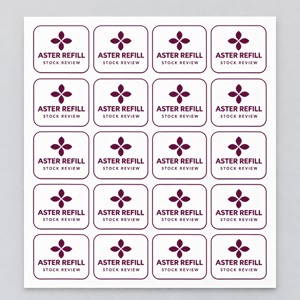
Stock-folder identity concept
The custom product labels page offers material, shape and finish choices, including white paper described for dry indoor use. The plum Aster artwork identifies a paper folder; it does not label a vessel as approved.
Confirm the configuration and finished-label quantity before ordering. The pictured sheet is an AI layout, not proof of label yield, chemical compatibility, adhesion, removability, cleaning or RFID performance.
Buy only after the usable supply and actual gap are clear
Keep the requirement, status groups, exclusions, deadline and decision together. Recheck the count when a pending vessel is released or an allocation changes. A documented choice to reuse existing stock can be the complete outcome.
If a separate, verified printing need remains, compare the relevant options at DecentCustom. The purchase should follow the task it must perform, with ordinary information printing kept separate from functional container and system requirements.
Prepared by DecentCustom from the named operators’ published FAQs, the original industry research and current catalog, reviewed November 6, 2026. Historical Mission material does not establish current service or inventory. Aster Refill, the quantities, stock statuses and release scenario are fictional. No physical inventory, cleaning, suitability or customer-demand test was performed.