FARM STORE OPERATIONS · CSA COLLECTION
Give members the right place, window, collection steps and exception contact. Make a friend’s pickup easy to understand without promising an unapproved change.
Write one route for the actual share format
A useful CSA pickup instruction tells the member when and where to collect, how to identify the correct share, what to bring and whom to contact if plans change. It also tells a friend how to follow that same route. A change request should stay a request until the farm confirms it.
Start with the service the farm actually runs. A market-style collection, where members choose quantities from current instructions, needs different wording from a prepacked share. Do not send someone to select produce when their subscription uses an assigned box.
Explain the collection method before the exception
Lansing’s CSA FAQ describes selected pickup days, members packing their shares using a whiteboard’s quantities, and advance contact or a friend’s collection when a member cannot attend. Its missed-share policy includes donation. Those details belong to that named program, not every farm store.
The UW Farm’s 2026 CSA page distinguishes staffed market-style and prepacked collection. It also asks members to notify staff about friend pickup and gives sign-off steps. This is an educational farm example, rather than a representative private retail model.
UW’s page describes a possible later pickup with a capacity qualification in one section and a less qualified follow-up offer elsewhere. A reader should confirm the current arrangement with that program. A different farm should not turn either passage into its own guaranteed late-collection service.
For your own instructions, settle the pickup point, approved window, share format, matching or sign-in step, current quantity source, carrier requirement and exception route. Keep customer-specific information in the farm’s appropriate record, rather than posting member details on a general sign.
A complete pickup notice for operator review
Here is a fictional Mossfield Farm setup: a staffed, market-style full share is collected inside the farm stand on Thursdays from 4–6 p.m. Members request changes through the CSA contact route supplied in their membership confirmation. These chosen teaching details are not a named farm’s actual schedule.
Your Mossfield full-share pickup
When and where: Thursday, 4–6 p.m., at the staffed CSA desk inside the farm stand.
Start with the team: Tell the employee the membership name and share type. Complete the farm’s check-in step before selecting your share.
Pack this week’s share: Follow the current full-share quantities displayed in the pickup area. Ask the employee if an item or amount is unclear. Bring your own suitable bag or box and leave the farm’s display bins in place.
Sending a friend: Notify the CSA team through your member contact route and give your friend the confirmed pickup details. The team will explain any required matching or sign-in step.
Need a different arrangement? Send a request through that same contact route before your pickup. Wait for confirmation; a sent message does not change the collection window. If you have already missed it, contact the team before travelling. A later pickup is not guaranteed.
The operator must approve the actual check-in process, who receives messages, change cutoff, proxy arrangements and missed-share policy before using a version of this notice. Put the working contact route in the member communication and make sure a new member can find it. Do not invent a phone service or an after-hours collection point.
It can help to separate pickup instructions from ordering channels. That related guide explains the distinction; its supermarket procedures do not supply CSA rules.
Give the friend a usable handoff message
A friend needs more than the farm name. For the fictional setup above, suppose the farm has confirmed that Mira may collect Jordan’s full share. Jordan could forward this completed message:
Thanks for collecting my Mossfield full share this Thursday. The CSA team has confirmed you as my pickup person. Come to the staffed CSA desk inside the farm stand between 4 and 6 p.m. and tell the employee you are collecting Jordan’s full share.
Follow the team’s check-in instructions, then use this week’s full-share amounts displayed in the pickup area. Please bring a suitable bag or box and leave the farm’s bins there. If an amount or matching step is unclear, ask the employee before packing. If you cannot arrive within that window, tell me so I can contact the CSA team; please do not assume another pickup time.
Jordan and Mira are fictional. The example assumes prior confirmation and does not establish how another farm verifies a proxy. Share only the details the actual process requires. A friend should not need the member’s account password, payment credentials or access to unrelated membership information.
Keep the current share format in the forwarded message. If the farm changes from self-selection to prepacked collection, replace the selection instructions with the actual box-matching and handoff steps before forwarding them.
Keep requested, confirmed and missed states distinct
Before pickup: a request is still pending
In a fictional planning case, Jordan asks to collect on Friday instead of Thursday. The team has not replied. The working record remains “Thursday collection; Friday requested, not confirmed.” Jordan should not send Mira on Friday on the assumption that the message was enough.
The next action is to seek the farm’s response through its published route. If the original window is still possible, ask about a permitted friend pickup. If neither option is confirmed, do not promise that a share will be packed, held or transferred to another day.
After pickup: ask before making another trip
In a second fictional case, a member notices the missed collection after the staffed window has ended. A useful inquiry identifies the membership and missed distribution, explains that collection did not occur and asks what options remain under the farm’s current policy. It does not assume a replacement, refund or later collection.
The team checks the actual record and policy before replying. Record its confirmed decision, who will collect if permitted and the agreed place and time. If the applicable policy has already directed the share to donation, do not leave a customer-facing message suggesting it is still waiting.
These are communication examples, not instructions for holding produce outside its normal handling process. The farm must control its actual food handling, storage and distribution decisions.
Keep the identifier stable and the pickup details editable
An email, website or current whiteboard may already do the job. If a dry indoor information holder needs a consistent farm identifier, compare custom labels and stickers for that limited role. Changing dates, locations, quantities and exceptions belong in an updateable message.
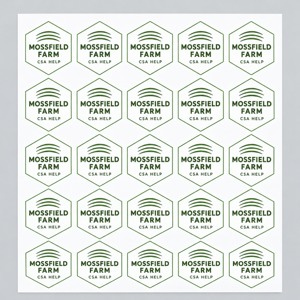
CSA-help header concept
The custom product labels page offers material, shape and finish choices, including white paper described for dry indoor use. The Mossfield hexagon identifies the notice; it does not authorize collection.
The AI sheet establishes no food-contact, outdoor-weather, water-resistance, adhesive or system-tag performance. Confirm the selected configuration and finished-label quantity before ordering.
Review an ordinary pickup and one exception
Read the draft as a member and as a first-time friend. Both should know where to start, which share instructions apply and how to ask for help. Then check the missed-window wording against the team’s actual capacity and policy.
Once the route and update responsibility are clear, compare any genuinely needed print options at DecentCustom. Keeping an existing notice and improving its wording is a valid finished decision.
Prepared by DecentCustom from the linked farm program pages, original industry research and current catalog, reviewed November 6, 2026. Named programs have their own arrangements; UW is an educational farm. Mossfield Farm, its schedule, Jordan, Mira and all example messages are fictional. No member was contacted, collection changed, produce held or customer test performed.