FOOD CO-OP OPERATIONS · BEFORE CHECKOUT
An owner can choose online pickup and still lose an in-store benefit. Explain those limits before the order, with a clear path back to the current co-op rules.
Answer the benefit question before giving pickup directions
When someone asks, “Can I use my owner benefits for pickup?”, “We offer curbside” is only half an answer. They may be asking about an owner discount, a gift card, product prices or the amount charged at checkout. A collection location does not answer any of those questions.
For a food co-op, useful shopping information connects the benefit to the transaction in which it actually applies. Explain the difference while the shopper can still choose a channel, rather than asking the collection team to fix an expectation after payment.
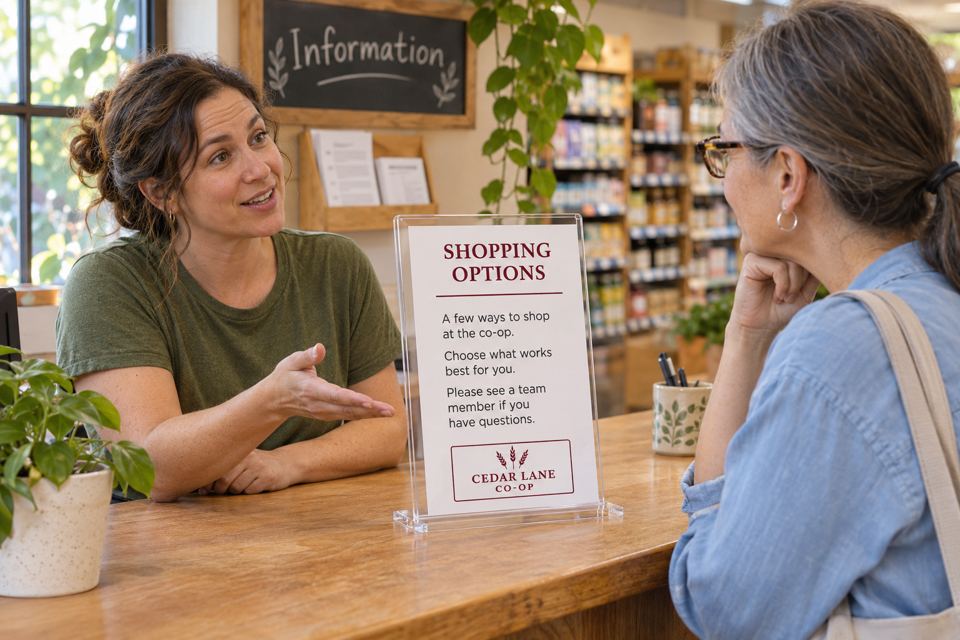
“Same prices” does not mean “same benefits”
A concrete example comes from North Carolina’s Weaver Street Market. Its official online-shopping information directs shoppers through its own Instacart link for store pricing; other entry routes may show different prices. It also distinguishes online promotions, owner discounts, gift-card acceptance and service fees. These are the published conditions of this operator, not rules for every co-op.
Its ownership page says non-owners can shop and limits a listed owner sales benefit to in-store purchases. Ownership and shopping access are therefore separate questions, too.
Item price
Which storefront did the shopper enter, and which location, product, size and quantity are being compared?
Benefit eligibility
Does this particular discount or promotion apply to this channel and these items?
Payment acceptance
Can the intended card or other payment method be used for this transaction?
Final total
What does this checkout show after applicable discounts, fees and other charges?
A matching shelf price establishes only the first comparison. It cannot establish the other three. Keep each answer beside its source and scope instead of compressing everything into “all member benefits available.”
A worked question: an owner, a gift card and an online basket
Illustrative question: “I’m an owner. I found the online shop through a search, want pickup, and have a co-op gift card. Will it cost the same as coming inside?” No actual account or basket was accessed for this example.
The first useful step is to identify what would change the shopper’s decision. If using the gift card is essential, payment acceptance matters before choosing a pickup window. If an owner discount is the priority, its channel restriction matters before filling the basket.
This is editorial wording based on the linked policy, not an approved retailer script. A different co-op should replace the conditions with its own verified answers. Do not copy the exclusions into another store’s notice just because both organizations are cooperatives.
What can the shopper decide now?
They can stop treating pickup as an in-store payment transaction. They can return through the official ordering entry, review the actual basket and decide whether the online route meets their priorities. The employee has not promised a saving, invented a final total or guaranteed that any one coupon will work inside.
If comparing costs, use the same items, variants and quantities at the same time. Record unavailable items separately; do not quietly replace one with a different pack size. Leave an unverified charge unknown rather than entering zero. Without comparable basket evidence, “online is cheaper” and “in-store is always cheaper” are both unsupported conclusions.
Repair the claim where the decision happens
Consider this hypothetical website sentence: Shop online for pickup and enjoy the same owner benefits as in store. Adding a footnote to a collection sign would leave the original expectation in place.
For a service with verified channel exclusions, a more accurate introduction is:
Shopping online? Check the current online-shopping information before ordering. Owner offers and payment options may differ from in-store shopping. Review the terms that apply to your chosen service and the total shown at checkout.
That introduction still needs a direct link to the actual service page. Put specific, confirmed exclusions beside the ordering button where practical; do not make a shopper search through general membership material to find a condition that determines whether they can pay.
Keep the owner-benefit page and online-service page consistent. A broad headline on one page can contradict an accurate FAQ on another. If the two sources conflict, have the responsible team resolve the wording before approving the claim. A missing answer is a content gap, not permission to infer eligibility.
Then explain collection as a separate step
Once the shopper has selected the channel and placed the order, write the pickup arrival instructions: the ready signal, collection location, arrival action and working help route. Keep those operational instructions distinct from benefit and payment terms. Reaching the right desk cannot retroactively change which checkout processed the purchase.
Review the notice with a question that could expose an error
Ask a colleague to read only the proposed customer-facing material, then answer: “I have an owner account and a co-op gift card. Can I use both for this online pickup order?” Their answer should point to the verified conditions, rather than infer acceptance from the words “owner” or “pickup.” This is an internal editorial check unless actual target customers take part.
Keep the result with the reviewed source, channel, date and named update owner. Recheck when the ordering platform, benefit terms, payment options or official entry link changes. Replace stale wording at its original entry point as well as in the FAQ. Do not record this review as measured customer understanding or fewer support calls; those require separate live evidence.
Keep changing benefits off lasting identity artwork
An existing holder with a replaceable insert may be sufficient. If the holder needs a stable co-op identity, custom labels and stickers are a conditional option. Keep changing offers, fee amounts and payment claims in the editable notice. A logo label cannot keep a policy current.
Paper-label artwork for a dry indoor holder
The current custom product labels page offers rectangular shapes and white paper described for indoor, dry uses. Confirm the actual size, surface suitability and final configuration before ordering. The displayed order quantity is not a verified count of individual finished labels.
AI artwork concept; the pictured sheet count is illustrative. No removable-adhesive, food-contact or wet-use performance is established. Click the small image for the actual product.
Make the next decision easier
First correct the benefit and payment information. Retain the current notice holder if it does the job. If a physical format is genuinely needed, use DecentCustom to explore the appropriate configuration after the message, placement and approval owner are settled.