FOOD CO-OP COMMUNITY PROGRAMS · EVENT PREPARATION
A submitted application is not a confirmed table, and a table is not permission for every activity. Settle the event scope before committing it to print.
Describe what will happen at the table
“We would like a community table” leaves several decisions unresolved. Will volunteers share information, sell something, ask for donations, distribute food or collect signatures? A co-op needs the actual activities to assess the request. The organization needs the same clarity before preparing signs and supplies.
Start with a short activity brief, then track which parts have been accepted. An email acknowledging an application does not establish a date, a location or permission to add fundraising later.

Tabling, donations and endorsement are different decisions
GreenStar Food Co-op in Ithaca, New York publishes distinct donation and tabling conditions on its community-support page. The published example calls for donation requests at least 30 days before an event and tabling applications at least three weeks ahead. Tabling uses two-hour sessions; the usual location and display-access restrictions are also specified.
The policy separately addresses fundraising and sales approval, and states that permission to table does not establish co-op endorsement. Check the current page and confirm the arrangements with the operator before relying on them. These are GreenStar’s published conditions, not universal co-op requirements.
Keep each request separate in your planning record. A gift-card donation is a contribution with its own conditions. It does not reserve a table, fund a print order or authorize use of the co-op’s identity across your materials. Likewise, the chance to apply does not show that a particular organization meets the eligibility criteria.
A filled brief that keeps the proposed activity clear
Fictional planning example: River Path Community wants to explain its neighborhood food-access information project. Two volunteers propose a two-hour information session on December 12, 2026. No application has been submitted and no organization or event has been approved.
- Purpose
- Explain where residents can find the group’s food-access information and ask questions about its project.
- Activities requested
- Conversation and distribution of an existing information leaflet.
- People
- Two volunteers; their responsibilities are greeting visitors and keeping the leaflets organized.
- Requested session
- December 12, 2026, 10 a.m.–noon; a preference awaiting availability and confirmation.
- Materials proposed
- Existing table covering, literature tray and leaflets. Exact table, placement and any display restrictions remain to be agreed.
- Excluded from this request
- No sales, donations collected at the table, petitions, food sampling or customer-order collection.
- Before submission
- Confirm organizational eligibility, requested alternatives and the actual application requirements. Use genuine contact details only in the operator’s appropriate application process.
This brief gives a reviewer something concrete to assess without inventing an approval. The exclusions matter: a volunteer cannot quietly turn an information session into a fundraiser because the table is already set up.
Keep the operator’s eventual reply with this exact activity version. If the reply confirms only a session and leaves an activity unclear, obtain the missing answer before advertising that activity. Do not relabel an unresolved condition as “approved” merely to finish an artwork file.
Calculate request dates without inventing a print deadline
Using the published lead times above, the hypothetical December 12 event produces two different dates:
Tabling application
December 12 minus three weeks, or 21 calendar days, is November 21, 2026.
This addresses the stated minimum request interval, not a promise that the requested session is available.
Separate donation request
December 12 minus 30 calendar days is November 12, 2026.
Use this calculation only if making that separate request. Do not count an unconfirmed donation as available event funding.
Submitting earlier can leave more room to resolve questions; it does not guarantee acceptance. Confirm how the operator applies its deadline and submit through the required process. A computed date cannot establish office hours, delivery of an application or compliance with every eligibility condition.
Now make a separate materials schedule: approved event details, final copy review, proof approval, actual production estimate, delivery and on-site preparation. None of those durations has been obtained in this example. Do not fill the gaps with a generic shipping promise or assume the application cutoff is also the last safe day to order.
If the confirmed arrangements arrive too late for new print, use suitable existing materials and a replaceable notice. A plain, accurate insert is more useful than a polished sign naming an unconfirmed time.
Reopen the scope when the activity changes
Suppose the River Path coordinator later proposes selling tote bags to raise funds. That changes the activity from the information-only brief. Hold the sales wording and any related materials while seeking the required decision; do not treat the previous request as covering it.
The same applies if someone wants to add a food sample, a signature collection or a collection point for customer orders. Different activities can require different operational arrangements. If a real service will transfer goods to customers, map the handoff for each service separately. An approved community-table location alone does not define order matching, storage or release.
For co-op logos or sponsor language, establish the exact permitted wording and artwork before use. Describing the organizer’s own project is different from implying the host endorses it. Keep an unapproved host logo out of the production file rather than relying on a volunteer to remember which version is safe.
Use the confirmed brief to choose what goes on the table
Reuse an appropriate table covering and literature tray where possible. Keep the project identity stable while putting changing dates, directions and session details on replaceable material. Confirm the physical arrangement on site: a generated picture cannot establish clearances, accessibility or whether a display obstructs merchandise.
If the organization’s own dry indoor tray needs a consistent identity, custom labels and stickers are one option. A label may identify the project; it cannot convey venue approval by itself.
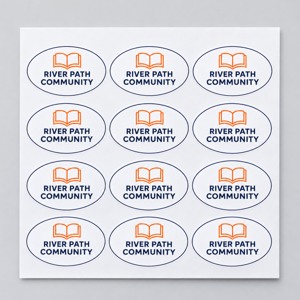
An optional identity label for the literature tray
The custom product labels page lists oval shapes and white paper for indoor, dry uses. Confirm the size, material configuration and suitability for the actual surface. An existing identification card may already be enough.
AI concept only. Sheet count is illustrative, and the displayed ordering quantity does not establish individual label yield. No removability, outdoor durability or food-contact performance is established. Click the image for the actual product.
Hand volunteers the current scope, not just a box of supplies
Before the session, give the team the confirmed time and location, accepted activities, current leaflet version and the person handling unexpected requests. Keep unapproved additions out of the packed set. If the brief later justifies new materials, explore the relevant configuration at DecentCustom after the message and permissions are settled.