One website can contain several fulfillment routes. Check each item, its collection or shipping method and its support contact before treating the whole purchase as one pickup.
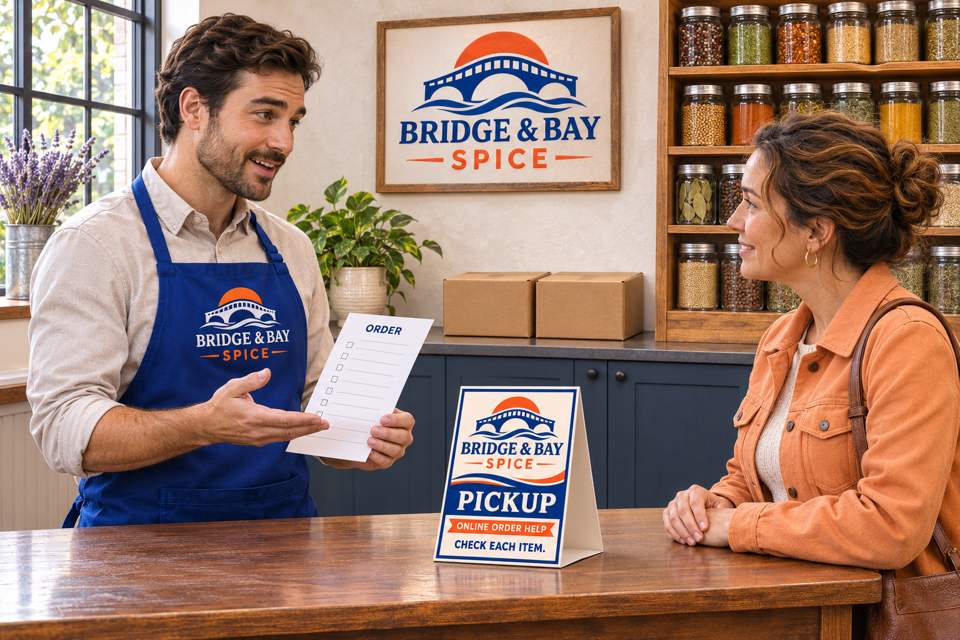
Read the fulfillment information at item level
A customer can see two products on the same website and reasonably expect them to follow the same path. The shop should make any difference visible before the customer plans a collection trip or expects one parcel.
Check the product’s format, fulfillment statement and actual selected method. A listing available online is not a count of stock at a named store. A store locator is not a reservation for a particular item. A shipping confirmation for one item does not establish the status of everything else.
As a specific operator example, The Spice House identifies certain partner products as vendor-direct and unavailable in its stores. Its location page separately identifies pickup at some shops. These are different pieces of information, not a promise that everything on the website can be collected at any location.
| Route | What to confirm | Useful status |
|---|---|---|
| Store pickup | The exact item, selected location, accepted collection arrangement and ready notification. | Requested, accepted or ready to collect—state which one actually applies. |
| Retailer-fulfilled online shipment | The order’s selected delivery method and the retailer’s fulfillment and tracking information. | Order received, preparing or dispatched, according to the actual record. |
| Supplier-direct item | The named fulfillment party, item-specific shipment details and support route. | Use that item’s record; do not copy the status of a separate store pickup. |
Before choosing a route, identify the correct jar and refill quantities. Collection permission is also separate from small-refill preparation questions: a shop offering pickup does not automatically offer to fill a customer’s jar.
C808: two products, two unresolved handoffs
This is a fictional planning example. Bridge & Bay Spice, the customer, product descriptions and records below are invented. No order was placed, reserved or collected.
The customer’s question
“I’m Sam. I want one packaged spice refill and one pepper mill I saw on your website. Can I collect both at the North shop tomorrow? The mill’s page says it ships directly from a supplier.”
The answer should not be a blanket “yes” based on the refill being sold by the shop. Record each proposed line separately.
| Proposed line | Known from this example | Still unresolved |
|---|---|---|
| A · Packaged spice refill | Sam requests collection at the North shop. | Exact variant, local availability, pickup acceptance and readiness. |
| B · Pepper mill | The listing says supplier-direct shipment. | Supplier shipment details, timing and item-specific support. No store pickup is confirmed. |
A complete staff reply
“These need separate checks. For the refill, please identify the exact product and format so we can check whether the North shop can accept your pickup request. Do not travel for collection until the applicable order is confirmed ready.
“The mill is marked supplier-direct, so we cannot treat it as part of the proposed store collection merely because it appears on our website. Please review that item’s fulfillment details. We can help identify the appropriate support route, but we have not confirmed that it will arrive tomorrow or be available at the shop.”
Current decision: neither line is ready for collection on this information. Line A needs a local pickup check; line B follows its stated supplier route. This is not a cancellation or a rejection of the customer—it is a clear account of what has and has not been confirmed.
The customer’s useful follow-up
“Please confirm the refill’s exact variant, whether North pickup is available and how I will receive the ready notification. For the supplier-direct mill, please identify who provides shipment updates and which support contact applies. I will not assume both items can be collected together.”
If one line later becomes ready or dispatched, update that line. Keep the other line’s unresolved status visible. An overall order acknowledgment should not erase the distinction.
Match the support question to the affected item
A useful inquiry names the item, purchase reference and question: pickup readiness, shipment progress, a requested change or a product issue. Use the shop’s approved private support channel for order details, rather than posting an address or billing record publicly.
Follow the item’s actual terms and fulfillment instructions. A retailer’s ability to edit an unfulfilled ordinary order does not establish the same ability for a supplier-direct item. A request for help is not confirmation that a change, cancellation or refund has occurred.
Preserve the relevant receipt and original packaging and store information so the product and purchase can be identified. Do not send the customer to a generic contact simply because it is printed on an unrelated insert.
For stock planning, keep local usable stock, expected incoming goods and supplier-direct availability distinct. A vendor listing is not physical inventory in the shop. Count the materials needed for the actual handoff; do not derive an outer-bag order or printing budget from the value of online food sales.
Use a counter prompt to start the right question
Finished route wording
Pickup or online order question? Tell us which item and order you mean. Check the selected location or shipping route for each product. A pickup request is not a ready-to-collect notice; supplier-direct items may follow separate fulfillment instructions.
Keep stock, collection times, shipment estimates and changing contact details in maintained order or service information. A static counter card should not announce that every online item is available today.
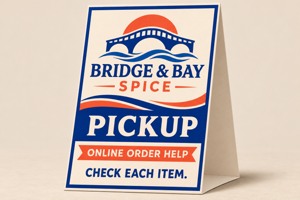
An optional order-help table tent
The fictional Bridge & Bay design links directly to custom table tents. The checked product is a 5 × 7-inch, 14pt paper format with matte and gloss options and a displayed minimum of 25.
Compare table tent formats if the physical counter needs this prompt. Confirm the folded proof, space, reading distance and approved wording. Existing order emails, a reusable sign or a staff explanation may already be sufficient.
The artwork is a paper information concept. It does not connect to inventory or an order system, and it does not establish shipment timing. One display location alone does not justify a 25-piece purchase.
Questions to answer before a collection trip
Does a store listing prove that my item is ready?
No. Confirm the item, location and actual ready notification. Opening hours alone do not establish item availability.
Can one order have different fulfillment updates?
Yes, where its items follow different arrangements. Read the actual item-level records rather than applying one parcel’s status to the entire purchase.
Should the same contact handle every problem?
Not automatically. Identify the affected item and the current support instructions. If the route is unclear, ask the retailer to clarify responsibility without assuming a particular outcome.
Define the route before printing the promise
Before preparing materials with DecentCustom, identify the service question the shop actually needs to explain. Print only stable, accurate route information, and retain order-specific details in the systems that are maintained. No new sign is needed if the existing route is already clear.
Research and boundaries
Reviewed November 8, 2026. The Spice House FAQ describes its limited supplier-direct arrangement; its shop locator separately identifies location services. These are one operator’s statements. Unspecified services and unyearmarked holiday hours were not turned into current availability claims. C808 and the artwork are fictional; no purchase, stock, pickup, shipment, cancellation or business outcome was verified for a customer.