A small purchase should not require guessing about a bag, jar or tool. Clarify the quantity you want and the opening you have before choosing a refill arrangement.
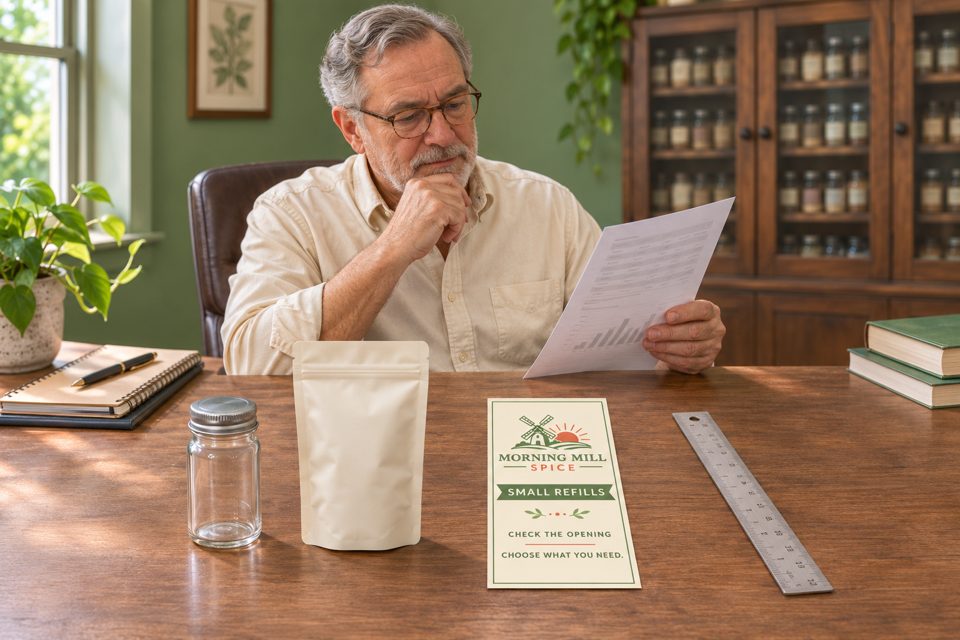
Start with how much the customer wants to buy
A shopper who needs a little of an unfamiliar spice may have a different goal from someone replacing a frequently used staple. Ask whether the customer wants a small available pack, a refill for an existing container, or information about a different format. Do not treat the largest bag as the default answer.
Check the actual available quantities and units. A bulk purchase may be sold by weight while a packaged refill uses a stated volume or a different pack size. Compare like information rather than assuming two bags hold the same amount because they look similar.
Also separate jar capacity and refill quantity. Buying enough to make a container look full is not the same decision as buying the amount the customer needs.
A separate anonymous bulk-spice discussion described difficulty handling a small amount in a much larger bag; replies reported different bag options at other stores. That is an individual convenience problem worth asking about, not evidence that every shop needs new containers or a particular transfer tool.
Describe the jar mouth, not just the lid
“A small spice jar” is not a useful tool specification. The outside of a cap, the jar’s widest body and the clear opening are different dimensions. If a proposed tool must enter the opening, compare the relevant opening with the outside dimension of the part that would enter it.
A simple dimensional rejection
Fictional example: a circular jar mouth has a reported clear diameter of ½ inch. The proposed rigid tool tip has an outside diameter of ¾ inch at the section that would need to enter.
Comparison: ¾ − ½ = ¼ inch. That tip is wider than the stated opening, so reject this proposed insertion arrangement. Do not recommend forcing it in or altering the jar.
This is an arithmetic screen using invented dimensions. It is not a tested tool, a pouring instruction or a claim that another tool will work.
The opposite comparison is limited too: a narrower tip is not proof of a convenient transfer. Tool shape, insertion depth and the particular spice can still affect use. Check a tool’s intended purpose and instructions rather than promising “no mess” from one diameter.
Keep questions about container suitability and product handling with the relevant product guidance or shop staff. Do not turn a graphic on a printed card into an unverified food-use procedure.
M606: a complete inquiry before buying or opening a refill
This example is fictional. Morning Mill Spice, the customer and all measurements are illustrative. No refill was opened, no jar was measured and no shop service was booked.
The customer’s message
“I’m Ellis. I want a small quantity of this spice rather than a large stock-up bag. I already have a jar, but its opening is narrow. My notes say the clear mouth is ½ inch and the tool I was considering has a ¾-inch outside tip. Which smaller pack sizes do you currently offer, and where can I find your product’s refill guidance? I do not want to assume that you fill customer jars in the shop.”
The message identifies three separate questions: available quantity, the proposed physical arrangement, and the actual service or guidance offered. It does not ask staff to infer everything from a photograph of a closed jar.
A useful staff response
“We should first check the available pack sizes for the exact spice. You do not need to choose a large bag simply to fill an existing jar. The tool dimensions you supplied rule out that stated insertion arrangement: the ¾-inch tip is wider than the reported ½-inch opening.
“That comparison does not qualify another tool or container. Please use the product’s applicable guidance, and ask us to clarify anything missing before opening the refill. If you want an in-store service, we need to confirm that our location actually offers it and accepts the proposed container.”
Decision in this example: do not buy the mismatched tool. Ask about smaller available quantities and the relevant guidance; do not assume a new jar, a large refill or staff-assisted filling is required.
A shop should answer the availability question with its actual current products. If the smaller format is unavailable, say so rather than promising it from another store’s forum report. Keeping the original suitable pack and its information may also be an option under that product’s instructions.
Give customers a short preparation note
A useful note explains what information to gather. It should not promise that every customer can bring a jar for filling, or that a logo on a bag makes it suitable for loose spice.
Finished preparation wording
Planning a small refill? Check the exact spice and available quantity first. If an existing jar matters to your choice, identify its model and clear opening. Follow the product’s applicable guidance. Ask our location before assuming we offer filling or accept customer containers.
Put location-specific answers on the maintained service page or in a direct reply. For example, “ask our location” is safer than printing a universal bring-your-own-container invitation when the shop has not established such a service.
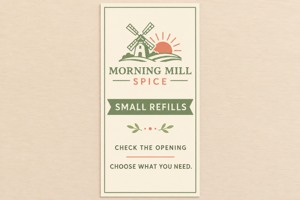
An optional preparation card
The AI-created Morning Mill design links directly to custom rack cards. The checked product is a flat 3.74 × 8.27-inch format with a displayed minimum of 50.
Compare rack card formats if customers need a repeatable take-away prompt. Check the selected stock, finish, approved wording and artwork proof. Existing email, a website or a reusable sign may do the job without a new print order.
This card is information paper, not a funnel, food-contact surface or protective spice package. Do not assume that its finish accepts handwriting or that a pictured jar or pouch is included with the printed product.
Questions that lead to a better refill decision
Should customers buy more spice to match their jar?
Not automatically. Establish the desired quantity and actual pack options first. The jar’s appearance does not establish consumption or a sensible purchasing amount.
Does a tool smaller than the opening guarantee a spill-free refill?
No. A dimensional screen can rule out an obvious mismatch, but it does not prove transfer performance or the tool’s suitability.
Can the same preparation card apply at every location?
Only the statements that are true for every covered location should be shared. Confirm local services and use maintained information for changing rules or stock.
Choose information that helps the next purchase
Before asking DecentCustom for a printed version, identify the recurring question and the answer the shop can actually provide. A useful note reduces guessing about quantity, openings and service; it does not require a new container or a bulk print order.
Sources and limitations
Reviewed November 8, 2026. The Spice House FAQ supplies a packaged-refill reference, and its shop information shows why location should be identified. The separate anonymous refill discussion is a limited customer perspective, not industry-wide evidence. M606, the dimensional screen and imagery are fictional; no tool, transfer process, food handling or customer outcome was tested.