Before ordering event materials, connect each proposed change to the affected copy, quantity, layout and approval. Keep the current baseline and the proposed revision distinct until the relevant decisions are confirmed. A request to add something is not itself an instruction to produce it.

Which part of the plan is actually changing?
Event agencies can coordinate several connected disciplines. EXP's service overview, for example, describes planning, design, management and production with in-house planners, designers and producers. A change that looks like a small graphic edit may also need a quantity, placement or supplier answer from another person.
Event Experience's published process moves from goals and alignment to a proposal, design, planning, execution and closeout. Its current wording about being aligned is not, by itself, evidence that a particular print file has been approved for production. Keep the specific material decision attached to the actual project record.
The distinction matters in ordinary client communication. In a qualitative event-production discussion, an anonymous technical supplier describes small requests accumulating, while a client-side reply welcomes early revised quotations with clear included quantities. The author says the business is not a full-service agency and the problem is not every client. This is a limited communication example, not a US market rate or a reason to blame a customer's budget.
Start with the current accepted scope and the affected material item. Identify the change requested, who requested it and which decision it needs. Copy, quantity, placement, cost and timing can each remain at a different stage. Do not turn a reply about one field into approval of all the others.
A filled example: thirty displays proposed to become thirty-four
Fictional M12 example: Kinfield is coordinating printed room-information table tents for a client event. Version 2 contains the approved draft wording and a count of 30 displays for the current layout. No print order has been placed. The client then asks to rename a room and add four display positions.
- Baseline — M12, V2
- Thirty paper displays for the recorded layout, with the V2 draft wording approved. The item remains un-ordered; this example does not involve cancelling an existing production job.
- Requested revision — V3 draft
- Replace the affected room wording and propose four additional positions. The provisional count is 30 + 4 = 34. It is a proposal, not evidence that those positions have been accepted.
- Layout and quantity check
- The coordinator asks the responsible layout contact to confirm the four positions and the resulting display count. An increase in expected attendance is not substituted for a count of places needing this item.
- Artwork check
- The client copy owner must review the exact V3 wording and proof. The agency keeps that file distinguishable from V2 and records what the copy review covers.
- Supplier and purchasing check
- The supplier is asked about the revised configuration, quantity and timing. The responsible purchaser reviews the resulting quotation before any release. The old quotation is not silently treated as covering the change.
- Current status
- V3 is a draft request. The proposed count is 34, with layout, final proof and revised purchasing decisions still open. No production instruction has been issued.
This record preserves the earlier plan without pretending the new one is complete. It also identifies a useful alternative: if the affected information can be handled by an existing suitable display or a current digital page, the team should check that option before assuming another print run is needed.
Answer the request without implying it has been ordered
The M12 client asks, “Can you update the room name and just add four more?” A complete response explains the proposed change and what remains to be confirmed:
Fictional client reply: We have recorded the room-wording change and four proposed additional display positions in the V3 draft. That would bring this item from 30 to 34 displays if the layout check confirms those positions. We will send you the revised proof for the affected copy and ask the supplier to confirm the revised configuration, quotation and timing. Nothing has been ordered for M12 yet. We will identify the version and quantity for release after the relevant checks and purchasing approval are complete.
If the client next replies “the wording looks good,” record that as the copy answer it actually provides. It does not automatically settle placement, quantity, an additional charge or a supplier's production arrangement. Ask the remaining question through the existing project channel rather than describing the whole item as approved.
For small requests, a short entry in the current project record may be enough. The goal is to preserve the changed decision and its owner, not to invent a new administrative system for every sentence. Keep private guest, registration and commercial details in the appropriate working record, not on the public artwork.
Release one identifiable item and version
Suppose the fictional layout contact later confirms the four positions, the client approves the exact V3 proof, and the purchaser accepts the revised quotation Q3 for the selected configuration and timing. Only after those answers exist does Kinfield record M12 as ready for release.
Fictional release note: M12 is released as V3, quantity 34, using the exact artwork matching the approved V3 proof and the configuration in accepted quotation Q3. V2 is superseded for this item and must not be used for production. Use the production and delivery arrangement confirmed in Q3. Raise any mismatch in the file, quantity or configuration with the coordinator before proceeding.
In a real order, the referenced proof and quotation must be available and must actually contain the agreed details. Check the file attached or selected in the ordering interface, not just the email subject. A filename ending in “final” does not establish which version the supplier received.
Record the supplier's actual acknowledgment separately from your release. “Sent” does not show that the supplier accepted a change or began production. Keep the earlier version recoverable with its superseded status so another colleague can explain the history without accidentally reusing it.
A later draft does not undo work already released
If a V4 request arrives after V3 was released, check the actual production stage with the supplier before promising a change, cancellation or unchanged cost. The practical options depend on the work already performed and the supplier's current answer. A revised PDF sitting in the project folder does not stop another process automatically.
A useful client update can say: “We have received the new wording request. V3 was already released, so we are checking its current production stage and the available options before confirming a revision. V4 has not been approved or released.” Follow with the real answer and the responsible decision; do not replace it with an assumed rush solution.
Keep the event-use date, preparation requirement and supplier order timing distinct. An agency's general planning window is not a DecentCustom production or delivery promise. Unaffected materials may remain usable; check the specific item rather than declaring every file obsolete.
Check the format after defining the information job
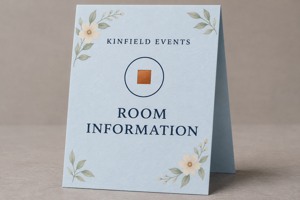
One folded paper information display
For approved dry indoor placements, paper table tents for approved room information list a 5 × 7-inch format on 14pt card stock, with finish options. Current quantity validation starts at 25; that minimum does not decide the number your layout needs.
Confirm the folded footprint, readable final artwork, actual placement permission and selected configuration. The fictional 30 and 34 counts come from the example's layout decisions, not guest totals or the product minimum. The AI illustration is a design concept, not a checked production proof or evidence of outdoor durability.
Compare table tent formats when the current display cannot serve the task. Give DecentCustom the approved artwork version, configuration and confirmed quantity, and verify the applicable quotation and delivery arrangement. Reusing suitable existing material or keeping information digital remains an option.
Reviewed November 9, 2026. Kinfield, its client, M12, Q3 and all quantities are fictional. This is a workflow example, not contract interpretation, an actual order or verification of cost, timing, print performance or business results.