A grain sack, a small sealed retail pack and an optional shopping bag do different jobs. Plan around the actual packed order before adding a logo or another carrier.
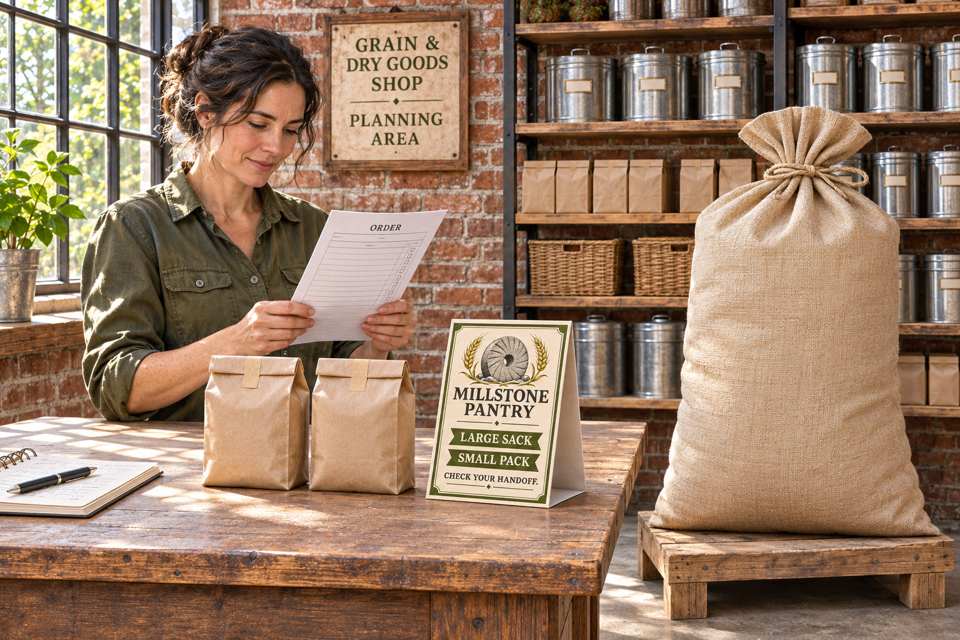
Separate the food pack from the optional carryout layer
A large sack of flour is already a packaged item. Two small sealed packs are also packaged items. Putting the shop’s logo on a shopping bag does not establish that the bag can replace either original pack, carry the entire order or serve as a shipping carton.
| Packaging job | What to identify | What a logo does not establish |
|---|---|---|
| Original grain or flour pack | The actual product, pack size, closure and original information supplied with it. | Food-contact suitability, product protection or an acceptable substitute structure. |
| Optional retail carryout | Which complete small purchases need an additional carrier, if any. | Fit, carrying performance or a suitable load merely because the bag is called a shopping bag. |
| Parcel-shipping arrangement | The complete shipment, its packing requirements and the selected fulfillment route. | Transit protection from a decorative retail bag. |
Keep the original product information available. A store emblem cannot replace product identification or supplied instructions. If a shop wants to change its original food pack, that needs a separate review of the actual product and packing process.
As one business example, Maine Grains operates a Dry Goods Shop alongside its mill and describes local pickup as well as shipping. Its FAQ notes that bulk bags’ size and weight affect shipping costs. That distinction does not qualify a generic tote or small paper bag for an entire grain order.
G909: food weight, pack count and shopping bags are different numbers
This is a fictional order-planning example. Millstone Pantry, the quantities and the record below are invented. No food, carrier or handling method was tested.
The proposed order
- One original closed sack, declared food net weight: 25 lb.
- Two original sealed retail packs, declared food net weight: 2 lb each.
- Requested route: local collection, subject to the shop’s actual confirmation.
Declared food total: 25 + (2 × 2) = 29 lb.
Original packaged units: 1 + 2 = 3.
The 29 lb is the total declared food net weight in this invented example. It excludes packaging and does not establish the gross handled weight, parcel weight or a shopping bag’s carrying rating. Three original packs also does not mean the shop needs three new shopping bags.
A complete handoff decision
Large sack: retain the original closed pack. Ask the shop to confirm the collection arrangement for that item; do not put it into an unqualified general carrier as a branding exercise.
Two small packs: keep them sealed and decide whether an extra carrier is useful. Review the complete pack sizes and the actual carrier before choosing one.
Information: retain the product identifiers and order record. Add a separate shop-information note only if something useful is missing.
Current purchasing decision: no new carrier is selected from the food-weight arithmetic. Continue the appropriate existing arrangement until a specific additional need and suitable format are established.
This keeps the decision practical: one order can have different physical handoffs. It avoids forcing the large sack and the small packs into a single branded-bag solution.
Confirm the actual collection arrangement before the trip
The customer needs to know which location to use, when the order is ready and what the shop expects at collection. Ask about the large item explicitly; do not assume the same handoff as a small counter purchase.
A usable customer question
“My proposed order contains one large original sack and two small sealed packs. Please confirm the collection location, how I will know the order is ready and the handoff arrangement for the large sack. Do I need any additional carrier for the small packs, or is your existing arrangement sufficient?”
That is an inquiry, not permission to arrive at a warehouse door or a promise that staff will load a vehicle. The shop should answer from its actual service arrangements. Neither a public opening-hours listing nor a general checkout acknowledgment supplies every collection detail.
For a shipped order, review the complete packing and current checkout estimate instead. Do not calculate the shipping charge from food weight alone or copy another operator’s shipping policy to a different supplier.
Explain the handoff without selling an unsuitable carrier
If staff need a physical reminder at the order counter, keep it about the service decision. An existing sign or order email may be enough.
Finished counter wording
Large sack or small pack? Keep the original packaging and product information. Confirm the collection arrangement for your complete order. Ask before adding a carrier; size, use and the actual packed items need to match.
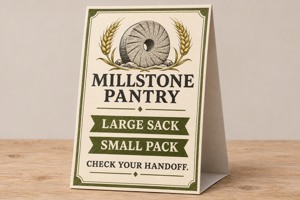
An optional information table tent
The AI-created Millstone Pantry design links directly to custom table tents. The checked product is a 5 × 7-inch, 14pt paper format, with matte and gloss options and a displayed minimum of 25.
Compare table tent formats only if a stable counter prompt serves a real need. Confirm the folded proof, space, reading distance and wording. The card is information paper, not a grain pack or evidence of carrying capacity.
Do not infer a print quantity from a mill’s annual food output or its total employee count. Establish the actual display locations and existing materials first. One counter position may be served by a reusable sign, with no new print purchase.
Questions worth settling before adding a bag
Can a general tote replace a grain sack?
Do not assume so. The original product pack and any additional carrier have different roles. A replacement needs evidence for that specific use.
Does 29 lb of food mean one bag rated for that number is enough?
The example has no qualified bag or gross-load measurement. Food net weight alone does not determine the complete carrying arrangement.
Should every small sealed pack get a separate outer bag?
Not automatically. Decide whether an extra carrier is useful for the actual purchase and review the intended combination.
Start with the packed order
Before preparing branded materials with DecentCustom, define the original packs, fulfillment route and specific missing information. Retain suitable existing packaging and use a new printed item only when it has a clear job.
Source and limitations
Reviewed November 8, 2026. The Maine Grains FAQ supplies the limited mill-and-shop, pickup and bulk-shipping context. One mill is not representative of every pantry retailer. G909, the calculations and the imagery are fictional; no food-packaging, fit, load, lifting, transit or business outcome was tested.