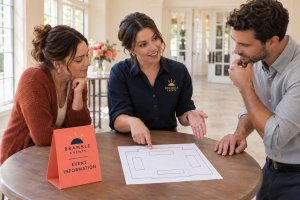
A client can accept the wording while a sponsor is still reviewing its logo and a venue has not approved the proposed location. Record the answer each reviewer can give, then resolve the gaps before treating the material as ready.
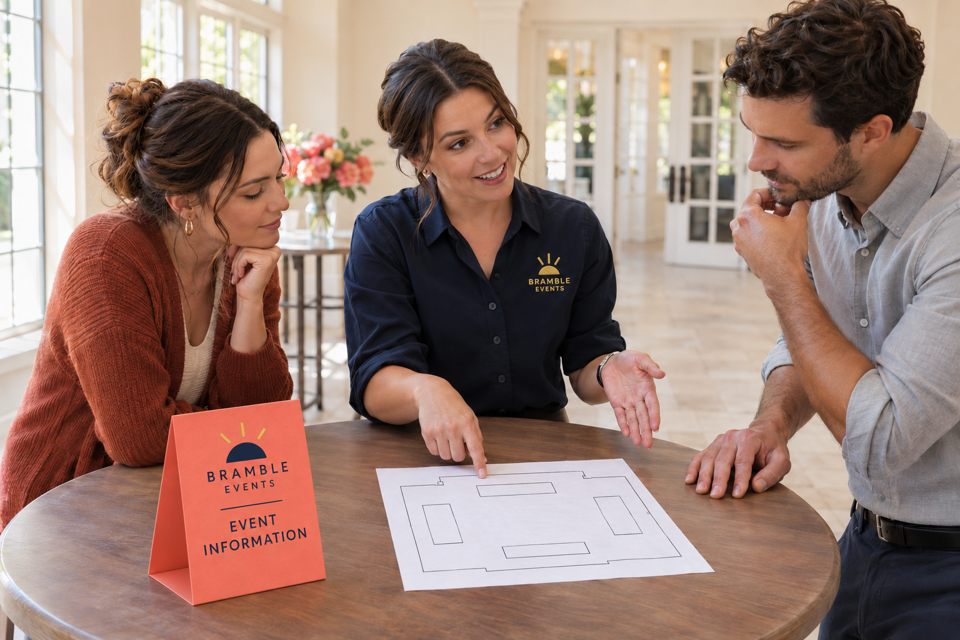
What does each reviewer need to decide?
Start with the exact material and proposed use. A general “looks good” reply is hard to apply if one person has reviewed the copy, another controls the brand artwork and somebody else controls the room. Keep the reviewers' actual responsibilities beside their answers.
- Client content
- Identify the person who can confirm the event wording and the client-facing information. Ask whether the answer covers the exact proof and its proposed use, rather than a previous draft or a different event.
- Sponsor artwork
- Use the sponsor's designated review channel to confirm the supplied logo, credit wording and proposed context. A downloaded image or last year's printed piece is not a current answer for this item.
- Venue placement
- Identify the venue or event-management contact responsible for the proposed location, dimensions, display method and applicable conditions. Approval of the event itself does not settle every display position.
- Purchasing and production
- Keep the person who authorizes the order, quotation and production instruction identifiable. Content approval alone does not establish that an order has been placed or accepted.
These are practical communication questions, not a universal legal approval chart. One person may hold more than one role on a particular project; record that person's confirmed responsibility instead of assuming it from a job title.
A venue's rules can remain relevant after the client says yes
Seattle Convention Center's current guidelines distinguish prior content and image approval for advertising and sponsored displays, location review, and surface-cling testing. They also restrict exhibitors from placing materials outside their assigned booth. Those venue-specific conditions illustrate why client approval and a proposed location are separate questions. Check the current rules for your actual event and building; the example is not permission to place a paper display at SCC.
The production relationship can be separate too. In Event Experience's House of Experian case study, the provider describes production work with the client and creative agency, while the agency maintained communication with the event and convention center. That account illustrates connected roles; it does not establish an approval process for every agency project.
A filled record: one proof, three different answers
Fictional worked example: Bramble Events coordinates a client briefing with a supporting sponsor. Item K22 is a proposed paper information display. Proof A2 contains the client's wording and a draft sponsor credit; placement sketch S1 identifies a proposed dry reception table. Neither the fictional venue nor the sponsor is one of the businesses cited above.
K22 — review status before ordering
- Client copy: Dana, the client's designated content reviewer, confirms the event wording in proof A2. The record states “copy confirmed for A2”; it does not say “all approvals complete.”
- Sponsor credit: sponsor reviewer Lee has been sent the draft credit and exact artwork context. No answer has been received. Status: sponsor artwork and credit pending.
- Venue placement: venue contact Rowan has received A2 and sketch S1. The proposed table position and paper-display format have not been approved. Status: location and display conditions pending.
- Order authorization: the purchaser has not released K22. The supplier's applicable configuration, quotation and timing still need to be confirmed before any order instruction.
- Next action: coordinator Quinn follows up separately with Lee and Rowan. K22 stays outside the confirmed production list.
One recorded content answer plus two pending reviews is not three approvals. A forwarded email shows that information was sent; it does not show that its recipient agreed. Keep the exact proof and sketch accessible to each reviewer, through the project's usual appropriate channel.
If Rowan replies only “the table is available,” ask whether the proposed display and its location are permitted. Availability is useful information, but it may not answer the question submitted. Likewise, a sponsor's approval of its logo file does not necessarily answer whether the credit wording and this event context were reviewed.
Send the complete question to the person who can answer it
For the fictional sponsor, Quinn can write:
For K22, please review your sponsor credit and logo as shown in proof A2 for this client briefing's proposed reception-table information display. Please confirm the artwork and credit wording for that use, or identify the changes needed. The client's event copy is confirmed, but your review and the venue placement review are still open. We have not released K22 for production.
The venue question needs different information:
For K22, proof A2 and sketch S1 show the proposed folded paper information display at the identified reception table. Please confirm whether that location and format are permitted and which conditions or further reviews apply. This is a placement inquiry, not an installation instruction. Sponsor artwork review is still pending, and nothing has been ordered for K22.
A complete client update can then say: “Your event copy in A2 is confirmed. We are still waiting for the sponsor's artwork and credit answer and the venue's location and format answer. K22 has not been ordered. We will bring any resulting copy or placement change back to the affected reviewer.” This preserves progress without implying that every decision is settled.
A no-sponsor version is an alternative to review
Suppose the sponsor does not approve the proposed credit. Quinn can ask the client whether a new proof without sponsor identification would still serve the information task. Record that as a proposed alternative, not an automatic correction to an approved file.
If the client chooses that option, create an identifiable revised proof and confirm the content and intended use. Tell the venue which proof is now being proposed. Removing a sponsor mark does not itself authorize the location, settle the display method or place a print order. Do not silently replace the file previously sent to a reviewer and retain the old answer as if nothing changed.
Other valid outcomes include using the venue's existing approved information, updating the appropriate digital channel or having no extra display. If the information is already clear, a new branded piece may add no useful function.
Release production only against the actual resolved record
When the relevant answers and purchasing arrangements exist, connect the order instruction to the exact final proof and permitted use. For the next step, see recording material versions and production release. It explains how to distinguish a draft, a specific release and a later change request.
Keep private approvals, commercial terms and guest information in the working record. The public artwork should carry the information appropriate for its audience, not an internal reviewer list or a substitute for event credentials. Check the actual supplier acknowledgment separately from an instruction sent.
Check the paper format after resolving the information job
A limited option for a permitted dry display
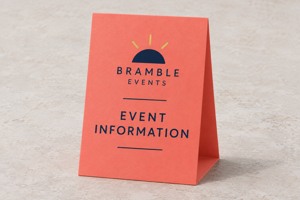
For an actual approved dry indoor position, paper table tents for approved event information list a 5 × 7-inch format on 14pt card stock, with finish options. Current quantity validation starts at 25; that minimum does not determine the event's requirement.
Confirm the folded footprint, final readable artwork, configuration, actual quantity and placement conditions. The coral Bramble illustration has fictional agency artwork only; it does not demonstrate sponsor approval, venue permission or a production proof.
Compare table tent options if a new display is useful, then give DecentCustom the final artwork and confirmed requirements. Verify the applicable quotation and delivery arrangement. Keep the event-use date separate from any unconfirmed production or delivery estimate.
Reviewed November 10, 2026. Bramble, K22, A2, S1 and the named reviewers are fictional. No real approval, sponsor right, venue permission, order, installation or business result was verified.