Before buying replacement event materials, separate ownership, present condition, current information and permission to use each item. Count the materials that are actually available for this event, not everything in storage.
Start with ownership and the current event brief
An agency's storage room may contain its own office supplies, a client's retained display, a rental supplier's equipment and décor borrowed from a venue. Being in the same room does not give those items the same permissions. Start with the actual owner, agreed use and return arrangement before treating anything as available stock.
- Agency-owned paper materials
- Check that the wording and artwork remain appropriate, the pieces are in usable condition and the intended display positions are confirmed. A former event date or sponsor mark can make an otherwise intact piece unsuitable for a new event.
- Client-owned retained components
- Confirm the client's decision, where the component is held and what documentation or specialist review is needed for its next use. A previous successful installation does not establish suitability for another location.
- Rental and venue items
- Check the selected booking's included items, availability, permitted use and return responsibilities. Do not count a borrowed item as permanent agency stock or cover its identification with your own label.
Keep current venue requirements and the approved client brief beside the inventory. If the brief has changed, review the affected item against that change rather than assuming that an old approved design remains approved indefinitely.
Separate an existing idea from a reusable physical item
Event Experience's House of Experian case study describes adapting a previously designed concept for a later show and its requirements. After that build, the client retained an interactive wall; the provider describes a custom crate and reinstallation instructions. Reusing a design and relocating a physical component were different tasks in that provider's account.
A venue inclusion can also remove a purchase from the plan, but only within that booking. Liljebeck Farms' FAQ lists venue-owned tables and lending-room items, while distinguishing supplies such as linens and dinnerware that it does not provide. It also gives a collection arrangement for borrowed décor. Check your own venue's current package and instructions; this example does not establish another venue's inclusions.
For each candidate, answer four practical questions: who may authorize its use, whether its current condition is acceptable for the intended purpose, whether its information is current, and whether it fits the confirmed location and task. Leave an unanswered question visible. Do not count “probably fine” as a confirmed usable piece.
For structures, electrical components, mounting or other specialist work, obtain the relevant provider's assessment and instructions. A purchasing worksheet does not replace that work. For ordinary paper displays, check the whole piece, its legibility and the actual dry display position; a new logo label cannot correct the wrong event information beneath it.
A completed review can show that no replacement order is needed
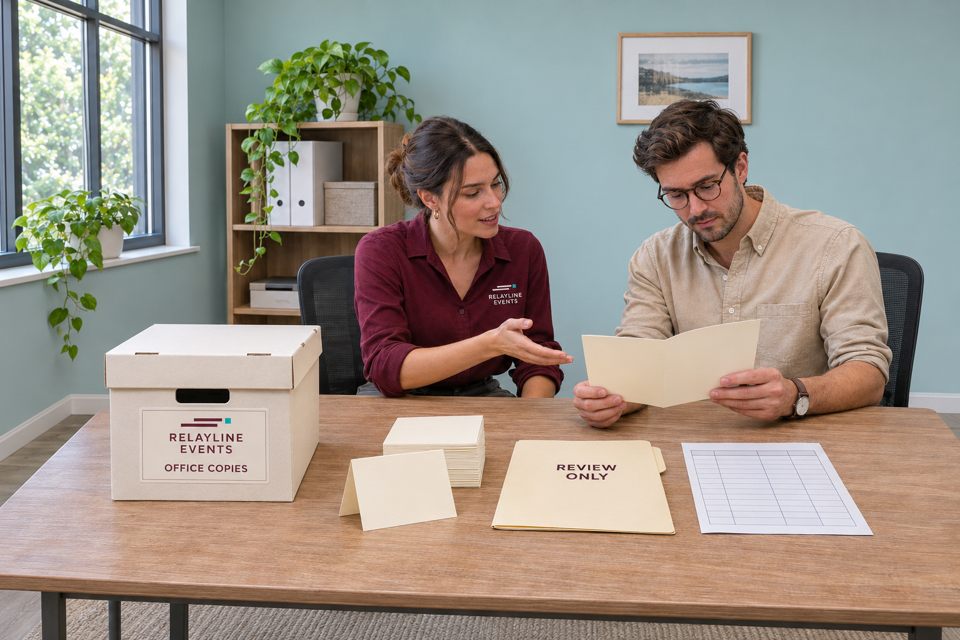
Fictional worked example: Relayline Events is preparing a small client briefing. Coordinator Maya has confirmed eight positions where an existing generic paper information prompt is useful. The following R18 record is invented to demonstrate the purchasing decision, not to recommend an event size or stock allowance.
R18 — existing materials review
- Stored agency-owned prompts: 18 pieces physically counted.
- Current and usable: 10 pieces with the approved generic wording, checked for this example's positions.
- Dated pieces: five carry a former event date. They are separated from the current stock; no disposal or alteration has been authorized.
- Condition questions: three have damaged folds and are excluded from the available count pending review.
- Confirmed requirement: eight display positions, one current piece at each position.
- Decision for these positions: use eight of the 10 eligible pieces. Two eligible pieces remain in stock. No new paper-display order is needed for the confirmed requirement.
- Client-owned display wall: not included in the paper count. Client consent, its present condition, reinstallation documentation and the proposed location still need review.
- Venue décor: not included in agency stock. Maya is checking the booking's available items and collection instructions with the venue contact.
The paper count reconciles as 10 current + five dated + three with condition questions = 18 stored pieces. The purchasing decision uses the 10 confirmed eligible pieces, rather than subtracting eight from the entire storage count. Ten eligible minus eight required leaves two eligible pieces; it does not establish the agency's future spare-stock policy.
If the client later requires new wording at all eight positions, the current pieces need a fresh review. Record the changed requirement and approval before deciding what to print. Do not preserve an earlier “no order needed” decision after its underlying conditions have changed.
Ask a question that preserves the unresolved decisions
For the fictional client-owned component, Maya could send this complete inquiry through the project's usual channel:
For briefing R18, we have eight confirmed paper-display positions and enough current agency-owned prompts for them, so we are not proposing a replacement paper order. Separately, do you want us to assess the retained display wall for this event? Please confirm the person who can authorize its use and where its reinstallation documentation is held. We still need the appropriate provider's condition and location review before including it. We will keep that component outside the confirmed materials plan until those questions are resolved.
The message does not turn an intention to reuse into installation approval. Keep the venue décor question with the venue contact, rather than asking the client to approve somebody else's lending inventory. Record each answer against the relevant item and update the materials plan when the conditions are actually confirmed.
For the confirmed paper portion, the team decision can be equally clear: “R18: use eight current generic prompts from the 10 checked eligible pieces. Leave the five dated pieces and three with condition questions separate for review. No replacement paper order is authorized for these eight positions.” Sending that note still requires the receiving team to acknowledge and follow it.
Label only the office classification that still needs clarification
Keep the changing inventory in its own record
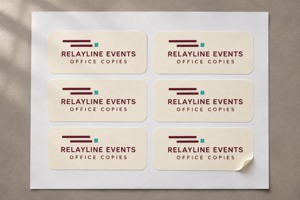
If an agency-owned dry paper box genuinely needs a stable description, consider printed labels for owned office boxes. The illustrated “Office Copies” heading leaves changing quantities and decisions in the inventory record. An existing clear label may already be sufficient.
The current product page lists paper and other material options, shape and size choices, and sheet packaging. Its minimum quantity validation starts at one ordering unit; that does not establish one finished label or the number of labels supplied per unit. Confirm the configuration, label count, artwork and actual box surface before ordering.
Compare sticker and label options, then give DecentCustom the approved wording and actual requirements if a new label is useful. This concept is for ordinary owned office-paper classification. It does not replace a rental asset label, safety information, a condition assessment or specialist installation instructions.
Reviewed November 9, 2026. Relayline Events, R18 and all quantities are fictional. No real inventory, reuse permission, component condition, installation, cost saving or environmental result was verified.