A refill’s declared quantity and a jar’s physical capacity are different measurements. Explain the unit and the intended use before promising how full a jar will look.
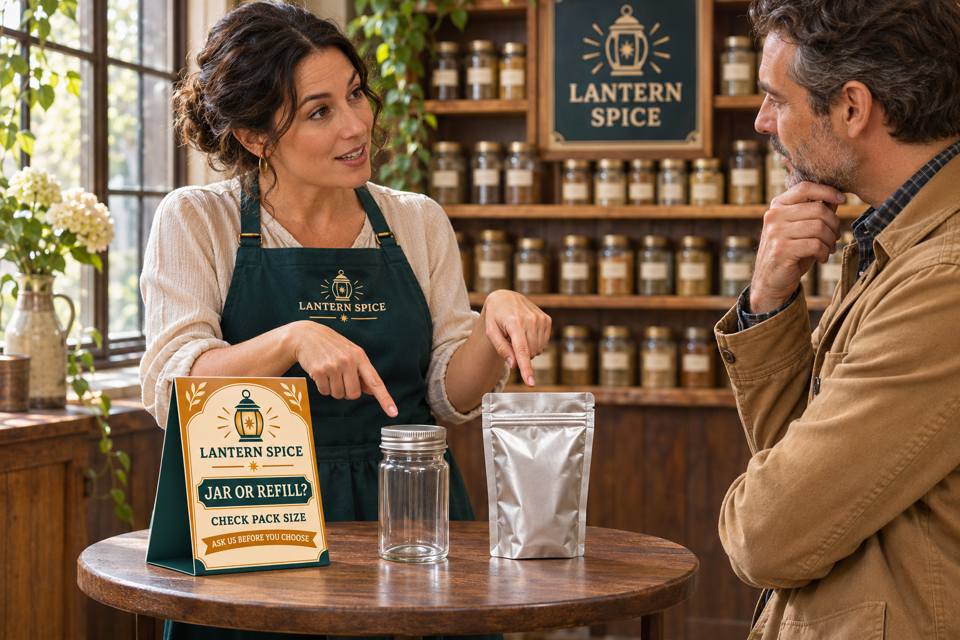
Explain what the pack contains before discussing the jar
“This refills your jar” can sound like “this will fill your jar to the top.” Those are different promises. A customer can receive the stated amount and still see space above the spice if the jar’s capacity is larger than that amount.
For a specific example, The Spice House describes its Flatpack as containing half a cup by volume and notes that its slightly larger jars will not be completely topped off. That is a useful explanation of one product format, not a guarantee for an unrelated jar or every spice refill.
| Field | What to identify | What not to assume |
|---|---|---|
| Refill quantity | The stated amount and unit on the exact product. | A pouch’s outside dimensions reveal its contents quantity. |
| Jar capacity | The actual container specification and whether it describes volume. | A familiar-looking jar has the same usable space as another jar. |
| Visible fill level | What has actually been observed for the particular spice and container. | A volume statement proves a brim-full jar or a particular fill height. |
| Fit for the customer’s purpose | Whether the customer wants the stated quantity, a new jar, or a complete top-up. | Everyone needs a new container or the largest available refill. |
Keep weight and volume distinct. A quantity in grams describes mass; cups describe volume. A bare “oz” on a jar listing needs clarification before it is compared with a food’s net-weight statement. Do not calculate grams from cups without information for that particular product and measurement basis.
J505: answering “Will one pouch fill my jar?”
This is a fictional customer conversation. Lantern Spice, the people and the jar description are illustrative; no product was poured, weighed or tested.
The question
“I’m Avery. I already have a jar marked ‘4 oz.’ Your refill says half a cup. Will one pack fill my jar completely, or should I buy a new jar?”
The useful answer begins with the two known pieces of information and the missing specification. Do not interpret the jar’s “4 oz” as a confirmed usable-volume measurement, and do not turn the refill’s half-cup statement into a promise about Avery’s jar.
A complete reply
“The refill you selected is described as half a cup by volume. That tells us the amount supplied, not that it will reach the top of every jar. Your jar’s ‘4 oz’ marking is not enough for us to confirm its usable capacity or the level this spice would reach. Please check the container’s actual size information or send the relevant jar model details through our normal support channel.
“You do not need to buy a new jar simply because we cannot promise a brim-full result. First decide whether the stated refill quantity meets your needs. If you want a particular container-and-refill combination, we should confirm the exact products rather than guess from their appearance.”
The completed decision record
- Known: the selected refill declares half a cup by volume.
- Not confirmed: Avery’s jar model, the meaning of its marking and usable capacity.
- Not promised: a brim-full result, a specific fill height or a grams conversion.
- Next action: clarify the actual jar specification and the quantity Avery wants.
- Purchase decision: no new jar recommended on the information available.
That response gives Avery an explanation and a next step. “It should fit” supplies neither. If the customer already bought the pack and questions the amount, use the actual product and order details to investigate; visible space alone is not enough to confirm either a shortage or correct fulfillment.
Replace a universal refill promise with specific information
Wording to avoid: “One pouch fills any standard spice jar.” “Standard” leaves the jar undefined, and “fills” leaves the intended level unclear.
A clearer format description
“Check the quantity and unit listed for this refill. It is intended for customers choosing that amount; we do not promise that one pack will top off an unspecified jar. Compare the exact container information before choosing a jar-and-refill combination.”
Add the actual quantity for each product where it is known. Do not copy “half a cup” across a whole range without checking individual formats. Keep the original product identification and information with the refill; a shop’s decorative card or outer bag is a separate information layer.
A refill can also be inconvenient for reasons unrelated to quantity. In a separate anonymous discussion, a bulk-spice shopper described handling a small amount in a much larger bag, while other shoppers reported different bag options. That is a prompt to ask about a customer’s situation, not a measured complaint rate or a finding about The Spice House.
Ask what the customer actually wants to improve: a clearer quantity description, a manageable purchase amount, or information about an existing jar. Do not automatically sell another container or adopt unverified pouring, cutting or sanitation advice from a forum.
Keep the counter prompt short and the product details specific
If shoppers repeatedly need help choosing formats, a small prompt can direct them to the right question. The detailed answer belongs with the exact product and the staff explanation. Existing web information or a reusable sign may already be sufficient.
Counter wording that leaves room for an accurate answer
Jar or refill? Check the stated quantity and unit. If you are refilling an existing jar, tell us which container you have. Ask before assuming one pack will fill it to the top.
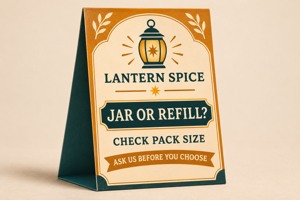
An optional paper counter prompt
The AI-created Lantern Spice design links directly to custom table tents. The checked product is a 5 × 7-inch, 14pt paper format, with matte and gloss options and a displayed minimum of 25.
Compare table tent formats only if a physical prompt has a useful place in the shop. Confirm space, viewing distance, the folded proof and the approved wording. One counter does not by itself establish a need for 25 printed pieces.
The card is information paper. It does not measure jar capacity, seal a refill, establish food-contact suitability or provide moisture protection. The illustration’s empty jar and closed pouch do not demonstrate that either is a product sold by DecentCustom.
Common jar-and-refill questions
Does space at the top prove that a refill is short?
No. Identify the declared quantity and actual container first. Investigate a suspected fulfillment issue with the relevant product and order records rather than treating appearance as the measurement.
Can I compare two spices by their weight if both say half a cup?
A shared volume statement does not establish the same weight. Use the quantities and units actually declared for each product.
Should the shop recommend a new jar whenever compatibility is unclear?
No. Clarify the existing jar and the customer’s goal first. Buying a new container may be unnecessary, and its compatibility still needs an actual specification.
Make the explanation useful before adding more print
Before preparing materials with DecentCustom, write down the exact question customers need answered, the product information available and the claims that remain unverified. Retain the original packaging and use ordinary staff or web explanations when those solve the problem.
Sources and boundaries
Reviewed November 8, 2026. The Spice House FAQ supplies the limited Flatpack example. The separate anonymous refill discussion concerns another retail setting and is not representative research. J505 and the artwork are fictional. No jar capacity, refill weight, pouring method, food performance or customer outcome was tested.