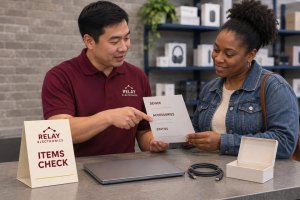
Use team clothing to help visitors recognize your company, official event registration to establish the applicable attendance arrangement, and a role plan to identify who can answer each question. These are three separate jobs. A matching polo does not complete a registration or establish that its wearer can approve a quotation.

Company recognition, event attendance and answer ownership
A visitor may recognize your company from its booth and team clothing without knowing who handles their question. Make the introduction useful: name the company relationship, identify the colleague's actual role and explain the next step. Do not make a visitor infer technical or commercial authority from a color, logo or job title printed on a shirt.
The event organizer controls its registration and credential arrangements. The exhibiting company controls its own team assignments and approved branding. The person approving a garment order may not be the person who registers staff or approves customer terms. Write those responsibilities separately so an artwork approval does not become an assumed attendance or sales approval.
Start with what already works. Existing appropriate company clothing, an accurate introduction and the organizer's required credential may be enough. A new shirt should address a real company-recognition need, with the wearer's actual style and size resolved. It should not conceal an unclear role plan or an unfinished registration.
Buying booth space does not settle every staff arrangement
IFMA's World Workplace exhibitor FAQ provides one concrete example: a booth purchase does not automatically register its staff, and its Full Event and Exhibitor Staff registrations include different activities. Its show-day clothing guidance also does not require a matching polo. Check the actual event's current rules rather than transferring that example to every show.
For each person expected on site, the responsible coordinator should verify the registration record and the activities the person needs to attend. A draft form, an email asking someone to register and a completed confirmation are different states. Keep any unresolved issue with the registration owner instead of marking it complete because the person's shirt is ready.
Use the organizer's approved route to resolve a missing or incorrect record. Do not create a lookalike badge, borrow another person's credential or treat company clothing as a substitute. This article does not determine an individual's access rights or complete any event registration.
A filled role plan: Cedarway's three colleagues
Fictional C81 example: Cedarway plans for three colleagues to support a booth. The coordinator records their company jobs and registration status separately. This is an invented planning example, not an actual event roster or a recommended staffing ratio.
- Mika — welcome and routing
- Mika welcomes visitors, asks what they want to discuss and introduces the relevant colleague. The registration record is confirmed for the applicable event arrangement. Mika is not assigned to approve quotations or make unreviewed technical assurances.
- Jon — product discussion
- Jon handles the product questions within the team's agreed role and records questions needing further review. The registration record is confirmed. The role label does not establish a professional certification or prove compatibility with a visitor's particular project.
- Ari — team coordination
- Ari coordinates unresolved requests and finds the appropriate commercial reviewer. Ari's on-site registration status is not yet confirmed. Having company apparel prepared does not clear that attendance question.
- Commercial approval
- The team must identify the actual authorized reviewer for proposed customer terms. Neither Mika's introduction nor Jon's product conversation is recorded as quotation approval.
- Current open action
- Ari follows up the registration question through the organizer's process and confirms how coordination will be covered. The working plan leaves the on-site arrangement unresolved until supported by the actual record.
This separates work the team can describe from arrangements it still needs to confirm. Three company shirts would not establish three registered attendees, three simultaneous booth positions or three people able to sign off the same answer. Garment quantities and an attendance record need their own supporting information.
Give an introduction that answers the visitor
At C81, a visitor asks Mika, “Are you part of the event's organizing team, and can you confirm the price for my project?” The company logo helps the visitor find Mika, but the reply needs to explain the actual relationship and approval route:
Fictional visitor reply: We are the Cedarway Systems exhibiting team, rather than the event organizer. I help visitors find the right colleague. Jon can discuss your product questions within our team's role, and we will record anything that needs further checking. I cannot approve a project quotation. Ari coordinates the request with the appropriate commercial reviewer, who will confirm any proposed terms through our normal company process.
If the visitor asks whether a product will work in a specific project, identify what needs review rather than treating the introduction as a technical answer. For example: “Jon can take the details of your question and establish what needs checking; we have not confirmed suitability for your project.” Use only the information appropriate to the conversation and the company's current process.
When handing over the request, preserve what the visitor actually asked and who is following up. An introduction to Jon is not evidence that the technical question was answered. A request sent for commercial review is not an approved quote. The next colleague should be able to see the unresolved question without asking the visitor to repeat the whole conversation.
A changed colleague needs more than a spare shirt
If someone joins, leaves or changes duties, check the role plan and the relevant event arrangement. Do not assume that a replacement colleague inherits the previous person's registration, approvals or technical responsibilities. Use the organizer's process for any attendance change and the company's process for assigning work.
Update the people making introductions so they know who handles a particular request. If Ari's attendance remains unresolved in C81, identify the actual coordination route available to the booth team. Do not keep directing visitors to an unconfirmed on-site arrangement simply because an earlier internal sheet lists it.
Clothing also needs its own practical check. Confirm the exact style, size choices, company artwork and intended use before ordering or issuing it. Avoid publicly posting personal size choices as part of the visitor-facing role list. Keep any role-specific protective clothing or other requirements with the responsible workplace owner; an ordinary promotional polo does not establish that suitability.
A polo can identify your company without claiming more
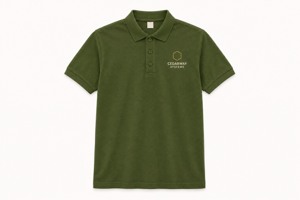
One ordinary company-clothing option
These regular-fit polos for a company booth team list a turndown collar, three-button placket, short sleeves and ribbed cuffs. The product describes 220 GSM cotton, with a polyester-content exception for gray, and unisex XS–3XL options.
Current quantity validation starts at two shirts; the listed 36-piece case pack is a different figure. Confirm the current chart and measuring method, actual color and size availability, artwork placement and quantity needed. The product notes measurement variation up to 2 inches (5 cm); no individual fit or readable dimension chart has been verified for this review.
Compare custom polo shirt options if the selected cut or range does not suit the team. Give DecentCustom approved company artwork and confirmed configuration requirements. The olive image is an AI concept, not an approved production proof or an availability promise. Existing suitable clothing may avoid an unnecessary order.
Reviewed November 9, 2026. Cedarway, Mika, Jon, Ari and C81 are fictional. The cited registration example belongs to one event. No actual attendance, authority, qualification, garment fit, product performance or business outcome was verified or changed.