Start with what the sentence says. Then use punctuation, line endings and changes in the scene to test a reading that listeners can follow. A short original poem below makes those choices concrete.
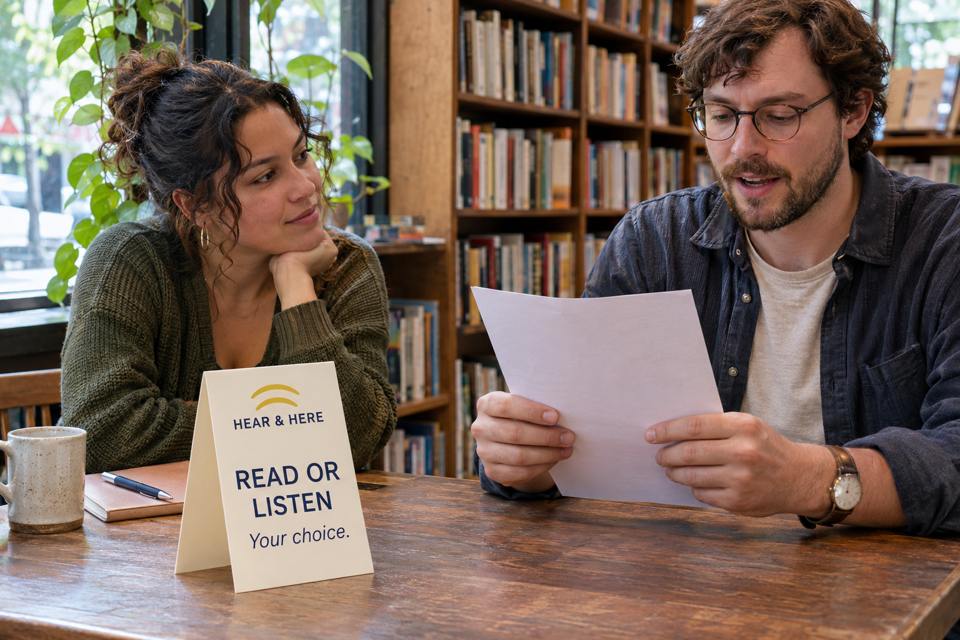
Understand the sentence before performing it
Read the poem silently first, check unfamiliar words, then rehearse aloud at a natural pace. Follow the sense of each phrase; do not insert the same full stop at every printed line ending. Leave the writer’s words and line breaks intact while making separate rehearsal notes.
The Library of Congress Poetry 180 reading guide recommends preparation, a relaxed voice and attention to punctuation instead of a mechanical stop after every line. Its setting is school reading; the example here adapts those practical starting points for an adult bookshop reader.
That starting point is not a rule that every poem must sound like ordinary prose. The Academy of American Poets discusses grammar and lineation together and encourages trying different readings. A deliberate hesitation can matter. Test what a choice does to this particular text.
If you want to use your own writing, first write a short poem from an everyday object. Practicing a reading and revising the poem are separate tasks: mark a possible pause on your rehearsal copy without silently turning it into new punctuation in the source.
A complete poem, with a workable reading plan
This new editorial example has five intended lines. It is not a quotation from a published poet or a customer’s work.
Window Seat
The rain taps
against the bookshop glass.
I turn one page,
then leave it open.
A bus takes the light away.
Editorial example written for this guide.
Title: say “Window Seat,” then leave a small separation before beginning. There is no measured number of seconds to copy.
Lines one and two: let “The rain taps against the bookshop glass” stay one sentence. “Taps” leads toward the surface receiving the sound. A heavy stop after “taps” can make the next phrase sound detached.
Lines three and four: the comma gives a natural place to test a slight separation. “Then” links the second action to turning the page. Let the full stop after “open” finish that sentence rather than giving both line endings identical weight.
Final line: allow the bus to change the scene. Try a neutral finish before adding dramatic emphasis to “away.” The reader does not need to mime the bus, rain or page.
This is one proposed reading. A light hesitation after “taps” could bring attention to the sound before the glass appears. Compare that with carrying the phrase through. The useful question is whether listeners can follow the relationship, not whether every reader uses identical pauses.
Fix a phrase instead of repeating “be more expressive”
A rehearsal problem might sound like four isolated announcements: “I turn one page. Then. Leave it. Open.” That added stopping breaks the printed sentence into pieces and gives “then” more weight than its connecting job needs.
Try the phrase as two linked actions: “I turn one page, then leave it open.” Keep the original line break on the page. On a separate practice copy, you might write “carry into then” beside the break and circle the actual full stop after “open.” Those notes are instructions for your reading, not extra words to speak.
Read again and ask a willing listener two specific questions: “Did the page turning and leaving it open sound connected?” and “Was any word hard to hear?” If the listener cannot identify “glass,” work on that word’s clarity before adding emotional emphasis elsewhere.
You can also practice privately and compare your own attempts. These are suggested checks, not reports of a listening experiment. No audio was recorded or timed for this guide, and there is no universal speed or volume setting here.
Make a small reading table easy to join
For a fictional Hear & Here session, the host could say:
“You may read, listen or pass. We will use the short poem in front of us. If you read, take a moment to look through it first. We will talk about a phrase we heard clearly, rather than score anyone’s voice.”
A quiet table, copies people can actually read and a clear choice about participation serve this activity better than compulsory stage performance. Ask before recording or posting anyone’s reading; joining a table is not agreement to appear in a promotional clip. Confirm what the actual session supplies rather than assuming every bookshop offers workshops, copies or a microphone.
A small invitation can clarify the choice
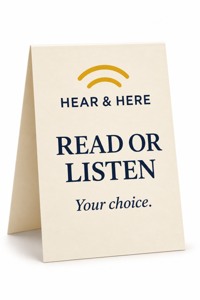
An existing sheet or a spoken invitation may be enough. For a notice kept on an indoor reading table, the linked custom table tents for a reading-table invitation list a 5 × 7 inch paper format, 14pt stock, a default glossy finish and a minimum quantity of 25. The illustrated wording is “Read or listen. Your choice.”
Compare custom table tent formats, then confirm artwork and the selected configuration with DecentCustom. The AI concept shows a folded paper notice, not an acrylic holder or a tested outdoor sign. Buying a notice does not establish that a reading will be clear or enjoyable.