Before putting World Wildlife Day artwork into a print proof, identify the exact file, its campaign year and its published use conditions. An available download does not answer every question about a proposed poster, giveaway or product design.
Which year's poster am I looking at?
The official World Wildlife Day materials page currently identifies its collection, social media kit and official poster as 2026 materials. Check those labels before copying a saved file into a new campaign layout.
An older poster should not be relabeled as an official 2027 poster simply by replacing its year or headline. Keep a distinction between the artwork's original campaign and a host's own current event notice. This check concerns the page reviewed here; it is not a claim that no 2027 resource exists elsewhere.
Does downloading the file authorize every use?
The page describes its digital publicity materials as supplied solely for noncommercial education and World Wildlife Day promotional activities. Read that stated scope alongside the exact use you are proposing.
Do not treat that notice as a blanket authorization for merchandise, sales packaging or every photograph linked from a gallery. If the intended use is not clearly established, confirm it with the publisher before approving the artwork. A printer needs a usable file and a clear account of what the buyer is authorized to reproduce.
Can the official logo be recolored or redesigned?
The materials page says its official logos must remain unmodified. It also provides versions in the six official UN languages.
For a proof, use the relevant provided version rather than redrawing the mark to suit a brand palette. Do not improvise a translated logo or combine an official mark into a new business identity. Keep the organizer's name and its own event information clearly identified in the surrounding layout.
Do file formats or language versions change the use conditions?
The page offers JPG downloads and vector-format links. Those options help identify available source files; they do not replace the page's use notice or establish that a proposed application has been approved.
Record which file and language version the team selected, where it came from and when the conditions were reviewed. Keep that information with the proof so that another designer can follow the decision. A file passed along without its source can lose the context needed to review it accurately.
What should the host and designer settle before printing?
Describe the actual job: an educational display, an event notice, a sale item or a branded giveaway are different proposed uses. Identify whose artwork is included and what permission or published condition supports that use.
If an official asset remains unconfirmed, an organizer can prepare a notice using its own approved identity and a link to the current official information. That is a separate design decision. Its wording should still avoid claiming that the organizer, supplier or printed item is an official partner without evidence.
A completed artwork-review decision
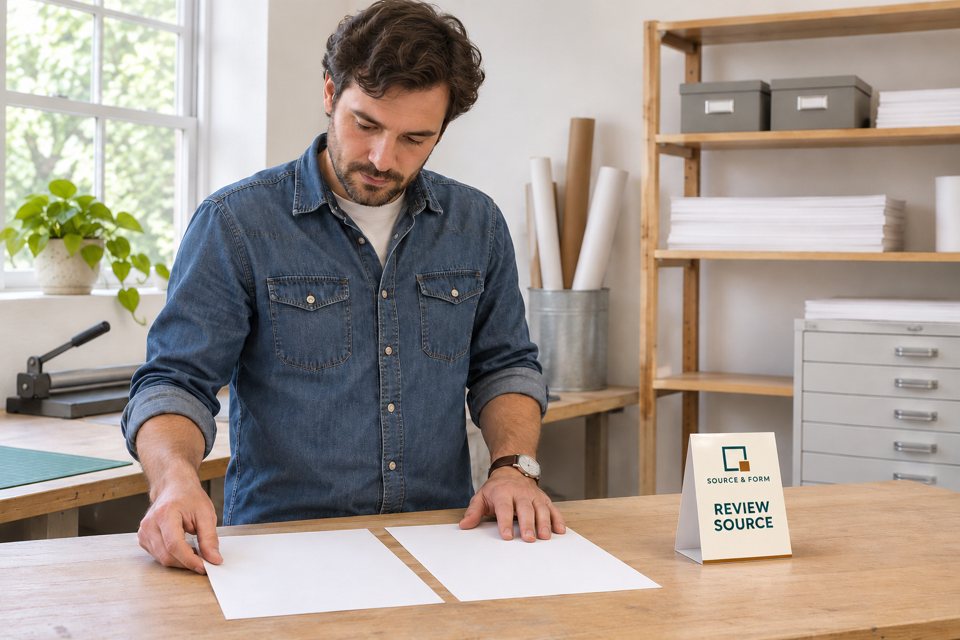
Fictional example: Source & Form's designer receives a layout with a recolored official logo and a 2026 poster retitled for a 2027 local event. The brief does not identify the basis for those changes.
The designer holds the proof and checks the official materials page with the host. They remove the altered official artwork from this draft. The host chooses its own original identity, its confirmed local event wording and a source link for readers who want the official information.
The host approves the corrected notice for its existing display. Its accurate paper display materials remain usable, so it orders no new table tents. The completed fictional decision approves that own-identity notice; it does not grant permission to reproduce another publisher's artwork.
An own-identity notice after host review
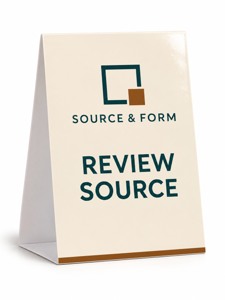
Paper table tent
These table tents for a host-approved display notice list a 5 × 7 inch size, 14pt stock and a default glossy finish, with matte listed as an option. The current quantity control starts at 25.
Compare custom table tents after deciding whether another display is needed. Bring the host-approved text and authorized artwork to DecentCustom for proof review. Product selection does not establish permission to use an official mark.
Reviewed November 20, 2026 against the cited materials page and its current displayed conditions. The fictional example illustrates a design-review decision, not an artwork license or an official campaign endorsement.