Choose one ordinary object and notice something precise about it. Then let that detail carry an action or a small change, rather than asking a first poem to explain everything you feel.
Start with a detail someone else could imagine
To begin a short object poem, choose one thing, write a few specific observations, put it into an action and revise one vague phrase. Four lines provide a small practice space; they are not a rule about what poetry must be. You can use a key, a folded receipt, a button or an object already beside you.
The Academy of American Poets describes imagery as language that represents sensory experience. That gives a beginner something concrete to work with. Instead of beginning “This is a wonderful object,” notice its surface, a sound it makes or the way it moves in your hand. You do not have to include all five senses, and you do not have to make the object rhyme with anything.
For a bookshop activity around World Poetry Day on March 21, an ordinary object can give everyone a starting point without requiring a personal confession. The exercise here is our own practical example, not a lesson tested with a group of customers.
First Line is an invented bookshop. For its example, imagine a small brass door key. The starting notes are: cold against the palm, a worn edge, dust between the teeth, two turns in the door lock, and shelves just inside the doorway. These are invented observations for the exercise. In your own writing, begin with what you actually notice, then decide where imagination will take it.
From a plain description to four lines
A first prose draft might be: “An old key opens the shop, and I feel happy that the day is beginning.” It tells us the situation and the feeling, but it does not yet give the reader much to experience.
Here is one complete revision. The title and all four lines are newly written for this article.
Opening
Brass chills my open palm.
Dust sleeps between its teeth.
Twice I turn the bookshop key.
Morning reaches the shelves.
“Brass chills my open palm” replaces a general age label with a physical detail. The reader can imagine material and touch. The poem does not need to establish the key’s actual age to begin.
“Dust sleeps” adds a figurative choice. The dust does not literally sleep. The verb gives a quiet pause before the key moves. If that word feels too gentle for the scene you want, try “grit catches between its teeth” and read the two versions aloud. They suggest different textures and moods.
The third line puts the object to work. Turning the key twice gives the scene an action rather than another description. The final line moves attention into the shop. It lets an opening moment carry a possible feeling without telling every reader that they must feel happy.
This is one version, not a model answer. You might prefer a sharper sound, an uneasy doorway or an ending that stays with the key. A small poem becomes more particular when its choices belong to the scene you are trying to make.
Change one phrase and listen for the difference
For your own draft, underline one phrase that could describe almost anything: “very nice,” “beautiful day” or “I felt a lot.” Replace just that phrase with a detail or action connected to your object. Keep the earlier version so you can compare what changed.
Read both versions at an unhurried pace. Ask a listener, if you want one: “Which detail stayed with you?” and “Where did the scene become hard to picture?” A useful response names a word or a moment. “Make it more poetic” gives the writer much less to try.
If a detail distracts from the object, remove it. If a rhyme forces an inaccurate word into the scene, try a version without the rhyme. You can also keep the piece as prose or use a different number of lines. The purpose is to make deliberate choices, not to pass a four-line test.
For a hosted session, confirm what the actual venue provides and whether it requires booking. Existing paper and pencils can be enough. Let writers keep their drafts private or choose to read them; participation need not mean publication. If the host wants to display someone’s work later, agree that use with the writer rather than treating a workshop draft as ready-made advertising.
A useful end to the activity is modest and concrete: the writer has an earlier draft, a revised version and a reason for one change. This article does not claim that a notebook, a short exercise or public sharing produces a measured creativity or wellbeing result.
Keep observations and revisions together
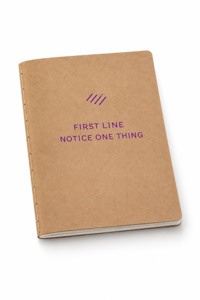
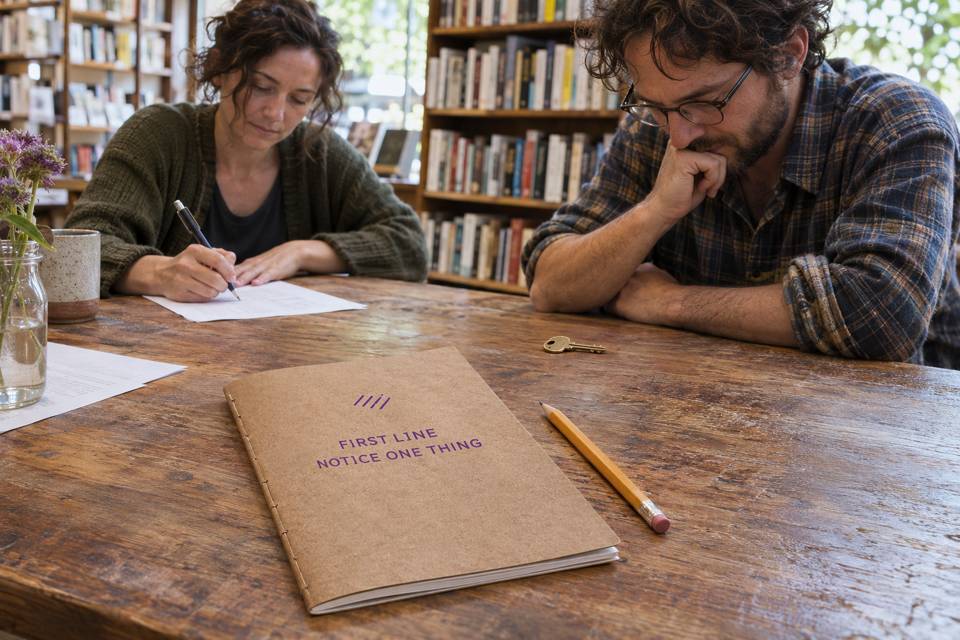
Keep using plain paper, phone notes or an existing notebook when they work. For repeated sessions, the linked custom kraft notebooks for recurring writing sessions list stitched A5 covers, blank pages and 80 sheets. The stated size is 8.26 inches high by 5.83 inches wide, with a current minimum quantity of 12. A pen is not included.
The fictional First Line cover is an AI artwork concept. Compare custom notebooks for other writing preferences, and confirm the selected configuration and artwork with DecentCustom. The notebook provides a place for drafts; the writing choices remain yours.