For National Craft Month in March, choose a knitting or crochet project by what its instructions ask you to do. A neat photograph and the word “easy” leave out information you need: the techniques, the pattern's terminology and the work required to finish it.
What do Basic and Easy project levels mean?
The Craft Yarn Council's project levels describe the techniques a project may involve. Basic includes basic stitches and can include simple increases or decreases. Easy can involve simple stitch patterns, colorwork or shaping.
These descriptions are useful starting points, rather than a complete account of an individual pattern. “Basic” does not necessarily mean every row is identical, and “Easy” does not mean there will be no shaping. Read the actual requirements before deciding that either label matches what you already know.
A project level also does not tell you how long you personally will take. Use it to identify techniques to investigate, rather than treating it as a personal score or a promised completion time.
How can I compare two beginner projects?
Read the requirements and instructions you are entitled to access, rather than choosing only by the finished photograph. Note unfamiliar techniques, construction, color changes and finishing. If the listing leaves an important requirement unclear, keep it as a question before buying supplies.
For an early project, decide how much unfamiliar work you want to take on. You might choose a project that practices known stitches, or deliberately choose one new technique with an appropriate explanation. Buying more equipment does not resolve an instruction you do not understand.
Also consider the finishing work. A simple-looking front does not show whether a project involves joining pieces or adding a border. Check that project's actual instructions; do not assume the photograph tells the whole story.
What if a pattern uses an abbreviation I cannot find?
The Council's knitting abbreviation reference collects common U.S. terms, including k for knit and p for purl. It also explains that designers and publishers may define additional abbreviations in the pattern or book.
Start with the pattern's own glossary, notes and special-stitch definitions. A general reference can help with common shorthand, but it may not contain a particular publisher's term. Do not replace an unfamiliar abbreviation with a similar-looking one and assume the instructions will work.
Keep a note of the relevant definition and where it appears in your legitimately obtained instructions. A notebook is a place for your own questions and observations, not a substitute for the full pattern or permission to copy and distribute it.
Are U.S. and U.K. crochet terms interchangeable?
No. The Council's crochet abbreviation reference and U.S./U.K. comparison show that U.S. single crochet corresponds to U.K. double crochet, while U.S. double crochet corresponds to U.K. treble crochet.
That makes an isolated abbreviation such as dc insufficient without its terminology system. Check the pattern's stated convention and its own definitions before starting. A familiar word can refer to a different stitch under another convention.
If the system is unclear, resolve that question through the pattern's supplied explanation or published support route before interpreting the instructions. This article compares terminology; it does not teach the stitches.
A project choice made before buying extras
Fictional example: One Stitch's adult beginner compares two hypothetical project briefs. The first uses stitches the learner already recognizes and has finishing instructions they understand. The second introduces unfamiliar colorwork and shaping. Both look approachable in a photograph.
The learner checks each brief's terminology and definitions, records the unknown techniques and chooses the first project to practice familiar work. The second stays on a later learning list. This is a choice about these two briefs, not a claim that one technique is difficult for everyone.
The learner writes the remaining questions in an existing notebook and proceeds with the selected instructions. The proposed purchase of extra branded notebooks is dropped. The example ends with one chosen project and no new notebook order; it reports no real learner result or completion time.
A notebook for an established project group
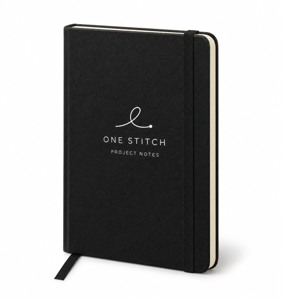
Own notes, questions and project decisions
If a group has a separate need for new notebooks for your own project notes, this PU hardcover model lists 70 lined sheets, a ribbon marker and an elastic closure. Its current quantity control starts at 75; the separately listed case pack of 50 is not that order threshold.
Compare custom padfolios and notebooks with supplies already available. Submit original group artwork and approved wording to DecentCustom for proof review. Stationery does not change a pattern's techniques or guarantee a learning outcome.
Reviewed November 20, 2026 against the three linked Craft Yarn Council references and the current product page. No Council symbols or pattern instructions are reproduced. One Stitch and the completed decision example are fictional. No personal skill, finishing time, search or business outcome was measured.