A changed meter reading can be useful evidence, but only when you know the unit, the display view and what was using water between readings. Here is a complete example you can adapt.
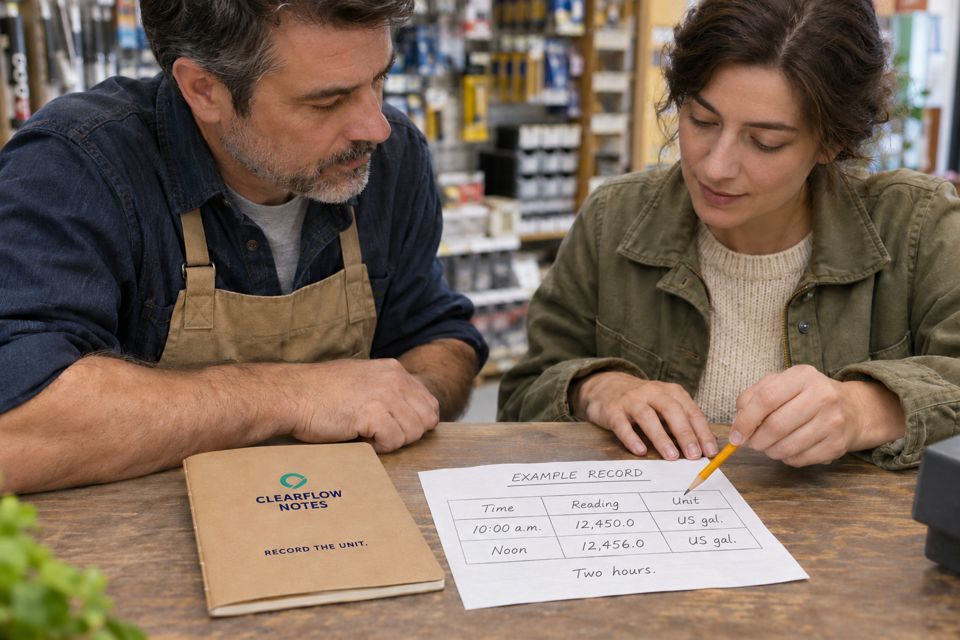
Compare two readings under a stated condition
Record the full reading, its unit and the time before and after a period when no water is being used. Check that both readings show the same meter view. A change needs investigation; the number alone does not identify a leaking fixture.
For a practical World Water Day activity, a useful starting point is learning to keep this record correctly. The EPA WaterSense home-maintenance guide describes comparing meter readings two hours apart while no water is used, with a changed reading suggesting a probable household leak. That is a home check, not a substitute for a building’s operating procedures.
Choose a period that can genuinely be quiet. Account for irrigation, washing appliances and other scheduled uses. In a shared building, first find out what the meter serves and who can confirm use. If that cannot be established, record the uncertainty instead of labeling the interval a controlled no-use test.
Use your water supplier’s instructions for accessing and reading the meter. If access or the display is unclear, ask the supplier; do not force a cover or change valves to create this exercise. A photo for your own record can help preserve the unit and display view. Keep account details out of a public campaign post.
A filled example shows what the subtraction means
The following readings are invented for explanation. They are not measurements from a customer, a test of a product or evidence of water saved.
Clearflow Notes — example record A
Meter view: cumulative volume.
Unit: US gallons, confirmed from this example meter’s instructions.
First reading: 12,450.0 at 10:00 a.m.
Second reading: 12,456.0 at noon.
Elapsed time: 2 hours.Condition recorded: no planned use; scheduled appliances and irrigation checked; no known use noticed during the interval.
Difference: 12,456.0 − 12,450.0 = 6.0 US gallons.
Interval average: 6.0 ÷ 2 = 3.0 US gallons per hour.Next step: ask the water supplier about the changed reading and any automatic uses that may have been missed. Keep the two original readings with this note.
The calculation gives an average for those two hours. It does not establish a constant flow for a whole day, a leak’s location, the cost of repair or the amount a campaign will save. A cumulative-volume reading is also different from a screen showing a flow rate such as gallons per minute.
If the record is interrupted: suppose someone uses a faucet at 10:37 a.m. Write that down. The difference still records water passing through the meter, but it can no longer be treated as unexplained no-use consumption. Keep that record and arrange a new suitable interval rather than deleting the interruption.
Full readings and billing increments are different
A reader in an older public meter-reading question was unsure how extended digits related to billing units. That is one person’s question, not a measure of how often customers have this problem. Conflicting comment calculations are not a meter manual.
Washington Water’s meter guide distinguishes full digital readings from the portion used for billing and identifies separate volume, model-number and flow-rate views. Its billing unit is 100 cubic feet, or Ccf. Other suppliers and meters can differ.
Example B: a coarse billing number can stay unchanged
Suppose a confirmed cubic-foot volume display changes from 12,540.0 ft³ to 12,542.0 ft³. The difference is 2.0 ft³, equivalent to 0.02 Ccf.
Using approximately 748 US gallons per Ccf:
0.02 × 748 ≈ 14.96 US gallons.
If a billing view shows only completed hundreds of cubic feet, both readings can still appear as 125 Ccf. That coarse view is not suitable for noticing this smaller change.
This is a second hypothetical meter, not a conversion of record A. Keep the original unit with every number. If you do not know whether a display is gallons, cubic feet, a multiplier or a flow rate, stop before calculating an amount. Ask which digits and display view your supplier wants you to record.
Send a useful question instead of a diagnosis
A complete enquiry for record A could be:
“I recorded 12,450.0 US gallons at 10:00 a.m. and 12,456.0 at noon on the cumulative-volume view. I had no planned use and noticed no interruption. Could you confirm that I used the correct view and unit, and tell me how to check whether an automatic use explains the change?”
If both readings are identical, say that only for the observed interval. A short unchanged check cannot rule out every intermittent leak. For ongoing concerns, follow the supplier’s process or contact an appropriate professional.
A hardware-store counter may help you organize questions or identify a part, if that is a service it actually offers. It does not automatically provide utility diagnostics, installation or repair. Preserve the supplier’s reading instructions and any professional findings alongside your own notes.
Keep the unit beside the reading
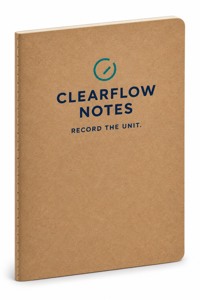
Existing paper, a phone note or the supplier’s form may be enough. For a group that wants a separate record book, the linked custom kraft notebooks for water-use records list a stitched A5 format, 80 blank sheets and an 8.26 × 5.83 inch size. The current minimum is 12; the 500-piece case pack is a different quantity. A pen is not included.
Compare custom notebooks and padfolios, then confirm the chosen artwork and configuration with DecentCustom. The AI cover concept is a place to keep notes; it has no leak-detection function or water-efficiency certification.