Shopping in a craft store, collecting an online order, reserving a workspace and leaving work for a service are different arrangements. Check which one the customer actually needs before promising access or writing a pickup notice.

Can I collect an online order if the store sells the same materials?
Check the named store's current order route. The WEBS FAQ says its website inventory reflects the shipping warehouse rather than the Northampton retail store. It also says store pickup ended on August 27, 2025.
Those answers resolve two different assumptions: an online stock indication does not establish that the item is on the shop floor, and the existence of the shop does not establish a collection option for a web order. A retail visit and an online purchase can therefore have different next steps.
Read the actual order confirmation and the current provider instructions together. If a page does not offer collection for that order, do not turn an order acknowledgment into a pickup invitation. Other craft businesses may operate differently; the WEBS example is not a sector-wide rule.
Does an open store mean I can use its workshop immediately?
Look for the specific workspace or class listing. Tandy's Maker Workshop page describes reserved workspaces, with one dedicated table per maker. Its FAQ asks visitors to arrive 15 minutes before a reservation for paperwork and check-in. Individual participating stores have their own booking calendars.
A store's opening hours and an available reservation are separate facts. Likewise, a workspace reservation should not be described as an instructor-led class unless the booked service actually includes instruction. Confirm the branch, service name, date, time and what the host expects the participant to bring.
Tandy separately asks makers to bring project materials and consumables or purchase them before the reservation. That is useful preparation information, not evidence that every store or workshop supplies the same tools, materials or teaching.
If drop-off needs no appointment, will every piece be accepted?
A no-appointment service can still have acceptance conditions. Seattle Pottery Supply's firing-service page allows drop-off during retail hours without an appointment, but requires the clay name and reserves the right to refuse a particular firing service when it is unknown.
The practical distinction is between reaching the counter and having work accepted for the requested service. Read the provider's current requirements before traveling. If a required material detail is unknown, ask the provider what information it needs rather than inventing it or treating a general event sign as approval.
These are intake and communication checks. The provider's technical requirements and staff assessment remain separate from an ordinary printed notice.
When is customer work actually ready to collect?
The same pottery-service page says customers receive an email when their pieces are fired and ready. Its expected turnaround is posted at the retail counter when work is dropped off and can vary with demand.
Keep that ready message separate from an intake acknowledgment, an estimate and the store's opening hours. A shop being open does not establish that a particular customer's work is finished. Use the provider's actual status and instructions before asking someone to travel.
What should a service notice make clear?
Identify the provider and branch, the specific task, the customer's current status and the next confirmed step. For collection, use the actual collection instructions. For a workspace, use the booked service and check-in details. For customer work, distinguish acceptance, processing and ready-to-collect status.
Review the notice against its source. If the words “ready,” “included,” “walk in” or “collect here” are not supported for the specific arrangement, correct them before approving a proof. An existing accurate confirmation or digital page may already answer the question without another printed item.
A completed correction of a group-visit brief
Fictional example: Maker Route's coordinator receives a draft for a group visit to WEBS. The draft treats online availability as store stock and tells participants to collect web orders during the visit.
The coordinator holds the brief, checks the current FAQ and separates shopping from online-order fulfillment. The organizer confirms that the planned visit is for browsing. The revised brief removes the unsupported collection claim and directs anyone considering a web purchase to the provider's current shipping and order information.
The organizer approves the corrected digital brief. Existing accurate information at the meeting point is sufficient, so no additional table tents are ordered. The completed fictional decision corrects a communication error; it does not claim that the visit, order or provider confirmation actually occurred.
A desk display after the service wording is confirmed
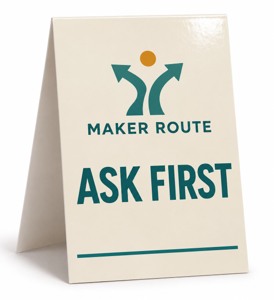
Printed paper table tent
These table tents for a confirmed service-information desk list a 5 × 7 inch size, 14pt stock and a default glossy finish. The current quantity control starts at 25.
Compare custom table tents only if an authorized ordinary indoor information desk needs a new display. Bring approved wording and original artwork to DecentCustom for proof review. A paper sign does not grant service access or replace provider instructions.
Reviewed November 20, 2026 using the three linked provider pages. Their examples are specific to those businesses, not rules for every craft store. The planning guidance is editorial and the case is fictional. No actual order, reservation or service result was verified.