Begin with what the poem actually puts on the page. Then build an interpretation that can point back to those words, while leaving room for another reading and for what the text does not tell you.
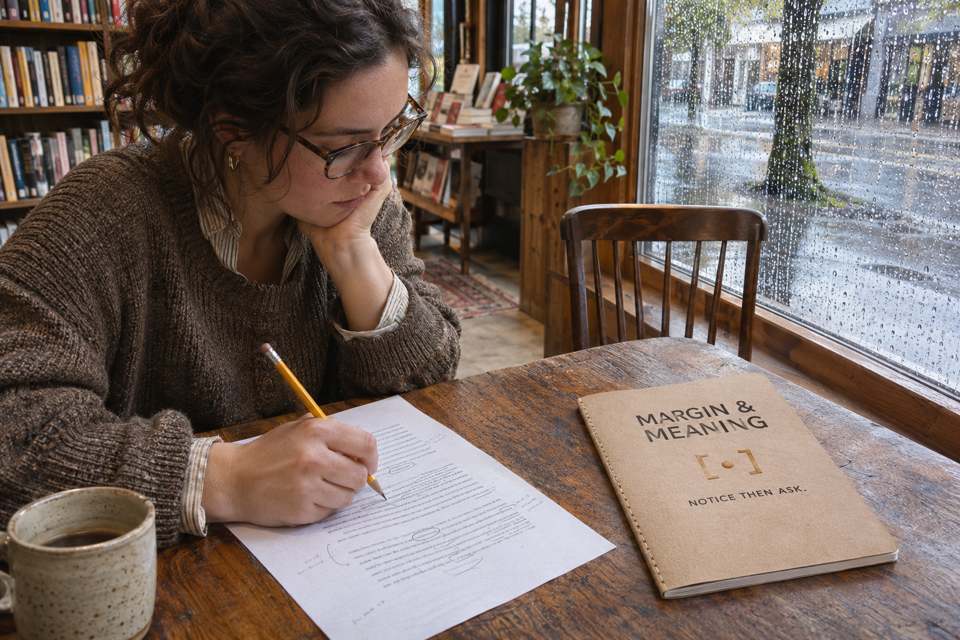
Make a claim you can bring back to the poem
First describe what happens. Next identify a word, image or change that shapes your response. Propose a meaning, then check whether another part of the poem supports or challenges it. You do not need an immediate final answer to begin reading carefully.
The University of Wisconsin–Madison Writing Center’s reading guide recommends rereading, annotating and examining the situation and word choices with specific textual support. The Academy of American Poets’ guide warns against both treating a poem as a code with one answer and assuming it can mean anything. Those are useful boundaries for the worked example here.
Read silently, or practice reading a short poem aloud if that helps you notice a phrase. Keep first impressions as notes rather than facts about the writer’s life.
Keep observation separate from interpretation
The following complete four-line poem was newly written for this guide. Its speaker and shop are fictional.
Before the First Customer
One chair faces the window.
Rain blurs the names on the glass.
I turn the sign to OPEN
and leave the chair where it is.
Editorial example written for this guide.
A literal account: a speaker turns a shop sign to OPEN while rain obscures names on the glass. A chair remains facing the window. The title places this before the first customer. No customer arrives within the four lines.
What is visible in the wording: “one” singles out the chair; “blurs” makes the names less distinct; “turn” changes the sign; “leave” keeps the chair in place. The final sentence continues across the break after OPEN. The opening action and the unchanged chair sit beside each other.
What is still unknown: who owns the shop, whose names are on the glass, who normally uses the chair and how the speaker feels. None is supplied as a fact. A reader can notice an atmosphere without inventing a biography to explain it.
A paraphrase helps establish the situation, but it does not replace the poem. It drops the sequence of the short observations, the visible emphasis of OPEN and the movement from turning something to leaving something alone.
Two possible readings—and where each stops
Reading one: preparing a place for someone
The title points toward an expected customer, and OPEN makes the shop available. The single chair can look like a place ready for someone to occupy. Leaving it by the window could feel welcoming rather than neglectful.
Support: the title, the sign and the chair together create that possibility. Limit: the poem never says the chair is for a customer or that the speaker is pleased. “A quiet invitation” is a proposed reading; “the shopkeeper happily welcomes a regular customer” adds details the text has not given.
Reading two: keeping a quiet pause within a working day
The speaker changes the public sign but preserves the chair’s position. Against rain and blurred names, that unchanged place could suggest a small area of stillness before business begins. The final action is restraint: the speaker leaves something as it is.
Support: “turn” and “leave” create a contrast between change and continuity. Limit: there is no explicit memory, loss or named person. A reader might associate an empty chair with absence, but that association does not establish a death in the fictional speaker’s family.
These readings can overlap: a chair can suggest both a welcome and a pause. To compare them, ask which detail each explains well and which detail remains unresolved. You need not select a winner to have learned something about the wording.
A guess the text challenges
“The business is closing forever” conflicts with turning the sign to OPEN and with the title’s expected first customer. A personal association with an abandoned shop may explain your initial reaction, but it cannot erase those words. Reconsider the claim or explain the contradiction rather than presenting it as established meaning.
Ask a question that makes room for evidence
A bookshop host could ask: “What changes in this scene, what stays in place, and how does that affect your reading?” This opens a specific conversation without demanding a private personal story.
Example response: “I read a quiet welcome because the title anticipates a customer and the sign turns to OPEN. I am less certain about the chair: it could be for that customer, but the poem does not say so. Leaving it by the window also makes the scene feel still.”
A useful follow-up is “Which words led you there?” If someone offers a different reading, return to a line together. Keep the distinction between the speaker and the real writer. The exchange above is a model response, not a quotation from a tested workshop.
Leave space for a second reading
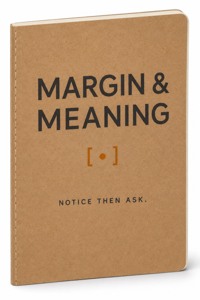
Existing paper or digital notes work for this exercise. If you want a separate place for reading notes, the linked custom kraft notebooks for reading notes list a stitched A5 cover, 80 blank sheets and an 8.26 × 5.83 inch size. The current minimum is 12; the listed 500-piece case pack is a different quantity. A pen is not included.
Compare custom notebooks and padfolios, and confirm the chosen artwork and configuration with DecentCustom. The small image is an AI cover concept. Keep a first impression, its supporting line and a later revision together, so a changed reading remains understandable.