A useful clinic handoff tells people who handles the next question and how to reach that role. Keep check-in, language assistance and clinical decisions distinct.
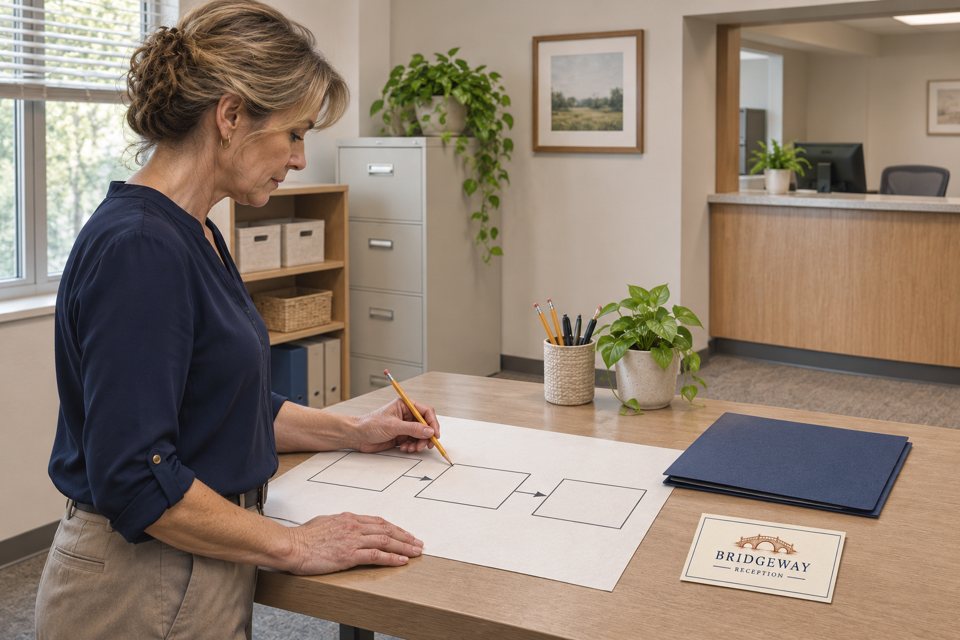
Map the question to the responsible role
Begin with the clinic’s approved process, then write the visitor-facing explanation. Reception can explain its administrative check-in steps and connect someone to the appropriate team. Language assistance helps people communicate. Clinical questions need the clinic’s appropriate clinical contact. A logo, shirt or printed card does not establish any of those professional responsibilities.
Seattle Roots’ first-visit guide describes checking in at reception before a medical assistant calls the visitor. It separately explains language support and asks people seeking an in-person ASL interpreter to contact the organization in advance. That sequence makes a useful editorial distinction: arriving at the desk and arranging a particular form of support are separate steps.
UW Medicine’s interpreter information provides a request route through the clinic or hospital and says the need can be raised when making the appointment. It describes qualified interpreters helping communication with care teams and other staff. Use the actual organization’s process; these two Washington examples do not establish one universal staffing arrangement.
| Question | Role or route to identify | Information to confirm internally |
|---|---|---|
| Where do I check in? | Reception or the stated check-in point | Exact location and approved arrival process |
| How do I request language assistance? | The clinic’s language-support request route | Who receives the request and confirms arrangements |
| I have a clinical question | The clinic’s designated clinical contact | Approved contact instructions, without improvising clinical advice |
| Who updates this information? | A named internal role | Version owner and replacement process |
Write down the handoff, including what remains pending
An internal map needs more than department names. For each handoff, record the question, receiving role, approved contact route and confirmation step. Someone forwarding a request should know what reply establishes that the next team has received it. A request received is not automatically an appointment or a confirmed support arrangement.
Keep the public version short. It can explain where to ask for help without displaying an internal roster, personal phone numbers or individual visit information. If another language version is needed, use the organization’s approved language-review process; visual resemblance to the English version does not verify a translation.
A completed administrative correction
Fictional worked example. Bridgeway’s coordinator finds a draft card that says, “Our reception team can translate for every visit.” The clinic’s operations owner has not approved that promise. The coordinator holds the artwork and asks the owner for the actual request route.
For this invented example, the approved map says: reception explains check-in; the scheduling coordinator receives advance language-assistance requests and arranges follow-up; the designated clinical contact handles clinical questions. The coordinator does not list an interpreter as confirmed merely because a request was forwarded.
The resulting visitor-facing message is:
Reception and visit support
Please check in at reception when you arrive. If you need language assistance, tell our scheduling team when arranging your visit so the team can confirm the arrangements with you. Reception can help you find the appropriate contact. Clinical questions will be directed to the clinic’s clinical team.
A second coordinator checks each sentence against the approved map. The operations owner approves that version for this fictional clinic, and the desk explanation uses the same wording. If the support arrangement is still pending for an individual, staff follow the clinic’s existing process rather than treating the generic card as confirmation.
A contact card should solve a stable information gap
First check whether the current appointment message, service page or reception directory already provides the contact route. Those resources may be enough. A separate paper card is useful only if people have a clear reason to take stable contact information away.
Ordinary paper contact information
These custom business cards for reception contacts list a 3.5 × 2-inch paper format, default 14pt stock and a current minimum of 50. Choose the quantity from an actual use, rather than assuming the minimum proves a need.
Compare custom business cards for office information, then provide the approved wording and artwork to DecentCustom. A contact card is not a staff ID, professional credential or confirmation of a service.
AI artwork concept, not a physical printed sample or evidence that a clinic offers interpretation.
Check who receives the next question
Give the draft to a colleague and ask where they would take each question in the table. If they infer that reception provides every service or that a forwarded request is confirmed, revise the message. Check the actual contact route through the organization’s normal internal review before printing.
Keep entry arrangements separate from role descriptions. Our clinic appointment and arrival-time guide explains that earlier decision. Together, the information should tell someone both how to arrive and whom to ask, without creating a clinical protocol.
Provider and product information reviewed November 14, 2026. The Bridgeway map and wording are fictional editorial examples for administrative communications; actual clinic policies and support arrangements must supply the local details.