Use the clinic’s actual entry model in every notice. A booked appointment, a walk-in visit and an expected online-queue arrival time describe different arrangements.
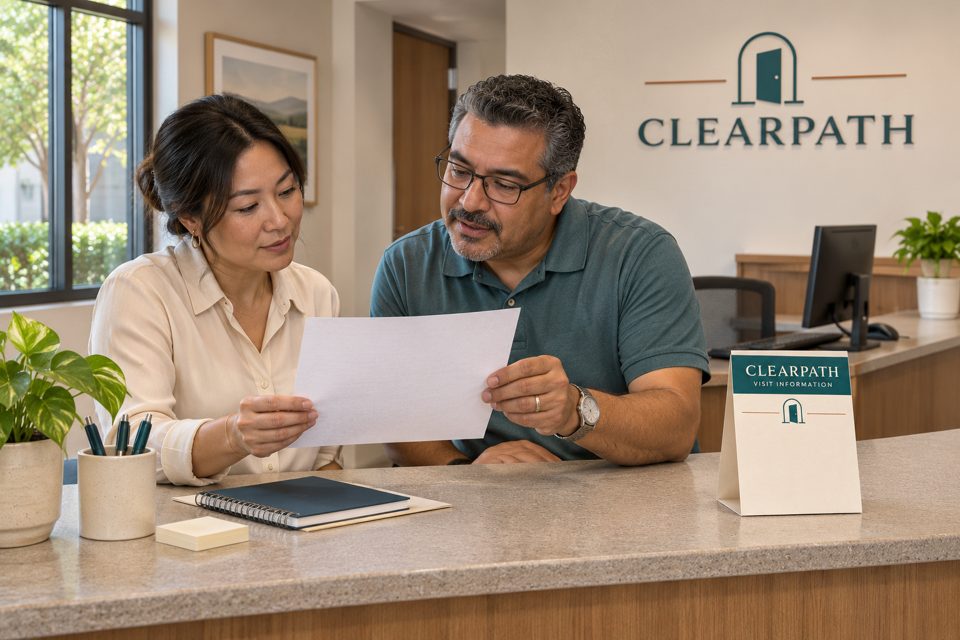
An arrival time does not always mean an appointment
Start with what the clinic has actually confirmed. A scheduled visit normally has an appointment record. A walk-in process accepts arrivals under that location’s current rules. An online queue can ask when someone expects to arrive without fixing when the clinical visit will begin. The words on a reception sign should preserve those differences.
Two Seattle-area providers illustrate why one generic rule is insufficient. UW Medicine’s urgent care page explains that its Get in Line process takes an expected arrival time and is not a fixed appointment. Its page also distinguishes the online tool from walking in during clinic hours. In contrast, Ballard Pediatrics’ appointment information says the practice is not a walk-in clinic and requires scheduled Saturday visits. These are provider-specific examples checked November 14, 2026, not rules for every clinic.
| Entry model | What the message should identify | What it should not imply |
|---|---|---|
| Booked appointment | Confirmed clinic, visit date and appointment time; any separately stated arrival instruction | A request form automatically confirms a booking |
| Walk-in visit | The exact location’s current arrival process and where to check in | Every clinic accepts walk-ins or starts visits immediately |
| Online queue | The provider’s name for the process and the meaning of its displayed time | An expected arrival time guarantees the clinical start |
Keep appointment time and requested arrival time in separate fields when the provider distinguishes them. For example, Ballard Pediatrics asks people to arrive before the scheduled appointment. Copying only one time onto a card can remove the relationship that makes the instruction understandable.
Build a short source-to-notice brief
For each location, ask the operations owner to approve four entries: the entry model, the source that confirms it, the visitor’s next administrative action, and the person who maintains the wording. Record a review date. Use the actual confirmation or current official visit page rather than a search snippet, old brochure or neighboring branch’s process.
Read the source as a complete instruction. If an online button is unavailable, do not translate that observation into “closed” or “walk-ins prohibited.” Check what that provider says about the situation. Likewise, a form submission can be a request that still needs a reply; label it as pending until the organization’s process confirms the appointment.
A generic sign can direct people to reception. Individual booking details belong in the clinic’s existing confirmation and check-in process. A public tabletop notice does not need names, reasons for visits or other personal information to explain an entry model.
A completed correction before printing
Fictional worked example. Clearpath’s administrative coordinator receives a proposed sign reading, “Book online. Your visit starts at your selected time.” The operations owner confirms that this fictional desk uses an online arrival queue, not booked appointment slots. The coordinator holds the print order.
The owner approves the process name and confirms that visitors should check in with reception after arriving. The coordinator replaces the misleading promise with this complete message:
Online arrival queue
Your selected time is your expected arrival time. It is not a booked appointment or a guaranteed visit start time. Please check in with reception when you arrive. Ask reception if you need help understanding your confirmation.
A second coordinator compares that wording with the approved brief and reads it aloud as a visitor would. The same wording is then used in the desk notice and staff explanation. Individual confirmations continue through the existing system. This finishes the communication task without claiming the sign changes clinical priority or reduces waiting.
Use a paper desk notice for a stable, repeated question
Keep changing queue estimates and individual times in their current system. A paper notice is more suitable for stable information such as where to check in. If the existing screen, reception explanation or ordinary paper notice already answers the question, a custom purchase may add little.
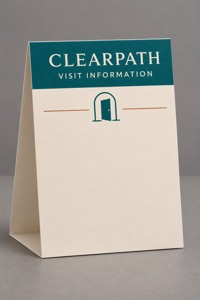
A small paper reception notice
These custom table tents for reception information list a 5 × 7-inch paper format, 14pt stock and a current minimum quantity of 25. That minimum does not establish how many notices a clinic needs.
Compare custom table tents for desk notices. Bring the approved wording, intended placement and actual quantity requirement to DecentCustom before choosing a configuration.
AI artwork concept of an ordinary paper table tent, not a physical proof. Placement and suitability for the facility’s cleaning practices require its own review.
Test what the reader thinks the notice promises
Ask a colleague unfamiliar with the draft: “Does this tell you that you have a booked appointment, or that you have chosen an arrival time?” Then ask where they would go on arrival. If their answer differs from the approved process, revise the words before approving the proof.
Check the location name, the process label, the next action and the update owner across every version. Remove obsolete copies when the approved process changes through the clinic’s normal replacement procedure. Clinical questions and decisions remain with the clinic’s appropriate team; this guide covers administrative wording.
Sources: current provider pages linked above and the DecentCustom product page, reviewed November 14, 2026. The comparison and Clearpath example are editorial guidance, not a clinical protocol or report of actual patient outcomes.