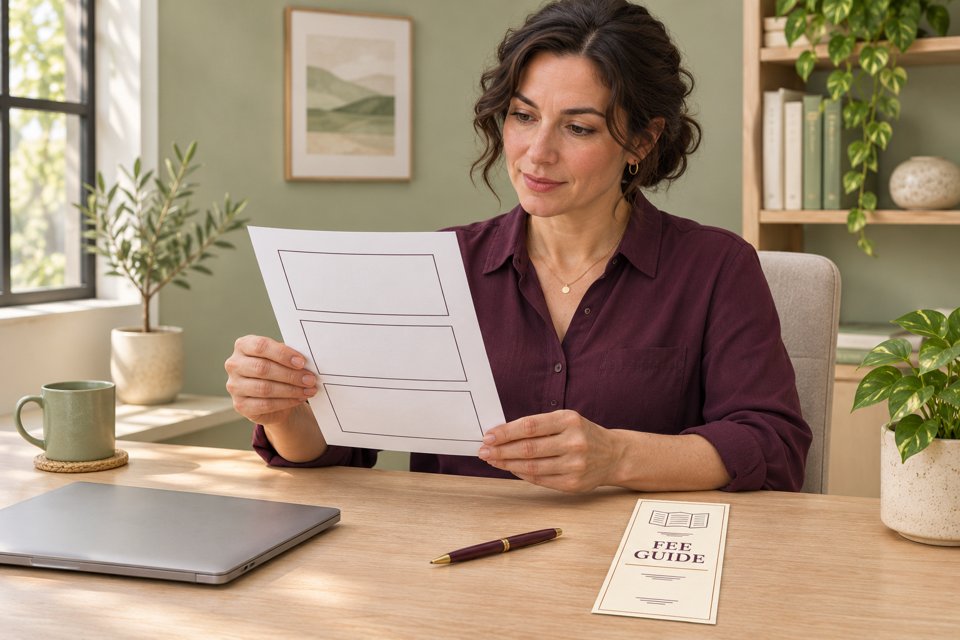
Show what each payment covers and whether it reduces a later balance. The words deposit, design fee and included service should lead to different, explicit answers. Someone reading the explanation should be able to identify the amount due now, what remains due later and which items require separate confirmation.
Before adding new materials, check the materials already included. A revised service page or booking message may explain the offer more clearly than another printed card.
AI illustration of reviewing a fee explanation. The person, blank planning sheet and Fee Guide artwork are fictional; no actual client payment, quote or receipt is shown.
Explain the purpose of the payment before its label
In Bellwether Tattoo’s FAQ, the provider distinguishes a deposit applied toward the service cost from a drawing fee that is paid separately and does not reduce that cost. This is a useful example of two advance payments doing different jobs. Its terms belong to that provider; they are not a universal policy for personal services.
For your own explanation, identify what the payment covers and how it appears in the later balance. Keep the provider’s approved change, cancellation and refund terms with the current offer. Do not borrow another studio’s restrictions or turn an example into a statement about a customer’s legal rights.
Payment or item
Question the explanation must answer
What to keep explicit
Credited deposit
Which later charge does this reduce?
The credit amount, applicable service and balance calculation.
Separate design fee
What work does it pay for, and is it additional?
Its scope and whether any part is credited elsewhere.
Included service or item
Exactly what does the stated price cover?
The named inclusion and any excluded or separately priced option.
Name inclusions and extras separately
An included item does not make the whole visit all-inclusive. Olympus Spa’s Lynnwood FAQ says its Day Pass is a separate charge from services and that lockers are available with the pass. Its Day Pass page separately lists the tea-room offer. These distinctions describe that location’s offer, not every spa package.
Review your own offer one line at a time. Separate the booked service, any admission component, included materials and optional additions. Where an amount or condition is not yet confirmed, identify its owner and the next confirmation step rather than hiding it inside “everything included.”
Keep service prices separate from your materials-purchasing budget. A provider’s appointment fee, hourly rate or admission price does not establish what reception needs to buy from a print supplier.
Worked example: reconcile a credited deposit and a separate fee
Fictional arithmetic example: an invented studio offers one fixed service priced at $300. It requests a $60 deposit credited toward that service and a separate $45 design fee. These are made-up amounts, not a quote from either provider above. Taxes and any other charges are outside the example and remain unconfirmed.
Due now: $60 credited deposit + $45 separate design fee = $105. Service balance later: $300 service price − $60 credit = $240. Combined amount in this limited example: $105 now + $240 later = $345. Cross-check: $300 service + $45 separate design fee = $345. The $60 deposit is already part of the $300, so do not add it again.
A vague draft such as “$105 deposit, service $300” obscures the difference. A complete replacement would say:
For this fictional example, $105 is due at booking: a $60 deposit credited toward the $300 service and a separate $45 design fee. The remaining service balance is $240. These listed components total $345 before any taxes or other charges that must be separately confirmed.
The arithmetic explains the credit; it does not decide what happens after a cancellation, a design change or a different service choice. Those situations need the actual provider’s approved terms. The example should not be copied into a real booking message with its invented amounts still in place.
Check the explanation against the source used by reception
Have the offer owner compare the service page, booking message and reception script. Use the same names for the same charges. A second reader should be able to identify each component, follow the credit and see which questions remain unresolved.
Record the reviewed version and its owner. When an offer changes, update the maintained explanation and replace outdated references through the same channels. Keep individual payment records in the business’s established system; a public information card is not a receipt or an account balance.
If the current page and message already answer the question, another printed item may add no useful function. If paper is needed, keep its role narrow: help people find the current explanation and the right contact.
The linked SKU is 3.74 × 8.27 inches, with a default 14pt glossy option and a starting quantity of 50. A holder is separate. Review an actual-size proof and rack card formats and options when preparing approved artwork with DecentCustom.
The Fee Guide image is an AI design concept, not a receipt, payment instrument, gift voucher or real customer order. Keep using the existing digital explanation when it already serves the reader.
Sources and linked SKU reviewed November 14, 2026. The provider examples retain their own terms. All worked amounts are fictional and in U.S. dollars. This is communication guidance, not a real quote, legal advice or evidence of visitor or business results.