Check the service’s existing materials before ordering replacements or promotional additions. Separate provider-owned items, client belongings and an actual information gap. A new logo does not explain why a working towel, tea set, preparation guide or client garment needs replacing.
First identify the service and joining route. Then review what that particular provider supplies and what its clients are asked to bring. Shared reception does not make every operator’s materials interchangeable.
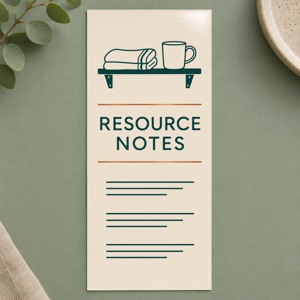
AI illustration of an inventory review. The person, linens, tea set and Resource Notes artwork are illustrative; no real stock count, cleaning procedure or product test is shown.
Begin with the materials already supporting the service
Float Seattle’s FAQ describes supplied towels and other existing visit materials, and also refers to tea after a visit. These details support checking what is already there. They do not establish that another operator needs replacement linens or disposable cups.
The opposite case matters too. Salt Spa Wellness’s FAQ says visitors do not need towels for the session described there. An industry label such as “wellness” therefore cannot justify the same towel purchase for every service.
Client materials need a separate decision. In its editorial family-session guide, White Moth Studio advises avoiding bold logos in the client wardrobe and allows familiar comfort items when needed. That is a direct counterexample to putting a large business logo on every garment associated with a studio visit.
These are individual providers’ descriptions, not a general inventory standard. Keep their preparation and professional-use decisions with them. This review concerns ordinary purchasing and information, not treatment, cleaning methods or the suitability of materials for a professional procedure.
Record the owner, task and remaining problem
For each proposed purchase, write down the existing item, who owns it, the task it already performs and the specific unresolved problem. Mark a count or condition as unknown until someone checks it. Do not turn a missing stock count into an assumed shortage.
Item group
What to check first
Possible decision
Provider linens
The provider’s existing supply and responsibility for replacement.
Retain working stock; assess a documented gap with its owner.
Tea service
Whether tea is actually offered, with what existing ware and arrangements.
Keep the current setup when it already serves the offer.
Client clothing or familiar items
The provider’s current preparation guidance and the client’s ownership.
Clarify what to bring; do not treat personal items as branding stock.
Preparation information
The existing page, email or guide and the question it leaves unanswered.
Correct the source before adding another printed piece.
Record the task in concrete terms. “Clients cannot find the approved preparation page” is different from “we want more branded items.” The first may need a clearer link or reception explanation. It does not by itself call for new textiles or drinkware.
Worked example: complete a shared-reception review
Fictional purchasing example: a reception coordinator supports independent providers in a shared building. A proposed order combines branded towels, cups and a preparation card. The coordinator reviews each proposal with the relevant owner rather than treating the building as one service.
Linens: the provider confirms that its current stock serves the planned service. Retain it; do not add promotional towels to this order. Tea: the provider confirms that its existing ceramic set serves the current offer. Keep that setup; no additional cups are included in this proposal. Client materials: use each provider’s approved preparation guidance. Keep client garments and familiar personal items outside the reception branding order. Information gap: reception has been sharing an outdated preparation link. Update the existing message to the correct maintained page. Decision: no new item is required to fix that link. Reconsider a separate paper pointer only if a visitor task remains after the correction.
The coordinator finishes by having each owner confirm its line and by opening the corrected link from the actual reception message. The record now says what stays, what changes and why the proposed order does not proceed. It does not claim savings or improved service results without observing them.
Add an item only after the gap is clear
If a gap remains, separate its content owner from its buyer and user. Confirm the intended task, existing alternative, actual quantity, artwork authority and receiving arrangements. For professional-use materials, let the provider establish the relevant specifications rather than selecting by appearance alone.
A reference page or revised email may be enough. If paper would help visitors return to stable information, proof that specific content at its intended size. Keep private client details and changing instructions in the provider’s established system.
Consider paper for a stable preparation reference
When reception has a confirmed need to share a maintained preparation page, custom rack cards for a stable preparation-resource pointer are one possible ordinary paper format. This is a separate information decision, not a replacement for linens, tea ware or client materials.
The linked SKU is 3.74 × 8.27 inches, with a default 14pt glossy option and a starting quantity of 50. A holder is separate. Check an actual-size proof and rack card formats and options when preparing approved artwork with DecentCustom.
The image is an AI paper-design concept, not a customer order or evidence of clinical, hygiene, food-contact or textile performance. Keep the existing digital resource when it already answers the visitor’s question.
Sources and linked SKU reviewed November 14, 2026. Provider examples retain their own scope; the completed inventory is fictional. Actual stock, suitability, purchasing needs and visitor or business results remain to be established locally.