Before adding a grain-shop label, identify the information already on the package and the job the new message needs to do. Sometimes the useful change belongs at the counter instead.
Keep the original product information readable and the existing package intact. Put temporary order details in the order process. Consider a separate shop-information label only when it adds a useful, verified message and its location and material have been checked.
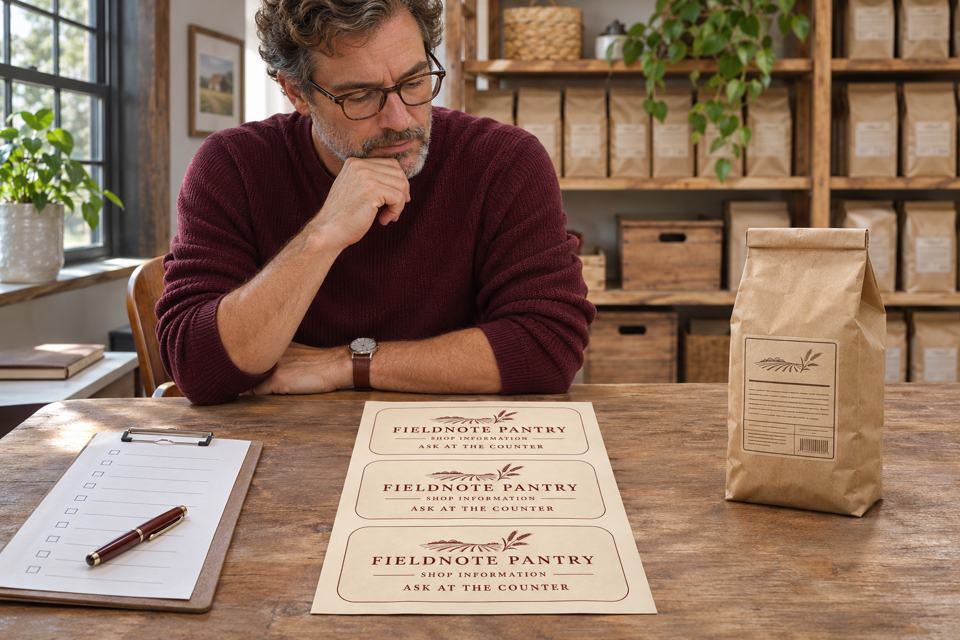
Start with the package customers already receive
A grain retailer can handle more than one kind of package. A manufacturer’s closed retail pack, an original bulk sack and a separate carryout container have different jobs. Review the actual item before assigning a new label to it; the distinction between bulk sacks and retail carryout matters here too.
Our industry research includes Maine Grains, whose FAQ identifies a mill-side Dry Goods Shop. That is one operator’s setting, not evidence that every pantry retailer mills or repacks grain. A reseller receiving a finished pack should not start the design brief as though it controls the manufacturer’s packaging.
Place an actual pack on the desk and record what can already be found. Use the following as an information inventory, not a list of legal labeling requirements.
| Information to locate | Question for the review |
|---|---|
| Product identity and pack quantity | Can the shopper distinguish this item and size from the neighboring option? |
| Original ingredients and other product statements | Can the full existing wording still be read without removing a shop sticker? |
| Existing codes, dates and producer contact details | Where are they on this particular pack, and can staff find them later? |
| Closure, seam and opening instructions | Would the proposed position interfere with the package or its use? |
| Proposed new shop message | What question does it answer that the existing information does not? |
The FDA’s consumer explanation of reading food labels emphasizes checking ingredient information. That makes access to the actual wording important. A decorative shop label is not a substitute for it. This guide does not determine whether a food label meets applicable requirements or supply new ingredient or allergen statements.
A worked decision: move the pickup message off the food pack
Consider a fictional planning exercise, F1111, at Fieldnote Pantry. The owner wants customers to understand collection arrangements. The first idea is a burgundy sticker saying “Pickup today” across the front of every grain pack.
Three questions change that decision. Is every item reserved for a collection order? Has the individual order actually been confirmed ready? Does that sticker cover any original information? The proposed message cannot answer those questions reliably by itself. It also puts a changing service state on a product that might remain on a shelf.
In this example, the owner keeps the grain pack unchanged. Order-specific readiness stays in the actual order confirmation. A separate counter explanation handles the general question. Here is the complete fictional wording:
Fieldnote Pantry · Collection information
Choosing collection does not mean an order is ready. Check the ready notice for your collection location and arrangements. If anything is unclear, ask the counter team before making a collection trip.
This is proposed copy for a fictional shop, not a report of Maine Grains’ process. A real retailer should use wording that matches its own service and communication channels. If the existing confirmation already explains everything clearly, the right decision may be to leave the pack and counter alone.
The principle is useful beyond pickup: place information where it remains accurate and where the next person needs it. A service change can belong on a maintained page or notice. It does not automatically require a new sticker on every product.
When a separate shop-information label is worth considering
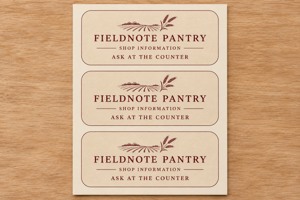
An optional identity and help prompt
The fictional Fieldnote sheet illustrates a short shop-name and counter-help message. Explore custom product labels if a separate information label has a defined purpose, or compare label and sticker options after deciding the format.
The current Product Labels page lists several materials, shapes, sizes and finish choices. Those choices need to be narrowed to the actual application. They do not establish that a selected label is suitable for direct food contact, a particular package surface, freezer storage or a specific cleaning routine.
For a secondary label, identify the intended surface and the exact message first. If no suitable space remains on the pack, use a separate counter notice, receipt or other appropriate communication. Do not shrink useful wording until it is unreadable merely to preserve an attractive layout.
Confirm the ordering unit as well. The listing describes sheets; the three-label arrangement in this AI concept is artwork, not a promise of labels per sheet or a quoted order quantity. Ask for the finished count and selected dimensions before working out how many to buy.
Give the designer a decision, not just a logo
A useful handoff to DecentCustom or your existing designer explains the message’s role and its boundaries. For this example, the brief would read:
- Purpose: identify Fieldnote Pantry and prompt a counter question; do not announce order readiness.
- Exact wording: “Fieldnote Pantry / Shop information / Ask at the counter.” Use only if counter help is actually available.
- Artwork: burgundy and oatmeal with the approved field-and-barley emblem.
- Location: still to be confirmed on a separate suitable surface; do not cover the original food information, codes or closure.
- Proof needed: selected dimensions, readable text at actual size, material suitability and the finished-label ordering unit.
Keep product-specific factual approval with the person responsible for that information. A designer should not fill gaps by copying another grain product’s ingredients, dates, claims or instructions. If the project actually involves repacking or replacing food labels, obtain the appropriate packaging and labeling review before proceeding.
Check the proof through the next person’s task
Before approving a run, use the real pack and a full-size paper proof to discuss placement. That discussion is not a substitute for material or application testing. Give a colleague the pack and ask them to find the product identity, original information and relevant code, then ask what the new shop message tells them to do.
Record what they could find, what they misunderstood and what should change. If the new label creates a question the old pack did not have, remove it from the proposed layout or move the message elsewhere. Do not report this review as a reduction in errors or an improvement in sales unless those outcomes have actually been measured.
Can one shop label go on every grain product?
Only after checking the actual message, package and intended position for each application. A shared logo does not make different packs interchangeable.
Can a shop sticker replace the producer’s information?
That is a different project from adding a help prompt. Retain the original information and seek the appropriate review if you intend to change the food label.
What if the existing packaging already works?
Keep it. Clear existing product information and a useful order message can be sufficient without an additional print purchase.
Sources and scope
Reviewed November 8, 2026. The linked operator FAQ supplies limited shop context; the FDA page explains why consumers read food-label information. The placement framework, Fieldnote branding and F1111 exercise are editorial examples. No customer complaint, real order, material test or business result is claimed.