Choosing pickup tells the shop how you want the order fulfilled. A clear ready notice tells you when and where to collect it. Keep those messages distinct, including for telephone orders.
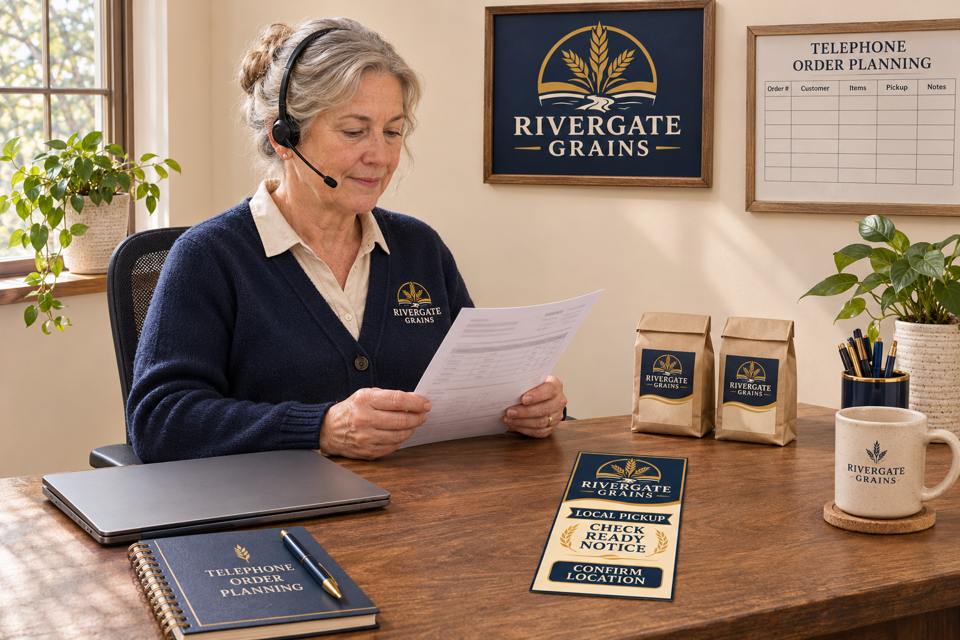
Make “pickup selected” different from “ready to collect”
An online pickup option answers a fulfillment question. It does not by itself establish that the goods have been gathered, the selected variant is available or the customer can collect immediately.
| State | Useful message | What remains unresolved |
|---|---|---|
| Pickup requested | “Your request specifies local collection.” | The shop’s acceptance, preparation and collection details. |
| Order accepted, preparing | “The accepted order is being prepared; wait for the ready notice.” | Whether it is actually ready and the permitted handoff. |
| Ready to collect | Identify the confirmed order, location, collection instructions and applicable time information. | Any remaining changes or special arrangements must still be resolved. |
As a limited business example, Maine Grains describes selecting Local Pick-Up at checkout and offers telephone ordering assistance. Its published office contact hours do not supply a complete pickup window or check-in procedure. Confirm those details for the actual order.
Use the shop’s real order process to determine which message applies. Do not relabel an acknowledgment “ready” merely to make the wording shorter.
T1010: read back the product, format and collection request
The following is fictional. Rivergate Grains, the products, reference and messages are invented examples, not Maine Grains’ order records or service rules.
“Two bags of flour” would lose both the grain and the pack size. A useful read-back repeats the exact requested product and configuration before the order is finalized.
In this invented request, two packs at 2 lb each describe 4 lb of declared food quantity. That is a product-selection check, not a gross parcel weight, a carrying recommendation or proof that the packs are in stock.
Record the fulfillment route as carefully as the product. If the customer changes from shipping to collection, or asks for a different variant, check whether the actual order can still be changed. Do not silently substitute a different flour or promise an alteration before the shop accepts it.
This example assumes the fictional shop has checked and accepted the order. A real shop must perform its own checks before using an acceptance message. If it is still checking, say “request received” instead.
A ready notice should remove the customer’s next uncertainty
“Your order is ready” is incomplete if the customer cannot tell which location to use or what to do on arrival. A useful notice identifies the order and the actual handoff. For large sacks and small retail packs, the shop may need to explain different arrangements.
The date, window, counter and reference above are demonstration details. They are not published availability or instructions for an actual business. A real notice must use the verified location and agreed process; do not replace a missing address with a vague “at the mill” if several entrances or operating areas exist.
Any substitute collector procedure, identification requirement, access arrangement or large-item handoff must come from the actual shop. Do not invent these policies from a generic template. The useful template is the set of questions the final notice answers.
For a telephone order, use an agreed follow-up channel the customer can access. A polished email is unhelpful to a customer who was never told to expect it or cannot use that channel. Confirm the communication method during the actual order conversation.
Keep the reusable card separate from order-specific permission
A printed card can remind a customer to look for the ready notice and check the location. It should not pretend to authorize collection of a specific order.
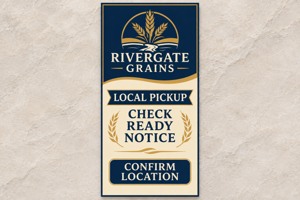
An optional pickup-information card
The AI-created Rivergate design links directly to custom rack cards. The checked product is a flat 3.74 × 8.27-inch format with a displayed minimum of 50.
Compare rack card formats if a stable take-away reminder has a distinct job. Confirm stock, finish, artwork proof and wording. Do not assume a selected finish is suitable for handwriting order details.
Keep changing order references, collection windows and readiness states in the actual confirmation system. Existing messages or a maintained service page may already provide all the information, with no need for a new print order.
Common pickup-instruction questions
Are office contact hours the pickup hours?
Not necessarily. Confirm the collection instructions for the actual location and order instead of borrowing a customer-service timetable.
Can “pickup selected” be used as the ready notice?
No. It identifies the requested route; readiness requires the shop’s actual confirmation.
Does telephone ordering mean the customer must call again to check readiness?
Only if that is the agreed process. Establish how the ready notice will be communicated rather than leaving the customer to guess.
Make the next trip predictable
Before creating materials with DecentCustom, decide which messages belong in the order process and which stable reminders belong on paper. Give the customer a clear state, location and next action. Keep the existing system if it already does that well.
Source and boundaries
Reviewed November 8, 2026. The Maine Grains FAQ supplies the limited pickup-option and telephone-ordering context. T1010, its dates, location wording and artwork are fictional. No call, order, payment, stock, pickup readiness, handoff or business outcome was verified for a customer.