Name the work the volunteer actually did, explain one observable way it helped, and thank them without attaching another assignment. A short accurate note is enough.
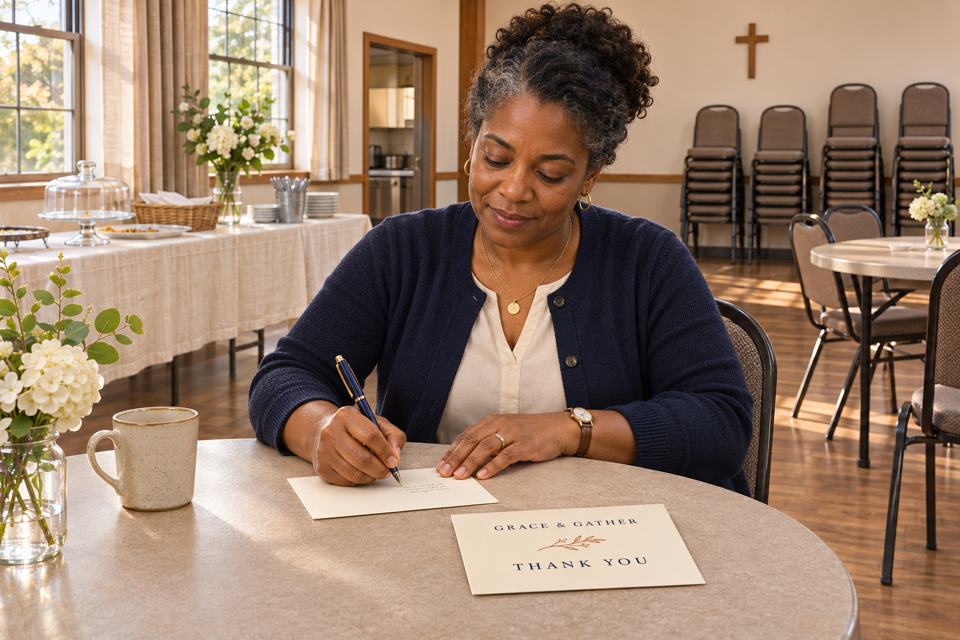
What should an Easter volunteer thank-you note say?
Use three parts: a specific thank-you, the contribution you can verify, and a personal closing. For example, thank someone for sorting the service leaflets they actually prepared. Do not credit them with leading music because that was their original assignment on an early roster.
The Points of Light service toolkit, pages 7–8, treats recognition as something that can be expressed through simple words or email and asks how people prefer to be thanked. It supports a useful starting point: appreciation does not require a purchased gift. The writing framework below is our editorial guidance, with fictional examples rather than reported church results.
| Part | Include | Leave out when unverified |
|---|---|---|
| Direct thanks | The person and the Easter activity | A role copied from an old schedule |
| Specific contribution | An action the team lead confirms happened | Attendance totals or money raised by inference |
| Observable help | What that action made available or ready | Claims that every visitor felt welcome |
| Closing | A named sender expressing appreciation | An automatic request to work the next event |
Specific does not mean elaborate. “You sorted the current leaflets into the welcome baskets before doors opened” tells the recipient what you noticed. “You changed hundreds of lives” adds a claim the sender may not be able to support.
A complete example: the volunteer changed jobs
Fictional worked example. Grace & Gather is an invented organization. Its coordinator drafts a note to Jordan using an early Easter roster. Jordan was originally listed for music, but the team lead confirms that Jordan switched to preparing visitor materials. The coordinator has not yet sent the message.
Draft held for correction: “Jordan, thank you for leading our Easter music and welcoming every visitor. Please sign up for the next service.”
The team lead confirms only that Jordan sorted current service leaflets into the welcome baskets and removed outdated inserts. The coordinator replaces the incorrect music credit, removes the universal visitor claim, and separates the future request. A second reader checks the corrected wording against that confirmed contribution.
Dear Jordan,
Thank you for helping prepare our Easter welcome materials. You sorted the current service leaflets into the baskets and removed the outdated inserts before they went out. That gave the welcome team the correct materials to hand to arriving visitors.
I appreciate the care you took with a job that could easily go unnoticed.
With thanks,
Alex, Volunteer Coordinator
The note is now ready for a private delivery through the channel already agreed with Jordan. It does not claim that Jordan approved the leaflet, served all day, or produced a measured attendance result. The correction is the useful work; adding more adjectives would not fix the original error.
Private thanks and public recognition need different decisions
A personal note can recognize one person's contribution without announcing their participation publicly. Before adding names, photographs or individual stories to a church website or social post, ask how the volunteers want to be recognized. Their agreement to help with an event does not tell you their publicity preference.
For a group message, thank the team for verified work without turning it into a list of personal details. Here is a separate fictional example:
To our Easter preparation team: thank you for arranging the welcome table and sorting the current service materials before opening. We appreciate the time and care you gave to those preparations. With thanks, Alex and the coordination team.
If you cannot yet confirm individual assignments, send a truthful general thank-you and follow up personally when you can. Do not guess specific contributions to make every note look personalized. Keep any invitation to volunteer again in a separate message with its own clear choice.
Choose a printed card only when it serves the message
A spoken thank-you or personal email may finish the task. Printed cards make sense when the coordinator wants a physical message and has a practical way to deliver it. For a small team, ordinary blank cards may be sufficient; a custom order is optional.

A flat paper postcard concept
Our custom postcards for volunteer thank-you notes offer horizontal and vertical formats, including 6 × 4 inches; the page lists 16pt as the default thickness and ordering increments of 50. An increment is not a count of volunteers who need cards.
Compare custom postcards for appreciation messages, then prepare the approved wording and artwork for DecentCustom. If handwriting is planned, confirm the chosen surface and test the intended pen before ordering.
AI-generated fictional design, not a printed sample or proof of pen compatibility. Flat card only; no envelope or folded construction is shown or promised.
The final review is about accuracy and delivery
Read the recipient's name, actual task and sender aloud. Ask the team lead to catch assignment errors. Check that a public version includes only the recognition people agreed to, and that a private note uses the intended delivery route. If cards are printed, inspect one finished proof before repeating the message.
Keep preparation information separate: our volunteer group brief guide covers work before an activity, while the church handout guide explains the materials mentioned in the example. A thank-you note closes the contribution with appreciation; it does not need to become another instruction sheet.
Source scope: selected recognition guidance on pages 7–8 of the older Points of Light toolkit; current DecentCustom product fields checked November 14, 2026, China time. All messages and organizations above are fictional examples. No volunteer retention or attendance results are asserted.