An interested group is not yet an arranged volunteer project. Confirm the actual event, the group's registration and the host's preparation instructions before buying branded supplies.
Choose an available opportunity before describing a custom project
A community group can agree that it wants to help without having an event to attend. Start with a current opportunity and its actual registration route. A newsletter subscription, an expression of interest or a proposed date does not establish that the host can receive the group.
For a concrete operator example, the King County Parks volunteer page, checked November 13, 2026, directs groups toward existing events. It says that, where capacity exists, a registrant can include up to nine additional guests without extra coordination. It also states that new custom-event requests are not currently being accepted and points groups toward partner opportunities.
That is a conditional route for this provider, not ten reserved places or a rule for every organization. Check the actual event listing. Do not divide a larger group into separate registrations simply to assume coordination is unnecessary, and do not advertise a private project the host has not agreed to provide.
Separate host instructions from your group's arrangements
| Get from the host or event listing | Set within your group |
|---|---|
| Confirmed event, date, time and meeting point | Who forwards the current brief and checks acknowledgments |
| Registration status and any group arrangements | Which members are actually included in the confirmed plan |
| Preparation instructions and what the host provides | Who checks the supply list before buying anything |
| Current update or cancellation route | Who checks it and passes changes to the group |
| On-site contact and arrival instructions | How members reach the group organizer if confused |
Use the host's approved instructions for the work itself. Your group's short brief should help people find those instructions, not replace training, add unapproved tasks or decide that someone is qualified for a role. Keep personal registration information in the host's appropriate process rather than on a public handout.
Complete a four-person plan without ordering a box of extras
Fictional planning example: four adults in Common Ground want to join an existing volunteer event. The organizer checks that the selected event can receive them and completes its required registration process. The resulting confirmation includes all four people; until that confirmation exists, the group's message describes the plan as pending.
The organizer then sends the confirmed meeting details, the host's preparation instructions and the update route in one digital brief. Each member acknowledges it. The supply check shows that the host provides the necessary event tools and gloves under its instructions, so the group removes duplicate tool purchases from its shopping list. It also decides that a new batch of printed help cards is unnecessary for this single small outing.
Before departure, the organizer checks the host's update route and forwards the current status. On arrival in this example, all four meet the designated host lead and receive the host's instruction. The brief has completed its job: it connects the confirmed group to the actual host process. It does not certify training, prove volunteer hours or promise that a real event will proceed.
Buy only for a verified gap
The King County page describes providing tools, supplies, gloves and instruction for its events. It also distinguishes ordinary wet-weather operation from cancellation in hazardous conditions. Treat both as reasons to read the selected event's current instructions, rather than inventing a universal equipment list or a guarantee that every event runs in any weather.
A useful supply record has three headings: host provides, group already has and unresolved. Ask about an unresolved item before moving it into a purchase list. Branded clothing or paper materials do not replace protective equipment, required training or permission to undertake a task.
Check dates on general information too. The reviewed page retains a program-refresh note referring to the end of June 2026. That past time window cannot establish November availability. Current listings and the host's answer must settle the real event plan.
A small help card is optional, not an event credential

Stable group contact information
For recurring activities where a separate contact card has a clear use, these custom business cards for group information list 3.5 × 2-inch paper cards with 14pt as the default. The current minimum is 50, with ordering increments of 50.
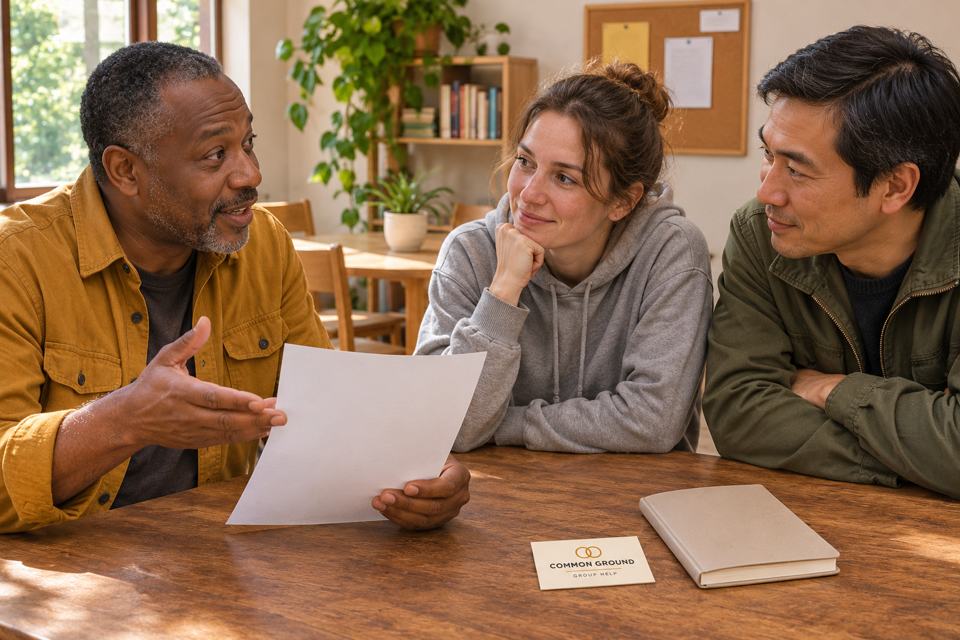
Compare custom business cards for community contacts or review the actual artwork with DecentCustom. The small image is an AI artwork concept. An ordinary paper card does not establish registration, clearance, protective performance or access to a site.
For the four-person example, an existing digital message already answers the contact question. A 50-card order would need a separate, credible future use; a minimum order is not evidence that the group needs that many copies.
Official King County Parks program information and the linked product page reviewed November 13, 2026. Provider conditions and opportunities can change. The group brief and Common Ground scenario are editorial examples, not a real registration, safety assessment or report of volunteer outcomes.