A visitor may need today's service leaflet, help finding a room or a way to ask a later question. Give each need the right information rather than putting every instruction on one permanent welcome card.
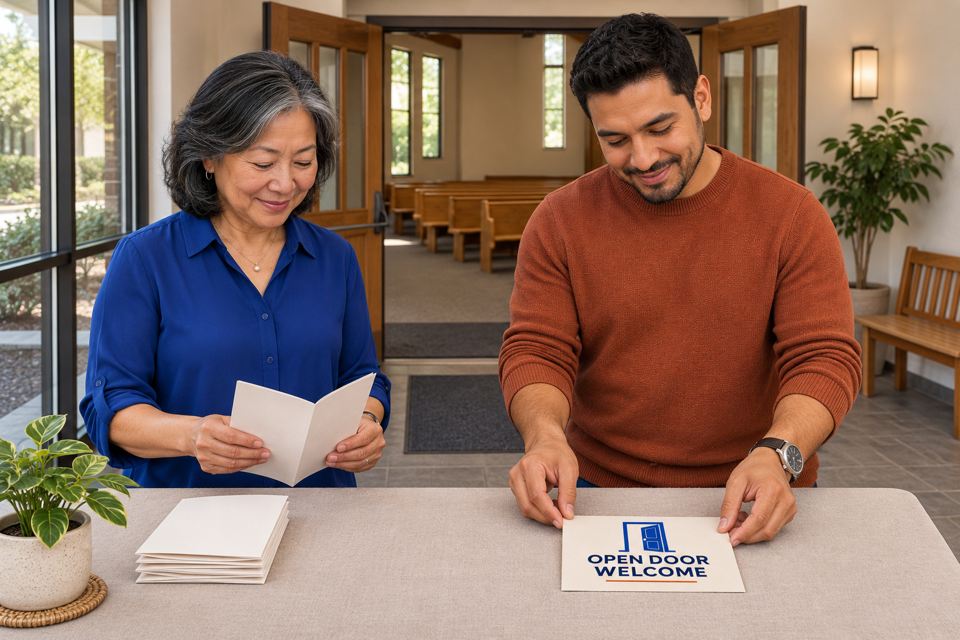
Give each printed item one clear job
A useful visitor pack answers the question in front of the visitor. Someone looking for today's readings needs the correct service leaflet. Someone asking about a later gathering needs current event details. A general welcome card can explain where to get help, but it should not become the only source for information that changes each week.
| Material | Primary job | Check before use |
|---|---|---|
| Stable welcome card | Identify the organization and provide a useful help route | Identity, approved contact destination and wording still work |
| Service leaflet | Help someone follow the particular service | Correct date, service and approved edition |
| Dated gathering notice | Explain a particular meeting's time, place and next step | Current organizer-confirmed details and update source |
Saint Mark's Episcopal Cathedral in Seattle provides a concrete example of this separation. Its visiting page says a greeter provides a service leaflet, including the readings. The page also distinguishes office business hours from Sunday worship times. Those are different kinds of information; office availability is not a substitute for the current service schedule.
Its newcomer page separately offers a welcome form and a route to membership information. For your own materials, make the purpose of any follow-up route clear. Do not describe an inquiry, a newsletter signup or possession of a welcome card as proof of membership.
Read the date on the notice, even when the heading says “next”
During our November 13, 2026 review, the newcomer page still displayed a coffee gathering dated November 1, while the visiting page displayed December 13. The former date had already passed. This does not establish that two upcoming gatherings exist, that an event was canceled or that every other detail remains unchanged.
The practical response is to check the current organizer's event information before printing an invitation. Record the full date, time, room, source and time checked. If two pages disagree and the current answer cannot be established, hold the dated invitation and give visitors the approved contact route instead. A polished layout cannot resolve a factual conflict.
Keep the date next to the event name, not in a distant footer. Give a dated notice a clear retirement point in the team's work plan. A stable card can remain useful while the event insert changes; printing a temporary gathering date on every evergreen card makes the whole batch harder to maintain.
Complete the correction across the visitor's materials
Fictional preparation example: the Open Door team finds an old coffee-gathering date on a draft insert. The office confirms the replacement gathering details through its actual planning record. The editor updates the insert, checks it against that confirmation and removes the old insert from the prepared visitor packs through the team's normal process.
The welcome card stays unchanged because it contains only the organization's identity and stable help route. The service leaflet is checked separately for the relevant service. A second volunteer reviews a finished pack and confirms that it contains the current leaflet and corrected insert. The team then briefs the desk volunteer with the same current date. That closes the correction; changing one online sentence while leaving old paper in the packs would not.
This is an invented workflow, not a claim that a particular church ran an event or gained members. Its useful output is a consistent pack and staff explanation, which a real team can check before distribution.
Give the team a short material brief
Welcome card: [approved identity and help destination].
Service leaflet: [date, service and approved edition].
Event insert: [confirmed gathering details or “not included while awaiting confirmation”].
Update owner: [person responsible for replacing dated information].
Ask a colleague unfamiliar with the draft to find the help route and identify which page applies to the intended service. Check any room directions at the actual venue. A generated scene does not verify a doorway, access route, seating arrangement or someone's ability to use it.
Choose a postcard only for information that deserves a separate card

An optional stable welcome card
These custom postcards for visitor information list a 4 × 6-inch format and 16pt paper as the default thickness. The page specifies ordering increments of 50; that statement alone does not establish a minimum order.
Compare custom postcards for welcome materials and review the actual configuration and artwork with DecentCustom. The small image is an AI concept of a flat paper card, not a service booklet or membership credential.
An existing leaflet or digital page may already provide the help visitors need. Order a separate card only when its role is clear, its contact destination is maintained and the team knows which details must stay off the permanent artwork.
Official Saint Mark's visitor and newcomer pages and the linked product page checked November 13, 2026. Published details can change; the dated discrepancy is an observation from that review. Material planning advice and the completed Open Door example are editorial guidance, not evidence of attendance, membership growth or a real event.