Discount-grocery checkout information
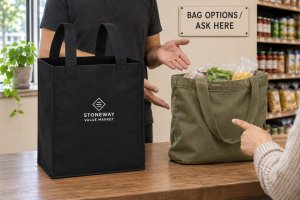
Give shoppers the next action before the checkout handoff, with an available way to ask for help.
Explain self-bagging as a sequence: what happens at checkout, where groceries go after payment and where the customer packs them. Put the first explanation before the handoff. A sign above the packing bench is useful only after the shopper knows how to reach it with the purchase.
Keep the wording calm and specific. Someone buying a few items, using an existing bag or asking for assistance still needs a workable next step. A warning to “keep the line moving” does not tell that person what to do.
Borrow the distinction, not another retailer’s whole system
ALDI U.S.’s official FAQ, reviewed November 5, 2026, says its cashiers place purchases in a shopping cart and customers bag them in designated areas after checkout. Its ALDI 101 page also describes its quarter-cart arrangement and customers packing groceries.
That is a named operator’s U.S. model. It does not establish that every discount grocer uses a cart deposit, swaps carts, has the same bagging area or handles small purchases identically. The retailer describes efficiency benefits, but we have not measured queue times or savings from its arrangement.
The original industry research also included a customer discussion about bagging at checkout. The post complains about customers trying to pack at the register, while a visible commenter describes preferring to avoid a cart for a small purchase. These anonymous accounts show different situations worth asking about. They are not a representative customer survey or authority for a store rule.
Start with your own cashier and shift lead. Confirm where paid items go, what happens when the customer has no cart, where bag options and any charges are explained, and who helps if the normal route does not work. Settle those answers before placing instructions on a sign.
Write the handoff before writing the packing-bench sign
Fictional setup: Clearfield Market operates a staffed checkout lane. Paid groceries normally go into a cart, and customers pack at a separate counter. The cashier can explain the store’s approved alternative when someone has no cart or needs help. This is an invented workflow for the examples, not an ALDI instruction or a claim about every shop.
The three messages have different jobs. The first sets expectations while a change can still be arranged. The spoken handoff identifies the actual purchase and destination. The counter notice confirms that the shopper has reached the packing area.
Do not print the fictional help promise unless staff can fulfill it. Name the real available help point if “a team member” would be difficult to find. If bags must be purchased before the handoff, make that clear before payment rather than sending someone back through the queue after reaching the bench.
Keep cart-deposit and cart-return details on the applicable visiting information and the real cart-return location. The sample does not invent a quarter requirement, a cart-swap rule or permission to leave a cart anywhere.
A customer without a cart needs an answer, not a reprimand
Consider a fictional shopper, Lee, who arrives with three sealed items and a reusable bag. At the cashier, Lee discovers that packing normally happens after payment at a different counter. If the only instruction is “Bag at the counter,” Lee still has an unresolved question: how should the paid items get there?
The cashier should use the shop’s actual approved arrangement and confirm that Lee can use it. A suitable transfer arrangement, available assistance or another authorized handoff may solve the problem. Do not improvise a new rule from a forum comment or assume the customer can carry the loose items because the purchase is small.
A useful staff response
“Thanks for checking. Let’s agree how to move your purchase to the packing area before we finish. I’ll explain the option we can provide here.”
The wording opens the decision; the employee still needs a real option. If the arrangement is unresolved, involve the shift lead rather than sending the shopper to guess.
Now suppose the normal bagging bench is unavailable. Keep the old direction from sending more people there. The shift lead confirms the approved alternative and the cashier explains that route; the temporary message must agree with it. A sign saying “use the other counter” is incomplete when there are several counters or the alternative is unattended.
Keep the payment issue separate from the packing issue. If payment or an item needs checking, resolve that through the checkout process. A notice directing customers to pack paid groceries does not authorize taking an unverified purchase or substitute for an online-order collection procedure.
Check whether each message closes the next question
Try the draft with a colleague who has not helped write it. Use the actual approved route and harmless props away from live customer service. Ask them to explain what happens after payment, find the packing location and identify how to ask for help when they have no cart or the bench is unavailable.
Record the exact gap. If they find the bench but cannot explain how the groceries reach it, move the explanation earlier in the journey. If they follow an arrow toward an unavailable space, correct the current destination and tell staff. If they think they must buy a new bag, clarify the store’s accepted own-bag option and actual charges.
Our guide to instruction placement and route checks explains the separate method of checking a cue from the visitor’s viewpoint. Here, the handoff follows an in-store checkout; it is not a pickup notification or a refill-container check.
This internal walkthrough is an editorial check, not a customer study. If you later observe real questions, keep the context and counting rule with the record. Do not claim that a shorter notice has reduced queues or improved sales without appropriate evidence.
A carrier is one option; it is not the instruction system
Use an accepted existing bag when it suits the purchase and the store’s procedure. Consider custom grocery bags only when there is an identified carrier need and the person responsible can approve it. A chain store’s published self-bagging process does not authorize a local custom-logo order.

non-woven grocery tote
The current SKU decentcustom-to-000131 lists 80 GSM non-woven polypropylene, an open main compartment and an inner bottom board. Listed dimensions are 13 W × 15 H × 10 inches; the third dimension is not named, so confirm the opened shape for your intended contents.
The current minimum is 12 bags; the listed case pack is 100. Neither is a tested carrying limit or a recommended store order. The listing’s weight figure is not used here as an individual bag capacity.
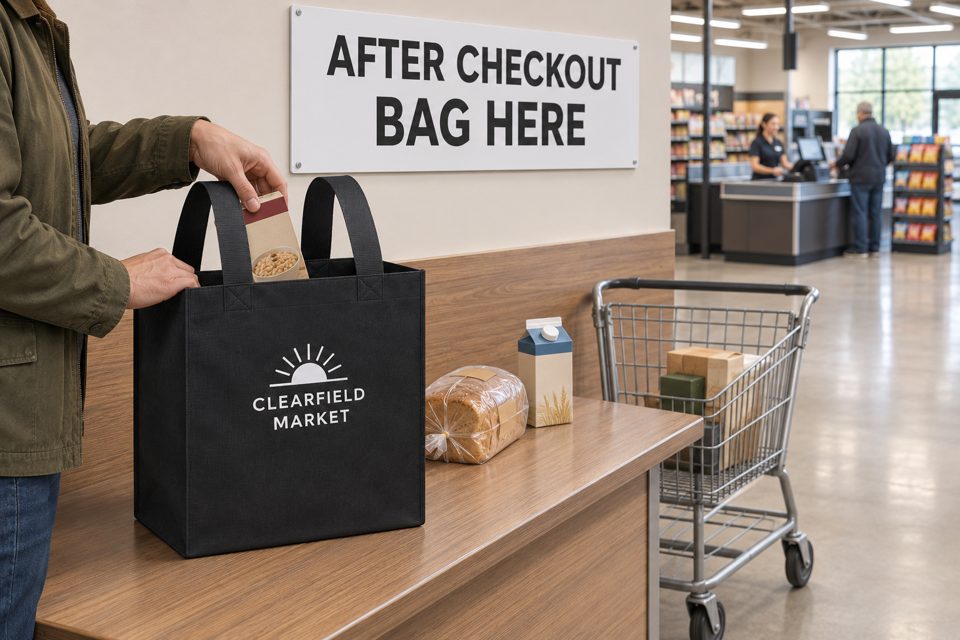
AI concept using the catalog bag form and fictional Clearfield Market artwork, matching the scene. No load, food-contact or temperature-control performance has been demonstrated. Click the small image for the actual product page.
At DecentCustom, review the actual configuration and artwork after the carrier decision is justified. Keep changing checkout directions on maintained notices and staff instructions. The useful result is a shopper who understands the next step and can reach real help, whether or not a new bag is purchased.