Discount-grocery handoff planning
The useful distinction is the question left unanswered, rather than a rule that small purchases need no help and large ones need a bigger bag.
Plan self-bagging information around the complete transfer after payment, then check it with both a small and a larger purchase. Keep the main direction consistent. Add the detail needed to choose a carrier, move the purchase and get available help. Item count alone cannot tell you whether someone can use the arrangement.
A few items may still leave a shopper without a suitable carrier. A cartful may require a clear place for the remaining paid items while the customer packs. Neither problem is solved simply by printing “Bag here” in larger type.
Start with the actual checkout model
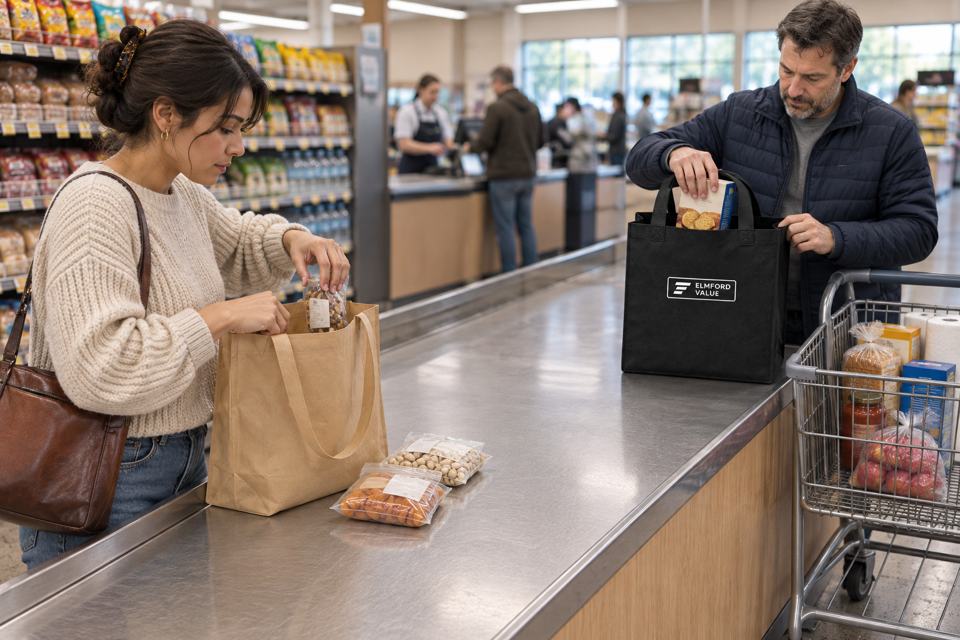
ALDI U.S.’s official FAQ, reviewed November 5, 2026, describes cashiers placing items in a cart and customers packing afterward in a designated area. Its ALDI 101 page explains features of that particular shopping model, including its cart deposit.
Those are useful distinctions for a staffed checkout. They do not establish your store’s cart-transfer procedure, a rule for purchases of a certain size or the process at a self-checkout machine. If you operate more than one checkout type, review each actual handoff separately.
The original industry research also included an anonymous customer discussion with different preferences about using carts for small purchases. Treat that as a reason to ask about exceptions, rather than evidence that all shoppers want the same arrangement. Do not turn “small purchase” into an instruction to carry loose items.
Compare the missing information in two complete walkthroughs
Fictional review: Elmford Value has a staffed lane and a separate packing counter. These examples are editorial exercises, not observations of real shoppers. The review team uses harmless props away from live service and asks a colleague to explain the next action.
Walkthrough A · a few sealed items
The destination is clear; the bag choice arrives too late
Setup: Dana expects to use a small existing carrier. During the exercise, the team finds it unsuitable for the complete purchase. The draft notice explains where to pack, but says nothing about obtaining another bag.
Unanswered question: “Do I need to buy a bag before paying, or can I get one at the packing counter?”
Editorial change: explain the actual bag options, purchase point and applicable charge before payment. Retain the accepted own-carrier option.
Status: wording remains pending until the store confirms what it can supply and how the charge is handled. A clearer headline cannot create stock or a payment arrangement.
Walkthrough B · a cartful of closed packages
The shopper finds the counter; the transfer method is unresolved
Setup: Morgan reaches the packing counter with a paid purchase in a cart. The draft direction is understood, but the exercise has not established where items remain while packing takes place.
Unanswered question: “Am I expected to unload everything onto this counter, or take items from the cart as I pack?”
Operating decision first: the responsible manager must confirm a workable arrangement for that position and service. Do not publish a guessed instruction to spread the whole purchase across the counter.
Status: hold the transfer detail until that arrangement is confirmed. A product photo, a larger bag or an available stretch of counter is not approval of the method.
The two exercises produce different actions: A needs earlier, accurate purchasing information; B needs an operating answer before the wording can be finalized. Do not make separate compulsory “small order” and “large order” lanes from these invented examples.
Keep one core direction and add only confirmed details
The main message can serve different purchases without listing every exception. For the fictional staffed-lane setup, the proposed core is:
Pack after checkout at the bagging counter.
Using your own carrier? Have it ready. Need another bag or help with the transfer? Please ask your cashier before payment.
That draft still needs the real bag choices, charge information and available help arrangement. Place specific purchase information where the customer can act on it before paying; do not leave the first mention of a required purchase at the packing bench.
If Elmford’s manager subsequently confirms that paid groceries may remain in the customer’s cart at this packing position while items are packed, a staff explanation could be:
“You can pack from your cart here; you do not need to put the whole purchase on the counter. Please ask us before moving the purchase if this arrangement does not work for you.”
This is conditional sample wording. It is not an ALDI instruction or permission to use any cart, counter or waiting space. If the arrangement is unconfirmed or the space is unavailable, keep this sentence out of the live notice and resolve the process with the responsible person.
Keep frequently changing details on maintained notices or staff guidance. A permanent bag print is a poor place for a temporary packing-location instruction.
Record what changed, and what still needs an answer
A useful review note is more specific than “small and large orders checked.” For the fictional exercise, record:
- Information change
- Move bag availability, purchase point and charge explanation before payment. Owner: the person responsible for checkout information. Pending confirmation of current options.
- Operating question
- Confirm how the cartful is transferred at the named packing position. Owner: the responsible store manager. Keep the conditional cart sentence unpublished until resolved.
- Repeat check
- Use the revised words and the actual agreed arrangement in both walkthroughs. Ask what happens next and where help is available. Note the exact remaining question rather than marking the entire process “passed.”
Keep customer choice separate from the exercise. A small purchase can require assistance; a larger purchase can use an existing suitable arrangement. Do not infer physical ability, transport method or a preferred bag from appearance or item count.
This internal review can reveal a missing explanation. It does not demonstrate real customer comprehension, faster queues or lower bag use. Those outcomes need their own appropriate evidence.
Make the carrier decision after the information decision
An accepted existing carrier may already meet the need. If a new format is justified, compare custom grocery bags against actual wrapped purchases. Our guide to grocery bag sizes, packing and reorders covers that separate fit and ordering task.
non-woven grocery tote
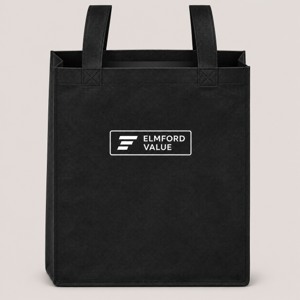
The current SKU decentcustom-to-000131 lists 80 GSM non-woven polypropylene, an open compartment and an inner bottom board. Its dimensions are 13 W × 15 H × 10 inches; the third dimension is not named, so confirm the opened shape.
The current minimum is 12 bags, with a listed case pack of 100. These are ordering figures, not an individual carrying limit or a recommendation to purchase. No load, food-contact or temperature-control performance is established here.
AI artwork concept with fictional Elmford Value branding matching the scene. The small image opens the exact product page; the pictured contents and layout do not establish suitability or capacity.
When reviewing a configuration with DecentCustom, bring the actual carrier need, fit checks and approved artwork. Keep the result of the information review even if no new printed bag is needed.