Discount-store sign review
A correct logo does not settle whether the instruction belongs at that counter. Review the words and their placement together.
Before printing a store sign, approve the instruction at its intended location as well as the brand artwork. Check what a shopper would do after reading it. A technically tidy file can still direct the wrong action if it is placed at the wrong stage of checkout.
Give the reviewer the exact wording, a named placement and the current service process. Then keep the purchasing decision tied to the version that passed those checks. “The logo looks right” is a useful answer to one question, rather than approval of the whole sign.
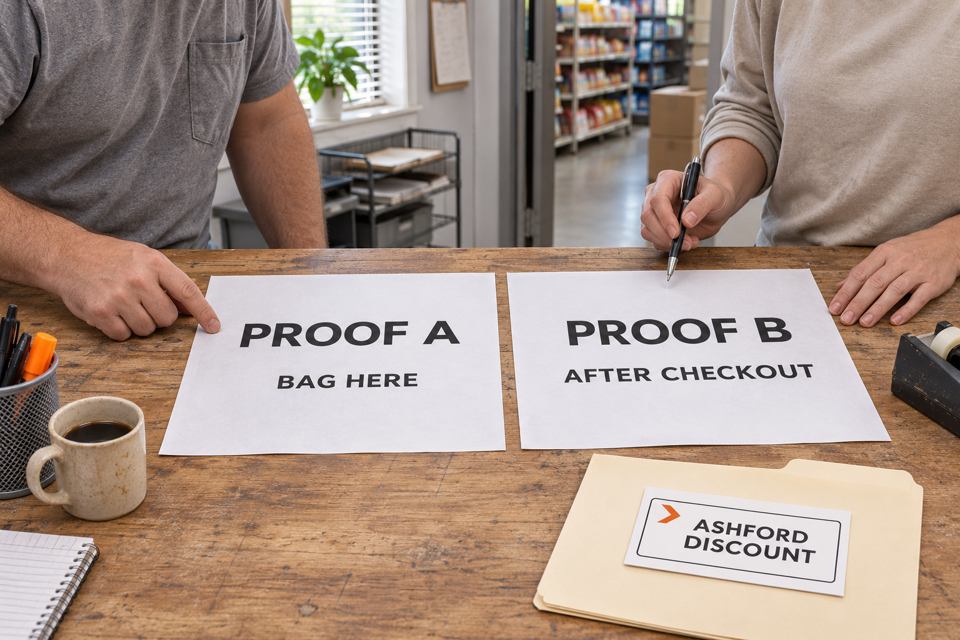
A service instruction needs an operating fact behind it
ALDI U.S.’s official FAQ, reviewed November 5, 2026, distinguishes staffed checkout from the designated area where customers pack groceries afterward. Its ALDI 101 page describes self-bagging within its particular operating model.
Those pages can help an editor notice the distinction between service stages. They are not an internal brand manual or permission to print signs for ALDI. Another discount store may use a different process. Confirm the actual service with the person responsible for it rather than copying an instruction because it fits the available design space.
Write the operating fact before the headline: “At this staffed lane, the cashier completes payment, paid groceries go into a cart and the customer packs at a separate counter.” That is the fictional Ashford setup used below. It is not a universal checkout rule or a verified description of any cited store.
Compare the action implied by each proof
Fictional job AS-19: Ashford has an approved store badge file, ASH-badge-v2. An editor is preparing a notice for the approach to its staffed checkout, before payment. The brand file is unchanged in both concepts.
Proof A · proposed before payment
“Bag here”
Brand check: the correct badge is supplied.
Operating problem: “here” points to the checkout location, although packing is supposed to happen at the separate counter after payment.
Decision: hold this proof for that placement. Correct artwork does not resolve the wrong implied action.
Proof B · revised before-payment message
“After checkout, pack at the bagging counter”
Brand check: the badge remains the same.
Content change: identify the service stage and the destination, with a real help route before the handoff.
Decision: a candidate for the next review, pending the actual position, visibility, service-owner confirmation and required brand and purchase decisions.
Proof B is not automatically released because it is better than A. The reviewer still needs to know whether the named counter exists, is available for that service and can be found from the proposed position. A generic “approved” stamp would hide these remaining questions.
If you cannot state the handoff plainly, map the actual handoff before asking a designer to solve it. The content decision precedes the artwork export.
Give the approach notice and counter notice different jobs
Revised before-payment copy for the fictional setup
After checkout, pack at the bagging counter.
Your cashier will explain the handoff. No cart, or need help with the next step? Please ask before we finish checkout.
Separate copy at the actual packing counter
After checkout — bag here.
Pack your paid groceries at this counter. Need help using this space? Please ask a team member before moving your purchase.
The phrase “bag here” can make sense at the packing counter while being wrong before payment. Review it with its location attached. Do not duplicate the same notice at every counter merely to create a coordinated look.
Use these examples only where the described process and help arrangement are genuine. In a real shop, name the available help point if “a team member” is too vague. An instruction cannot promise staff assistance that the operating plan does not provide.
Make a paper trial at the proposed position. Ask a colleague unfamiliar with the draft what they would do next, and compare that answer with the service owner’s intended action. Check the wording from the normal stopping point. This is an internal review; it does not prove that real customers understand the sign or that queues will shorten.
Attach the decision to the words and location that were checked
For AS-19, keep the following together so a buyer or later editor can tell exactly what is ready:
- Brand asset: ASH-badge-v2 and the confirmation of its permitted use.
- Current content proof: AS19-approach-v3, containing the full before-payment copy rather than the earlier “Bag here” concept.
- Placement: the named checkout-approach position reviewed in the paper trial. Keep a location photo or sketch with the record; the example does not supply a real store map.
- Operating confirmation: the responsible role confirms the after-payment packing route and the available help arrangement.
- Purchase status: record the selected material, size, quantity, configuration total and required buying authorization separately. Do not fill them with assumed values.
If the notice moves to the packing counter, review the location and the message again; a file approved for the checkout approach is not automatically the right counter notice. If the help route changes, check the relevant wording and its current availability. Keep the earlier proof as superseded for that job, so it cannot quietly return as the print file.
Compare the final design preview with the current proof before ordering. Check the words as well as the logo. If any required confirmation is missing, state the exact unresolved item and keep the release pending. We have not established any named chain’s approval hierarchy; follow the organization’s actual process.
Use a stable badge where it has a separate job
An existing approved holder and replaceable paper notice may be enough. Consider custom labels and stickers for a stable store badge on a suitable surface. Keep changing service instructions on a medium the team can maintain.
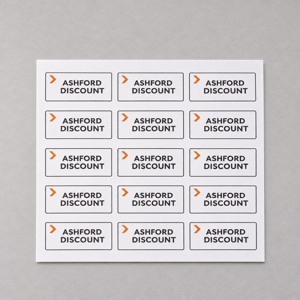
custom product labels
The current SKU decentcustom-st-000009 lists rectangular shapes and material and finish choices. Its white-paper description is for indoor, dry use. Confirm the actual dimensions, configuration and surface; a small identity badge is not the whole instructional sign.
Quantity starts at 1 ordering unit, while the package description refers to sheets without establishing finished labels per sheet. Confirm the count for the order. The illustration does not demonstrate removability, weather resistance, adhesive performance or sign readability at a given distance.
AI artwork concept with fictional Ashford Discount branding, matching the separate badge in the review scene. The pictured sheet count is illustrative. Click the small image for the actual product page.
When reviewing a configuration with DecentCustom, keep the approved artwork, intended use and purchasing record together. The practical check is whether the final material carries the right message at the right service stage, within the scope the store has actually approved.