Discount-grocery purchasing decisions
Count the problem that needs solving: a missing carrier, an unsuitable option or a stable branding task.
A discount grocery store needs new printed bags when an approved, suitable carrier and a lasting printed message have a defined job. First establish what customers requested and why an existing option failed. A checkout total does not tell you how many bags were wanted, and a bag request does not establish a preference for new branding.
A useful review can end with replenishing ordinary stock, explaining a charge earlier, keeping an accepted customer bag or preparing a custom order. Make the next action fit the recorded problem.
Start with requests and outcomes, not all checkouts
ALDI U.S.’s official FAQ, reviewed November 5, 2026, describes customers bringing their own bags or purchasing reusable bags. Its ALDI 101 page describes self-bagging as part of its operating model. Those published choices do not tell another store how many new printed bags it needs or who is authorized to buy them.
The industry research’s anonymous shopper discussion contains different cart and bagging preferences. That makes customer choice worth checking; it does not supply a demand forecast. Neither a retailer’s promotional claim nor a forum complaint establishes that shoppers at your location want a more expensive or newly branded carrier.
For a local review, define one observation window and one service. Record requests for that service’s bag option and the outcome of each request. Keep the number of bags requested separate from the number of requesting purchases. One shopper asking for three bags is not three customers.
A filled example distinguishes stock availability from price acceptance
Fictional record: Stoneway observes one staffed-checkout window with 36 completed purchases. Six of those purchases include a request for one additional store bag each. No names or order details are needed. The outcomes are recorded once per requesting purchase:
| Recorded outcome | Purchases | What it supports checking |
|---|---|---|
| One requested bag provided from the existing approved stock. | 3 | Continue tracking usable stock and the actual handoff. |
| Customer wanted the offered bag, but it was unavailable at the counter. | 2 | Find out whether stock was absent, stored elsewhere or not replenished. |
| Customer declined the available bag after the charge was explained. | 1 | Review when the choice and price were explained; do not assume a new logo changes acceptance. |
What the record actually counts
3 fulfilled + 2 unavailable + 1 declined = 6 requesting purchases.
The remaining 30 completed purchases had no recorded additional-store-bag request. That does not mean all 30 used their own bags; their carrying arrangements were not recorded.
Two requests were unfulfilled because the offered bag was unavailable. The record does not show six stockouts or a need for a bag on all 36 purchases.
Keep the “unavailable at the counter” description precise. If usable stock was on a back-room shelf, replenishing the counter is a different action from placing a supplier order. If stock was damaged or the format did not suit the purchase, record that instead of putting every problem into one “need more bags” category.
This one window is a convenience observation, not a normal weekly consumption rate. The six requests are not six new customers, six lost grocery sales or six requests for the custom tote below. All figures and outcomes here are invented; use your own verified records for a real decision.
Write a purchasing decision that the evidence can support
Stoneway’s provisional decision note
Observed problem: two customers requested the offered bag, but it was unavailable at the counter in the observed window.
First action: the shift lead checks actual usable stock and the counter-replenishment arrangement. Restore availability through the store’s approved process if appropriate.
Separate price question: one customer declined after hearing the charge. Explain the choice before payment and ask about suitable alternatives. This is not evidence that a newly printed bag would be accepted.
Custom-print decision: pending. The record has not identified a new stable branding or information task, confirmed the candidate’s fit, established a purchasing quantity or shown who can approve the order.
Review next: record comparable service windows and whether the specific availability problem recurs. Keep format, charge, location and observation coverage with the results.
The note gives staff an action without turning a small record into a sales forecast. If the store later identifies a genuine stable identity need, assess that separately. Examples might include a confirmed approved store-name change or a new carrier format whose artwork has been authorized. A logo’s visibility alone does not establish advertising return.
For a chain-operated location, verify the actual procurement and brand-approval route. Public shopping information does not grant a store employee permission to commission branded stock. For an independent business, identify the person approving the configuration and expenditure. We have not verified a private purchasing policy for ALDI or any named store.
Keep existing carriers in the comparison
A customer’s accepted bag can remain a useful choice when it suits the purchase and the store’s policy. Our guide to reuse and carrier acceptance separates that outside-carrier decision from refill vessels and returned containers. Do not treat a tote carrying sealed groceries as permission to refill food directly into it.
If customers ask about bag availability because the option is hard to find, clearer information or a reachable stock location may solve that problem. If the actual carrier is unsuitable, compare the packed contents and an appropriate alternative. Keep these questions distinct from whether printing is useful.
Before buying, confirm the chosen configuration’s complete current total, order unit, minimum, arrival quantity, receiving space and needed-in-hand date. An inexpensive unit price does not settle those questions. This article does not provide a supplier quote or recommend a spending amount.
Review a candidate only after the carrier need is clear
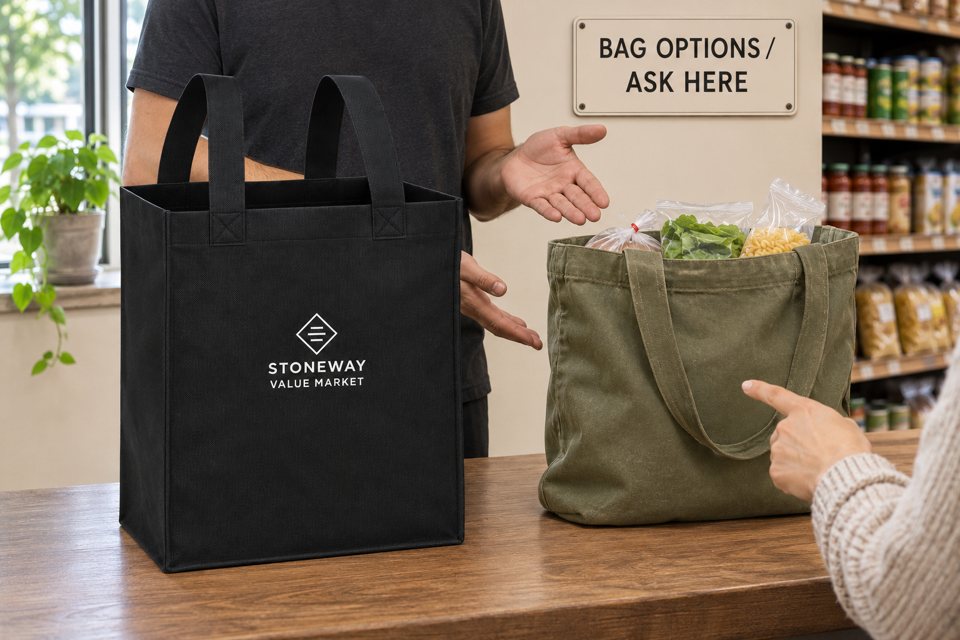
Compare custom grocery bags when the approved carrying task calls for one. Keep the candidate’s actual specifications beside the requirement; an illustration of a bag beside groceries is not a fit or load test.
non-woven grocery tote
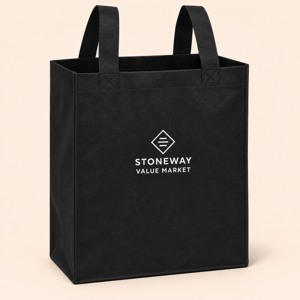
The current SKU decentcustom-to-000131 lists 80 GSM non-woven polypropylene, an open compartment and an inner bottom board. Dimensions are listed as 13 W × 15 H × 10 inches; confirm the unnamed third dimension and opened shape for your contents.
The current minimum is 12 bags, separate from the case pack of 100. Two unfulfilled requests in an invented observation do not establish a 12-bag purchasing need. Confirm the quantity and final configuration independently. No tested carrying limit, food-contact or temperature-control performance is established here.
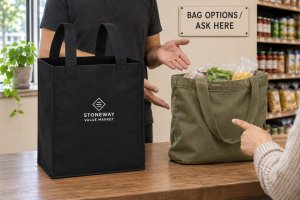
AI artwork concept of the fictional Stoneway Value Market tote, matching the scene. The catalog-based form and artwork are illustrative, not a manufactured sample or evidence of shopper preference. Click the small image for the actual product page.
When preparing a configuration with DecentCustom, bring the approved carrier requirement, artwork and quantity rationale. Keep the custom order pending if those are unresolved. A clear stock action or a better-explained existing option can be a complete, useful decision.