Community-store event information
Give visitors the right destination, an honest store role and a current plan when the venue changes.
Prepare community-event materials around the confirmed event location and the visitor’s next action. Identify who runs the event, which entrance visitors should use and what the store actually provides. A familiar shop name can help people recognize an area while still sending them to the wrong door.
Use a complete information page before the visit, a concise cue at the decision point and a clear help route for unresolved changes. Print only the copies needed for verified placements. A nearby venue’s audience size does not determine how many signs the shop needs.
Being neighbors does not make every service interchangeable
Saxapahaw General Store’s community directory, reviewed November 5, 2026, links to the Haw River Ballroom and Cup 22. Its catering page describes working with the neighboring Ballroom. Those are specific relationships; they do not establish that the store is the organizer, entry point or ticket desk for every nearby gathering.
The Ballroom’s own FAQ separates market operations from daily venue operations and explains that advance ticket sales do not take place in its coffee shop. It also describes outdoor-event relocation as conditional on the indoor venue being available. Do not turn that conditional arrangement into a blanket rain guarantee for another event.
Its parking and directions page identifies an entrance beyond the General Store and Butchery, rather than simply directing everyone to the shop door. These pages illustrate why the venue’s own current information matters. We have not inspected that route, bought a ticket or organized an event there. Use the linked operator pages for an actual visit; the worked example below describes a different, fictional setting.
For your event notice, write separate fields for the organizer, venue, entry point and store role. If the shop is only sharing approved information, say so. If it is catering, describe that agreed service without implying it controls admission, parking or schedule changes.
A complete notice makes the destination and the store’s role clear
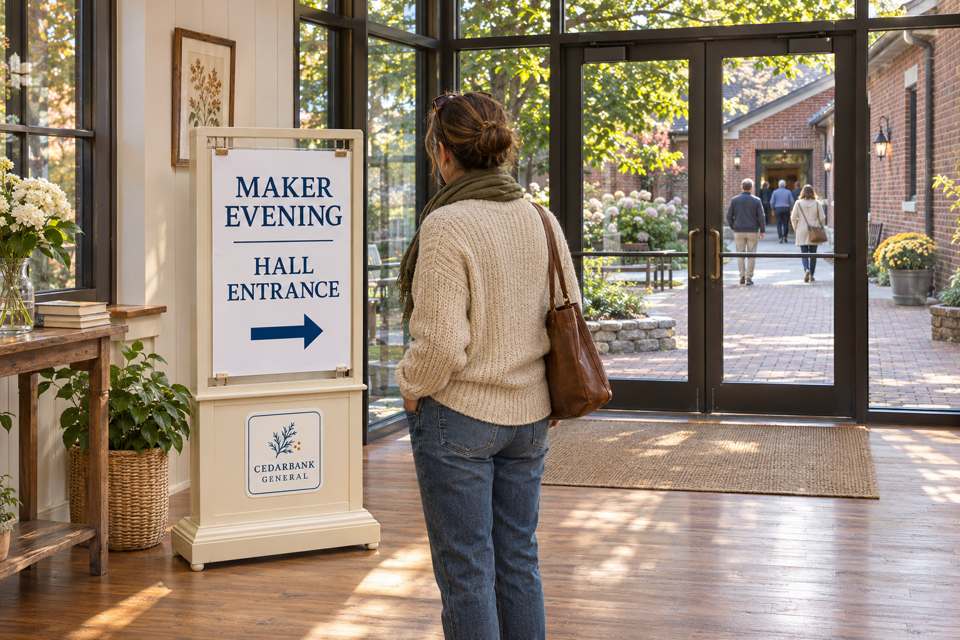
Fictional example: Riverside Makers runs a Maker Evening at Mill Court Hall on May 15, 2027. Cedarbank General has agreed to display the organizer’s information, but is not hosting the event or selling tickets. The organizer has confirmed the event and the use of the hall. The following is sample copy for that setup, not a real invitation.
Example before-visit notice
Maker Evening at Mill Court Hall
When: May 15, 2027. Entry from 5:30 p.m.; activity from 6 to 8 p.m.
Organizer: Riverside Makers.
Where to start: use the Mill Court Hall entrance across the courtyard. Event admission is handled by the organizer at the hall, not at Cedarbank General’s checkout.
Before traveling: check the organizer’s current event page for admission details, the confirmed venue address, access arrangements and any changes.
Store role: Cedarbank General is sharing the organizer’s information. Questions about event participation or admission go to Riverside Makers through its event contact route.
For a real notice, replace the descriptive event-page and contact references with the verified working destinations, and include the confirmed full venue address. Do not publish an incomplete template as visitor instructions. There is no working event link here because Riverside Makers and this event are invented.
Separate entry time from activity time. A person arriving at 5:30 needs to know whether admission has begun; a person planning to attend at 6 needs the start time. If registration is required, say where it happens and what confirmation is needed, using the organizer’s actual process. Do not invent a ticket requirement or free admission to fill a blank.
The short notice at the shop can then say “Maker Evening — Hall entrance,” with a direction checked from that precise position. Keep the fuller date, admission and contact details on the before-visit information and the organizer’s current page. The scene illustrates this division of work.
Publish a changed venue only after the change is confirmed
Suppose the fictional organizer initially proposed an outdoor courtyard activity with the hall as a possible rain alternative. Until the hall is confirmed, the shop should not print “Indoors if it rains.” The backup may be unavailable, or a different entrance and admission arrangement may apply.
While the fallback is unresolved
Planning status: outdoor location proposed; indoor alternative not confirmed.
Public wording: “The organizer will confirm any weather-related location change through its event page. Check that update before traveling.”
Store action: keep the possible hall move out of the directional artwork. Do not direct visitors toward an unconfirmed room.
After the organizer confirms the hall
Example update: “Maker Evening will take place inside Mill Court Hall on May 15. Use the hall entrance across the courtyard. Entry remains 5:30 p.m.; the activity remains 6–8 p.m. Admission questions go to Riverside Makers.”
Store action: replace the old courtyard instruction on the information page and both paper placements, then give staff the same current explanation.
The example keeps the times unchanged because that is an explicit assumption in this case. If the organizer changes them too, revise them. Keep a revision time and the organizer’s confirmation with the current proof so another employee can distinguish the update from an older draft.
If the organizer has not supplied an answer, show that status honestly and point to the current source. Do not let a permanent store logo make a provisional event plan look settled. Avoid retaining conflicting notices simply because both look professionally printed.
Count checked placements, then verify the route from each one
For the fictional indoor hall arrangement, the shop and organizer approve two paper placements: one inside the store vestibule where visitors choose a destination, and one at the hall’s event check-in. The first directs; the second confirms arrival and the admission step. Their text need not be identical.
Two placements mean two working paper copies
Store vestibule: 1 copy. Hall check-in: 1 copy. Total in use: 2 copies.
If a paper trial shows the vestibule holder should move to a different approved indoor position, moving that holder does not add a third placement. Keep two working copies unless the actual plan adds another location.
These are invented placement counts, not a turnout forecast, label-sheet yield or recommendation to print a fixed quantity for every event. An extra replacement copy is a separate choice to record.
Walk the actual route with the venue’s responsible person. Check the arrow from the visitor’s viewpoint, the visible name on the destination and how a visitor can ask for help. Confirm access arrangements through the venue; a short-looking path or an AI illustration does not prove it is suitable for every visitor.
Keep holders out of the normal shopping and entrance route under the site’s placement rules. Our guide to arrival-instruction placement checks covers the separate method of checking a cue where it is encountered. Here, the destination is an event entrance rather than a pickup counter.
Assign one store editor to the shop’s information page, paper notices and staff update, with the organizer responsible for confirming event facts. After the event, retire the dated instructions through the store’s normal approved process. Keep the record needed to understand what changed; this guide does not claim an activity has been run or measured.
Keep the store badge stable and event directions replaceable
An existing holder and ordinary replaceable paper may cover the job. Consider custom labels and stickers only if a stable store identity is useful on a suitable indoor surface. Keep the date, destination, arrow and organizer’s current instructions on the replaceable notice.
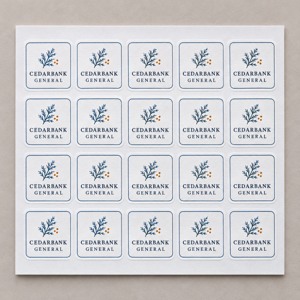
custom product labels
The current SKU decentcustom-st-000009 lists square shapes and material and finish choices. Its white-paper description is for indoor, dry use. Confirm the selected size, configuration and holder surface; the pictured sign and badge proportions are not SKU measurements.
Quantity starts at 1 ordering unit. The package wording refers to sheets without establishing finished labels per sheet. Confirm the count for the actual order. This image does not establish outdoor weather resistance, removability or an approved directional-sign system.
AI artwork concept of a fictional Cedarbank General badge, matching the holder in the scene. Pictured sheet count is illustrative. Click the small image for the actual product page.
When reviewing artwork with DecentCustom, keep the stable brand file separate from the event revision. The useful outcome to check is whether a visitor can identify the correct event destination and current next step, including when plans change.