Use the organizer's confirmed hunt schedule for an invitation. Easter Sunday, last year's announcement and a proposed planning date cannot fill the same field.

A holiday date does not establish a local hunt date
The USCCB 2027 calendar for U.S. dioceses lists Easter Sunday as March 28, 2027. That calendar establishes a religious-calendar reference within its stated scope. It does not announce a community egg hunt, reserve a venue or tell families when a particular hunt begins.
Local schedules can differ even within one city's program. Seattle Parks' March 31, 2026 spring egg-hunt announcement listed Miller on April 2 at 10:30 a.m., Ravenna-Eckstein on April 4 at 11 a.m. and Yesler on April 4 at 10:30 a.m. These are archived 2026 examples, not 2027 visitor instructions. Their practical lesson is that a shared seasonal theme does not create a shared date or start time.
As of this article's November 13, 2026 review, we have not verified a 2027 local hunt announcement for those locations. A planning guide can still be useful now, but it must not pretend that a future local event has been confirmed.
Keep a date-and-source record beside the artwork
| Field | Acceptable basis | Do not substitute |
|---|---|---|
| Event year and local date | Current organizer-confirmed announcement or event record | Easter Sunday or a previous year's date |
| Arrival and hunt start | The organizer's distinct instructions, if they differ | Office hours or a guessed early-arrival interval |
| Venue and meeting point | The confirmed site and approved visitor directions | A nearby sponsor's address |
| Participation details | Current event-specific registration, age or admission information | Conditions copied from another center |
| Proof revision | Version tied to the confirmed details and approving editor | The date a designer happened to save a file |
The record should identify the source, the person responsible for checking it and when it was checked. A blank field remains unresolved. Do not fill it with a plausible answer merely to make the postcard look finished.
Keep the organizer separate from any shop displaying the invitation. A participating retailer may share approved information without being the registration desk or controlling a weather-related change. Our guide to community event venue information covers that distinct destination-and-role problem.
Resolve the old year before approving the new proof
Fictional production example: Meadow Hunt's editor finds last year's date in a draft invitation. The new local schedule is still awaiting confirmation. The editor holds the dated proof rather than replacing its year and assuming the weekday, start time and venue remain correct.
Later in this example, the organizer confirms a new event date, arrival instructions and hunt start through its own record. The editor replaces the old fields, checks the day of the week against the confirmed date and verifies every repeated date on both sides of the artwork. A second reviewer compares the revised proof with that same source and approves the corrected version. The obsolete draft is clearly marked as superseded in the team's normal version process.
The editor then gives the current version to both the distribution coordinator and the person maintaining the event information page. The example ends with consistent, reviewed information ready for a separate ordering decision. It does not establish that an actual event, print order or delivery has occurred.
What to say while the local details are unresolved
Internal planning note: Local hunt date and participation details are awaiting organizer confirmation. Dated invitation artwork is on hold. The editor will update the proof from the confirmed event record before approval.
That is a useful internal instruction, not a public invitation template to publish with missing fields. If the organizer chooses to share a public planning update, use its approved wording and working update destination. Do not attach a prominent Easter date that could be mistaken for the hunt date.
Once details are confirmed, make a separate materials schedule for proof approval, the actual production estimate, shipping and distribution. Those durations are not known in this guide. Do not invent a fixed “order by” date or assume that approval today guarantees delivery before the event.
Choose a postcard after the message is stable
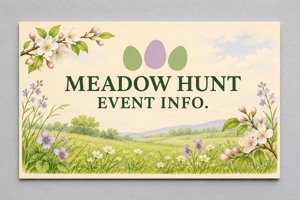
A paper event-information option
These custom postcards for egg hunt information list a 4 × 6-inch format, default 16pt paper and ordering increments of 50. An increment alone does not establish a minimum order. Confirm the selected configuration and actual required copies.
Compare custom postcards for event invitations or discuss the approved artwork with DecentCustom. The AI card concept deliberately has no event date, time or admission promise.
An approved digital announcement or replaceable paper notice may be enough, especially while details are changing. Seasonal artwork can be prepared early; factual approval and a credible delivery plan still have to happen before a dated print order.
Sources checked November 13, 2026: USCCB's 2027 calendar, Seattle Parks' explicitly archived 2026 announcement and the linked product page. Local 2027 event details require separate confirmation. Meadow Hunt and the completed proof-review example are fictional; no turnout, search ranking or production outcome is claimed.