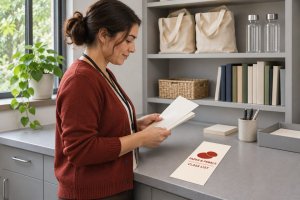
A spring handout should help gardeners identify their next step. Keep indoor sowing, moving plants outside and the store’s own opening or pickup dates in separate fields.
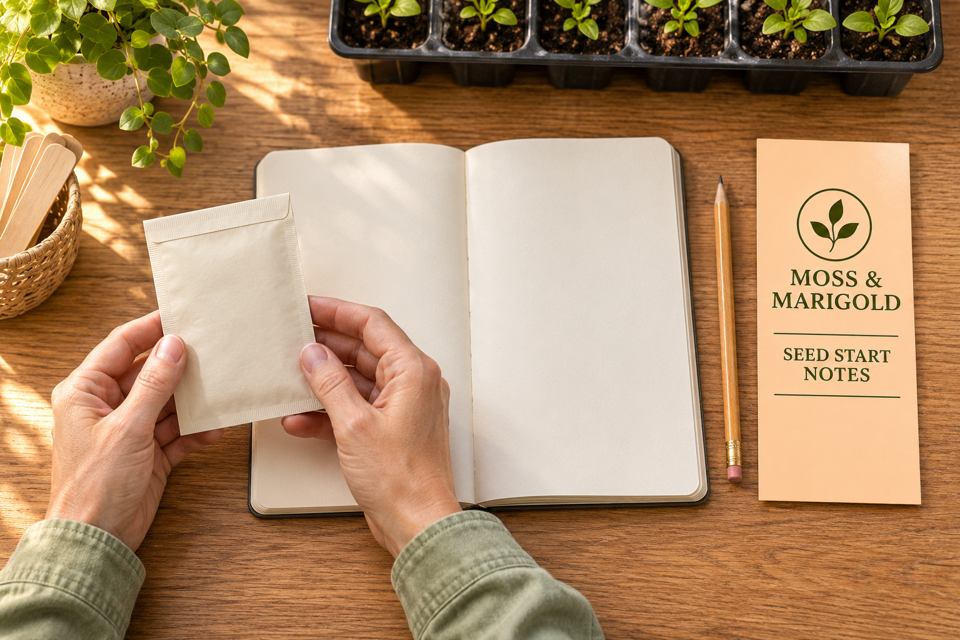
Name the action beside every date
“Ready for spring” does not tell a customer whether to sow indoors, move a plant outside or collect a retail order. Give each action its own label, and leave an unknown date unresolved until the right source supplies it.
| Date field | Source to check | What it does not establish |
|---|---|---|
| Indoor sowing | The actual seed packet and suitable local growing guidance | That the plant can already go outside |
| Outdoor planting or transplant target | Locally applicable guidance, the plant’s requirements and current conditions | A guaranteed frost-free day |
| Store availability or collection | The store’s current product or order information | The correct planting date for every customer’s location |
Keep regional instructions attached to their region
University of Minnesota Extension’s seed-starting guide, reviewed in 2026, directs readers to seed-packet or catalog instructions and gives a Minnesota calendar with different indoor periods for different plants. It also treats the transition outdoors as a separate step. That supports separating the actions; it does not supply a national planting calendar.
Before printing a date, record the named plant or packet, the intended locality, the applicable source and when it was checked. If the source is for a different region or a different plant, find the appropriate guidance instead of relabelling the date. Keep the original packet’s instructions available to the reader rather than replacing them with a generic spring slogan.
Count backward only after choosing a suitable target
Fictional arithmetic example: suppose a planning exercise uses May 15, 2027 as its outdoor target. An imaginary packet A says to start indoors eight weeks beforehand, while imaginary packet B says four weeks beforehand. Neither packet represents a named crop.
| Imaginary packet | Calculation | Example indoor date |
|---|---|---|
| A: eight weeks before the target | 8 × 7 = 56 days; May 15 minus 56 days | March 20, 2027 |
| B: four weeks before the target | 4 × 7 = 28 days; May 15 minus 28 days | April 17, 2027 |
The arithmetic explains why one indoor start date cannot serve both example packets. May 15 is an assumed teaching input, not a local frost forecast or a recommendation to plant outside that day. An actual plan needs the relevant plant instructions and local assessment before this calculation is useful.
To complete the example, the editor gives the two packets separate indoor dates and labels May 15 as the assumed outdoor target. They also place the store’s independently confirmed collection date in a retail-information field. If the outdoor target is still unknown in the real handout, the editor leaves that date pending and supplies the current local guidance route. They do not use the collection date to fill the gap.
Read the finished message as a first-time gardener
Check one entry from end to end: can the reader identify the plant, locality, action, source and relevant date without guessing? Does an indoor date remain labelled indoors? Can the reader find the original instructions and see which retail details may change? Correct a missing field before approving that entry.
For changing conditions or availability, give a current digital information route. A printed seasonal guide cannot update itself. Assign someone to review the active information and identify an old version clearly when its replacement is issued.
Use paper for a stable information route
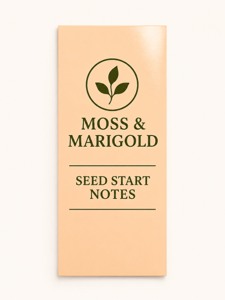
A dry-counter gardening information card
These custom rack cards for gardening information are listed at 3.74 × 8.27 inches, with 14pt standard paper and glossy finish as defaults. The current minimum allowed quantity is 50. The image shows an AI artwork concept.
Compare custom rack cards if a stable garden-center identity and information route would be useful. Prepare the actual approved artwork with DecentCustom. This paper handout is not a waterproof plant tag, seed container or guarantee of a growing result.
The original seed packet, an existing local guide or a digital note may already do the job. Order a new handout only when it adds useful information at its intended dry location; keep crop-specific instructions and changing dates tied to their actual sources.
Checked November 13, 2026: the linked university guide and current DecentCustom listing. The regional-source method and fictional arithmetic demonstrate editing decisions. No actual planting trial, frost prediction, customer study or business outcome was measured.