Start with the fully packed order and its handoff. A printed outer bag can identify the shop; its logo does not establish fit, food protection or shipping suitability.
Define the job before choosing a printed bag
A shop handing over a small, already packed purchase has a different requirement from a shop dispatching a parcel or preparing a large board for collection. Start by naming that route and the complete pack that needs to travel through it.
The printed outer layer can carry the shop’s identity and a short message. The existing product packaging still has its own job. Keep the original protective packaging and product information; do not replace them with a general paper bag because it looks attractive in a photograph.
- Small local handoff: assess an outer bag only around the suitably packaged item and the actual carrying requirements.
- Board collection: assess the complete board or tray package, not an individual wrapped item used in a promotional scene.
- Parcel dispatch: retain the appropriate shipping arrangement. A retail outer bag is not a protective shipping carton.
Keep pickup and staffed-event routes distinct when defining that handoff. Add gift-message and contents documents without treating them as protective packaging. Maintain subscription and shipping instructions separately from the physical bag specification.
Use dimensions to reject a poor candidate, not to certify a fit
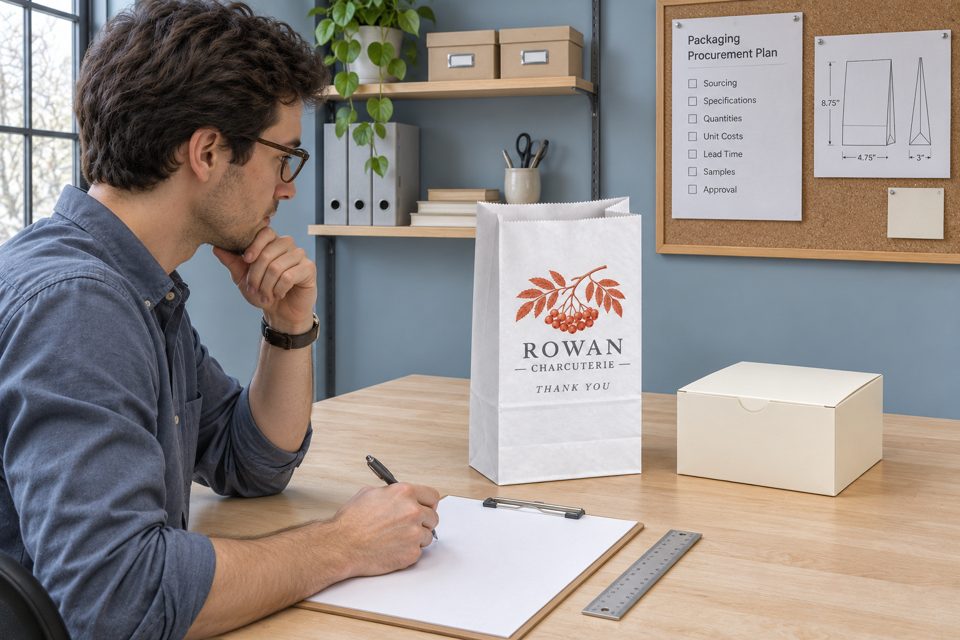
The checked white paper bag lists 4.75 inches wide, 8.75 inches high and a 3-inch third dimension. These are listed bag dimensions, not a measured usable interior. Seams, folds, the opening and the actual pack shape still matter.
The two examples below are fictional dimensional screens. Neither box has been physically tested in this bag. Both assume a rigid rectangular box must stay flat, with its base aligned to the bag’s nominal width and depth. They do not establish weight capacity or food suitability.
| Illustrative packed box | Nominal comparison | Decision at this stage |
|---|---|---|
| A: 4 × 2 × 5 inches | 4.75 − 4 = 0.75 inch across the listed width; 3 − 2 = 1 inch across the listed depth. | Not ruled out by these two nominal comparisons. Actual interior, opening, height, closure and carrying checks remain. |
| B: 5.25 × 3.5 × 4 inches | 5.25 − 4.75 = 0.5 inch wider; 3.5 − 3 = 0.5 inch deeper than the listed dimensions. | Reject this aligned flat-base candidate at the screen. Do not approve it by squeezing, tilting or removing the original box. |
Box A’s numerical differences are not usable clearance measurements. Its 5-inch height is below the listed 8.75-inch bag height, but that does not establish room to insert it or fold the top closed. Measure the complete intended pack, including cards and any other components, and inspect the actual bag before approving the combination.
If the pack needs its present orientation or protective structure, choose an outer format around that requirement. Changing the pack to make a small bag look suitable is a different decision and needs its own review.
A complete hold-before-purchase brief
Fictional example R404: the shop wants a branded outer layer for one defined local handoff. It has not yet confirmed usable stock, actual bag fit or the quantity needed. The right output is a clear decision record, not a premature order.
R404 · Rowan Charcuterie outer-bag review
- Purpose: identify the shop on an optional outer bag for a suitably packaged small purchase collected locally.
- Keep: the existing product protection and original product information. No change to the shipping arrangement is proposed.
- Candidate: handle-free white unlined paper bag, listed 4.75 × 8.75 × 3 inches; one-sided shop artwork.
- Initial size decision: box A requires actual fit review; box B is rejected for the stated aligned flat-base arrangement.
- Still needed: complete pack measurements, actual bag and closure review, carrying suitability for this use, existing stock count and a justified quantity.
- Commercial check: minimum 200 bags; compare the full selected order total and storage requirement. A case pack of 500 does not require ordering 500.
- Current decision: hold custom purchase. Continue the current appropriate handoff arrangement until the candidate and need are verified.
A completed brief can legitimately say “hold.” It also tells the buyer what would change that decision. For example, verified fit alone would not resolve an unknown quantity or an unsuitable carrying requirement. Conversely, a low unit price cannot make an oversized board fit a small bag.
Do not turn the minimum order into a demand forecast. If the shop cannot establish when it would use 200 bags, retain its existing materials while it gathers its own order and stock information. Plain bags with appropriate approved branding may also remain a reasonable option.
Check the actual white paper bag specification
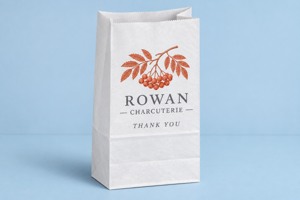
A conditional outer-layer candidate
The fictional Rowan design links directly to the checked small white paper outer bags. The current page specifies unlined white paper, a serrated top and bottom gussets, with a minimum order of 200 bags.
One-sided full-color printing is included; front and back imprint areas are each listed as 4.5 × 8.29 inches. Two listed imprint areas do not mean both sides are included in the same price. Compare other custom paper bags if this format does not match the complete pack.
The bag has no laminated poly liner and is described for dry contents. Do not infer grease, moisture, temperature, food-contact or load performance from the white-paper appearance or logo. The illustration shows no handles, no protective liner and no contents fitted inside it.
Review the selected artwork clear of folds and confirm the actual options and final total. The design preview helps assess spelling and placement; it does not prove printed color, physical fit or delivery timing. Keep changing offers, dispatch dates and order-specific instructions off a bulk bag unless the shop has a deliberate way to maintain them.
Questions that prevent the wrong purchase
Does a sealed product automatically make this outer bag suitable?
No. The full pack, its condition and the actual handoff still need review. Existing inner packaging does not supply missing evidence about the bag’s fit or carrying performance.
Is the 500-bag case pack the minimum?
No. The checked page lists a 200-bag minimum. The case pack describes carton packing; the order contains the number of bags purchased.
Can the scene image show whether a board will fit?
No. Use the actual complete board package and actual bag measurements. The AI image is a design illustration, not a dimensional test.
Take a defined pack to the product decision
Before requesting a branded option from DecentCustom, document the service route, complete pack, actual suitability checks and quantity needed. Keep the current appropriate arrangement if those answers are missing. Approve the physical use first, then the artwork and order.
Research and limitations
Reviewed November 8, 2026. The industry research distinguishes retail gifts, board collection and event services; see the operator’s catering information for one pickup-service example. Bag specifications come from the linked current DecentCustom product page. R404, the two boxes and Rowan imagery are fictional planning examples. No physical fit, food-contact, carrying, refrigeration or shipping performance was tested.