Give the recipient a recognizable sender, a personal message and a clear contents list. Keep purchase prices and buyer records separate, and leave the original product information intact.
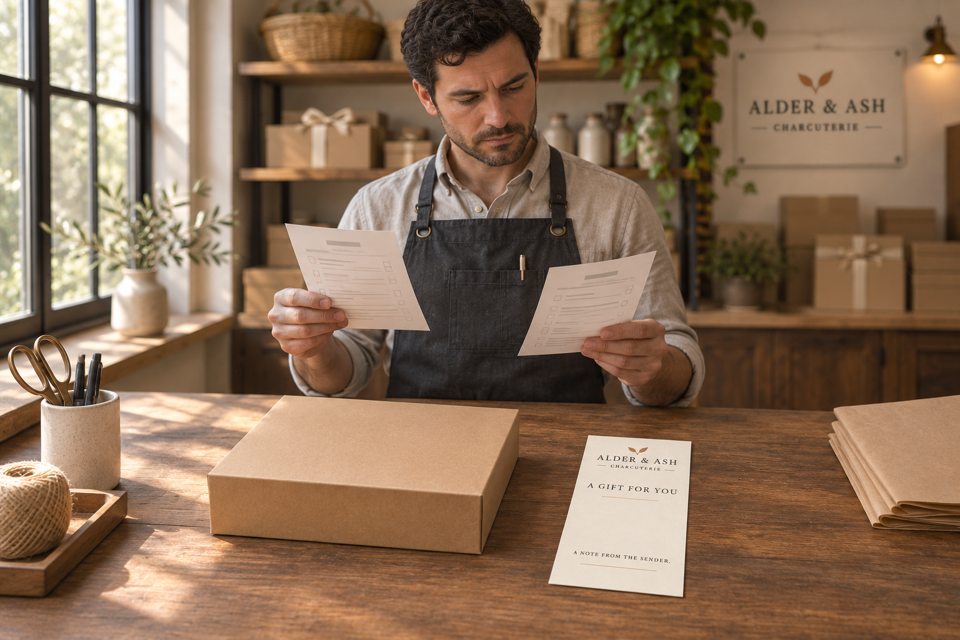
One gift order needs three different information jobs
A gift buyer may want Ana to know who sent the food without seeing its price. A packer needs to match the right note to the right order. The buyer still needs a purchase record. Putting all three jobs on one sheet makes the separation harder.
| Document | Who receives it | What belongs there |
|---|---|---|
| Personal gift note | Recipient | Recipient name, buyer-approved message and recognizable sender name. |
| Price-free contents list | Recipient, with the gift | Order reference and the actual item names and quantities packed, without prices or billing details. |
| Receipt or buyer record | Buyer through the shop’s normal private order channel | The purchase and payment details needed for the buyer’s records. |
Removing prices from the recipient’s list does not mean removing the original product labels, ingredient information or supplied storage directions. Keep those with the products. A decorative thank-you card cannot replace them.
As a specific shop example, Olympia Provisions says its checkout gift message is included with the order and its packing slip omits prices and billing information. That illustrates a useful separation; it does not establish every charcuterie shop’s current checkout capabilities.
A complete example: G101, from Riley to Ana
This is a fictional training example. The names, reference and contents below are invented to show the documents, not an actual sale or available gift assortment.
1. The recipient’s personal message
For Ana · Gift reference G101
“Ana, thank you for hosting the neighborhood dinner. I hope you enjoy this gift. With thanks, Riley.”
The final “Riley” matters: the shop’s logo identifies the retailer, while the sign-off identifies the person giving the gift. Before checkout is completed, let the buyer review the actual message, including names and punctuation. If the buyer leaves the message empty, use an agreed blank-message procedure rather than inventing a personal sentiment or sender.
2. The recipient’s price-free contents list
Gift reference G101 · For Ana
- Sealed charcuterie pack, item A — 1 package
- Sealed charcuterie pack, item B — 1 package
- Sealed pickles jar, item C — 1 jar
Total in this example: 3 individual packages. Keep the original product information with each item. This list describes the contents; it makes no serving-size, handling or delivery promise.
In a real order, replace “item A,” “item B” and “item C” with the exact ordered product names. Three packages here means two packs plus one jar. It does not mean three shipping cartons or three servings. Avoid a generic “assorted charcuterie” line when staff and recipients need to distinguish the items.
3. The buyer-only record
G101 · Buyer: Riley · Gift recipient: Ana
Recipient documents: approved gift note and price-free contents list. Buyer receipt: sent through the shop’s existing private order channel. Do not place that receipt in Ana’s gift box.
The recipient versions do not need Riley’s billing address, telephone number, email address or purchase amount. The shop’s private order system can retain information it needs without repeating it on a decorative insert.
Match the message to the packed order before sealing
Use the same order reference on the packing task and recipient papers, then compare the recipient name, approved message version and actual contents. This is a proposed working method, not a claim about any particular shop’s existing process or error rate.
- Read the approved record. Take the final message from the order record rather than copying it from a separate, unconfirmed email.
- Match the pair. For G101, both the note and contents list must refer to Ana. A note for another recipient is a reason to pause the handoff.
- Resolve a mismatch. If the printout says “Anna” but the approved order says “Ana,” confirm which record is authoritative, correct the draft and produce the matching recipient papers. Keep the buyer receipt separate.
- Check the actual placement. Decide where the recipient papers belong within the shop’s packing plan without covering product information or changing protective packaging.
If a buyer requests a change after checkout, staff should verify whether the shop can still accept it. Do not promise a late change merely because a note can be reprinted. If the order is already packed or dispatched, the appropriate response may be a separate message through an agreed channel.
A gift note also cannot resolve an unsuitable receiving date or an unattended destination. Work through gift-recipient delivery questions separately. A shipping date, recipient availability and the wording of a card are distinct decisions.
Use custom printing for stable information, not every personal note
If the existing checkout already produces a clear personal note and price-free packing list, start there. A new branded insert is optional. It is most useful when it has a stable job: identify the shop, introduce the gift and leave space for a separately produced sender message.
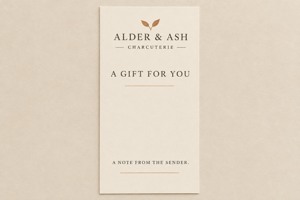
An optional flat branded insert
The pictured card is AI-created artwork for fictional Alder & Ash Charcuterie. The image links directly to DecentCustom’s custom rack cards, a flat 3.74 × 8.27-inch format. No holder is shown or included in this concept.
The product page showed a minimum of 50 when checked. That may suit a reusable shop introduction; it does not justify printing 50 copies of Ana’s personal message. Compare rack card formats only after identifying a repeatable information need.
Confirm the selected stock, finish, artwork proof, actual pack space and method for attaching or adding the variable note. Do not assume a finish will accept handwriting, or that variable messages are part of the printing service. This concept is for dry information paper; it carries no food-contact, refrigeration, moisture-resistance or protective-packaging claim.
A practical no-purchase outcome: retain the existing order-generated message and contents list, improve the sender sign-off, and stop there if recipients already receive clear information.
Questions to settle before the next gift order
Should the gift card include a price?
If the intended gift experience is price-free, keep purchase amounts on the buyer’s receipt and leave them off recipient papers. Check the actual templates rather than assuming a “gift” checkbox changes every document.
Can one branded card replace the packing list?
Only if it actually carries the accurate order-specific contents the recipient needs. A fixed “A gift for you” design alone does not identify what was packed.
Is a board pickup or staffed event the same workflow?
No. A recipient message for a shipped gift does not define pickup handoff, event staffing or a service booking. Ask which order type is being handled before adapting the paperwork.
Prepare a useful insert brief
Before comparing products at DecentCustom, write down the stable message, variable order fields, actual available space and confirmed quantity needed. If ordinary order papers already do the job, keep them. If a branded insert has a separate purpose, approve its content and proof before ordering.
Research notes and sources
Reviewed November 8, 2026. The Olympia Provisions FAQ supplies the narrow gift-message and price-free-slip example. Its catering information and restaurant and event information describe different service routes. These pages belong to one operator, not an industry-wide survey. The G101 documents, workflow suggestions and Alder & Ash imagery are original illustrative material, not that operator’s forms or endorsements.