A board collected at the counter and a team serving guests at a venue are different commitments. Identify the service first, then confirm the date, handoff and responsibilities.
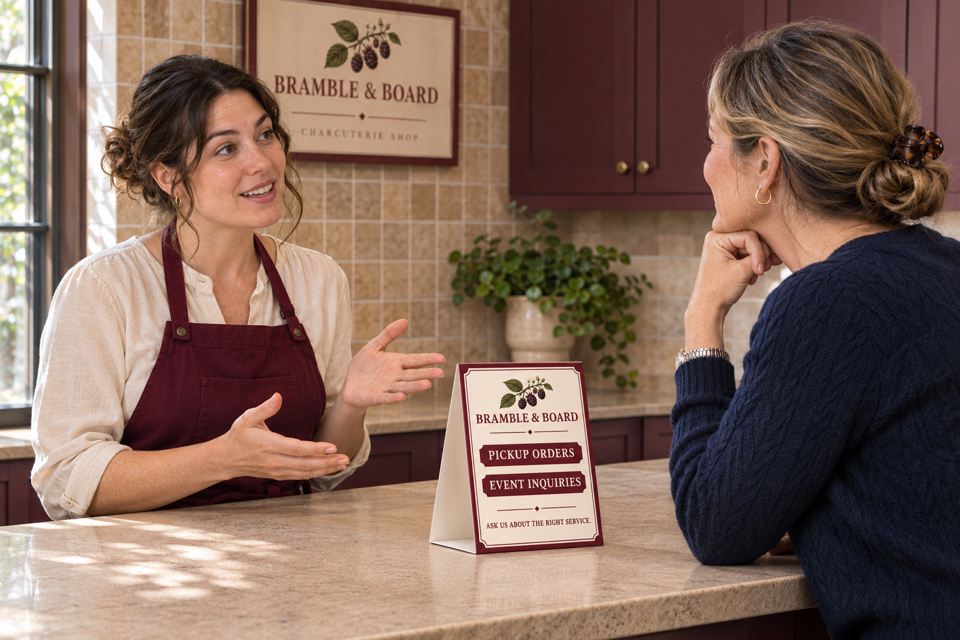
Ask what the customer expects to happen at the event
“I need charcuterie for a party” does not tell the shop whether the customer will collect prepared boards, needs a delivery, or expects people to set up and serve. Start with a concrete question: “Will someone collect the order, or are you asking us to provide service at your venue?”
Then establish what “service” means. Dropping off food, arranging a display, staying to serve, supplying equipment and clearing away are separate responsibilities. An event inquiry should identify which are requested before anyone implies that they are included.
| Route | Main question | What remains to confirm |
|---|---|---|
| Board pickup | Who collects which prepared order, from which location? | Actual items, quantity, accepted pickup date and window, collector and handoff instructions. |
| Delivery request | Does the shop offer delivery for this order and destination? | Availability, destination, handoff, charges and what the service includes. Do not assume setup or staffing. |
| Staffed event inquiry | What work is requested at the venue, and when? | Venue, guest count, menu discussion, access, staffing scope, equipment and the shop’s acceptance process. |
A shipped retail gift is another route. Its gift-message and packing information does not define event staffing or collection arrangements.
Two requests that should receive different replies
Both examples are fictional. The dates, names and quantities illustrate information to resolve. They are not available menus, real orders or accepted reservations.
P202: a prepared-board pickup request
Customer request: “I’m Morgan. I want two boards for a gathering on December 12, 2026. I can collect them at the downtown shop around 3 p.m. I do not need staff at the gathering.”
Intake record: Route: pickup. Requested collection: December 12, around 3 p.m., downtown location. Quantity: two boards, exact menu and sizes not selected. Collector: Morgan. Status: inquiry received; pickup window and order not confirmed.
Useful reply: “This is a pickup request. Please choose the boards and sizes you want so we can check the order and your requested collection time at the downtown location. Your message has not yet reserved the order or pickup slot. We will confirm the accepted order and handoff details through our normal ordering process.”
Two boards is an item count, not a guest-count or portion guarantee. Ask the shop’s menu team to discuss suitability rather than deriving servings from a decorative photo. The shop also needs an exact collection location: a restaurant, production site and retail counter may have different functions.
E202: a staffed office-event inquiry
Customer request: “I’m Jordan. We are planning an office reception for 30 guests on December 15, 2026, from 5 to 7 p.m. We want a charcuterie display and someone to set it up and remain during the reception. The office is on the fourth floor.”
Intake record: Route: staffed off-site event inquiry. Requested guest count: 30. Requested service: setup plus on-site presence during the reception. Venue access: fourth floor; lift, loading arrangements and access times unknown. Menu, staffing availability, equipment and price: not confirmed. Status: event inquiry received; no service booked.
Useful reply: “Thank you. This needs an event-service review rather than a board-pickup order. Please provide the venue location, the access and setup times, any lift or loading restrictions, and what you expect our on-site role to include. Our event team must review the date, menu and service scope before it can confirm availability or a proposal.”
The 30 guests describe the request. They do not establish a staffing ratio, menu quantity or accepted capacity. The event’s 5–7 p.m. reception window also does not include an assumed setup or clearance allowance; those times need a separate discussion.
Make an acknowledgment visibly different from a booking
A useful acknowledgment says what was received, what route it follows, what information is missing and who will respond. It should avoid “all set,” “reserved” or “we’ll be there” while the shop is still checking the request.
For an accepted order or event, send a separate confirmation through the shop’s established process. It should state the agreed service, location, date and times, items or menu, responsibilities and applicable commercial terms. Do not invent a universal deposit amount, cancellation rule or response deadline; use the actual shop’s terms.
Example of an unresolved change: Morgan later asks, “Can someone bring the boards and stay to arrange them?” Keep the original pickup request visible, identify the requested change, and send it for service review. The pickup confirmation alone does not approve delivery, setup or staff attendance.
A donation inquiry should likewise remain distinct from a paid order or event booking. A shop’s willingness to consider requests does not establish approval, a recipient list, a budget or permission to advertise an association.
A small counter card can point to the right conversation
If customers already reach the correct service through the website and staff explanation, keep that arrangement. Where a physical prompt is useful, use stable wording rather than printing temporary availability.
Reusable route wording
Pickup orders: tell us what you want to collect, which location and your requested date.
Event inquiries: tell us the venue, date, guest count and requested service.
Next step: ask staff which ordering or inquiry route applies. A request is not a confirmed booking.
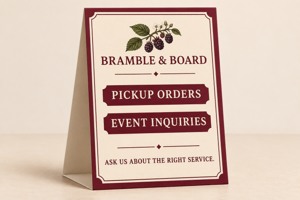
Optional paper table tent
The fictional Bramble & Board image links directly to custom table tents. The checked product is a 5 × 7-inch, 14pt paper format, with matte and gloss options and a displayed minimum quantity of 25.
Compare table tent formats if the shop needs a stable dry-counter prompt. One counter position alone does not justify a minimum-order purchase: an existing reusable sign or ordinary printed card may be sufficient.
Check the actual viewing distance, available counter space, folded proof and staff permission for the placement. The image shows a paper concept, not an acrylic holder or a claim about cleaning, outdoor exposure or food-contact suitability. Keep changeable dates, capacity, prices and contact details in the shop’s maintained service information.
Common service-routing questions
Does “catering” always mean staff attend?
No. The term alone does not specify collection, delivery, setup or attendance. Ask what the particular offer includes and what the customer is requesting.
Can a food-order notice period set the printing deadline?
No. Food preparation and printed-material production are separate schedules. Check the selected supplier and actual requirement rather than borrowing a shop’s food-order rule.
What if different parts of a service page suggest different delivery arrangements?
Ask the operator to clarify the relevant order type. Do not treat an ambiguous marketing phrase as a promise that every board order includes delivery or service.
Define the service before designing the sign
Write down which routes the shop actually offers, the question that separates them, and where the current instructions are maintained. If new counter information is warranted, bring that brief to DecentCustom. The useful outcome is a clearer service decision; extra print is optional.
Research and limitations
Reviewed November 8, 2026. Olympia Provisions’ catering page describes a pickup-only route, while its restaurant and event page separately invites event inquiries. These are one operator’s descriptions, not evidence that every charcuterie shop offers the same services. The request records, reply wording and artwork here are original fictional examples; they do not confirm availability, a booking or a business outcome.