A planting-day count records an activity. A later check records what was found. Keep the original group, review date and missing checks visible before turning either count into a success claim.
“Planted” and “confirmed alive later” answer different questions
A useful tree-planting update names the original planting group, the planting date, the later review date, how many trees were checked and what was found. Keep unassessed trees visible rather than silently counting them as alive or dead. Buying, donating or distributing seedlings is also different from confirming that they were planted.
For a shop or community group supporting a Forests Day activity, this distinction makes the follow-up more informative than a planting-day photograph alone. It does not require the host to claim expertise in forest assessment.
Wisconsin DNR’s guidance on caring for planted trees treats monitoring as work after planting and describes survival counts using live and dead trees. Its plantation sampling methods serve a different purpose from the small fictional register below; do not present this example as a substitute for a professional survey.
Keep a stable identity for each original record so a later visit can refer to the same tree. Record the actual site and project owner’s agreed method, review date, reviewer and condition categories. Where condition cannot be established, mark it unresolved and ask the responsible project lead what further check is needed. Do not diagnose a tree from an unclear photograph merely to finish a spreadsheet.
If a tree’s identity is uncertain, record features of a tree before naming it. A species guess and a survival count are different kinds of information; neither should silently supply the missing evidence for the other.
Worked example: 82 confirmed alive is not the same as checking all 100
Second Look is an invented community project. All dates and counts here are fictional. Its original register records 100 trees planted on March 21, 2027. At a September 21 review, the project records:
| Record category | Count | Meaning at this review |
|---|---|---|
| Original planting group | 100 | The fixed starting group |
| Checked | 90 | 82 alive and 8 dead recorded |
| Not checked | 10 | Condition remains unknown |
The counts reconcile: 82 + 8 = 90 checked; 90 + 10 = 100 original records. The ten unassessed records have not disappeared. This example assumes that the checked trees were matched to the original register and their condition was established by the project’s agreed review method.
If the group reports a percentage, it must say which group it describes. 82 ÷ 90 × 100 = 91.1%, rounded to one decimal place, among the trees checked. That is a descriptive figure for those ninety records. It does not establish a 91.1% survival rate for all one hundred trees. The unchecked trees might differ from those that were easy to revisit.
For a short public update, the counts may be clearer than a percentage: “82 confirmed alive, 8 recorded dead and 10 not yet checked.” An unknown condition is not a zero, a positive result or permission to extrapolate from a convenient group.
Keep the review interval beside the figures. A check after a few weeks and one after several growing seasons answer different questions. Do not compare their percentages as though the observation periods and methods were identical.
Use a dated paragraph that includes the unresolved work
Here is a complete update based only on the fictional example:
Second Look practice update — September 21, 2027
Our fictional March 21 planting register contains 100 trees. At this review, 90 original records were checked: 82 were confirmed alive and 8 recorded dead. Ten original records remain unassessed, so their condition is unknown. These figures describe the review to date, not a verified result for the whole group.
The next step is to agree access and a follow-up check for the ten unresolved records with the project lead. Any replacements will be recorded as a separate planting group. No completed forest-restoration, carbon or biodiversity result is established by these counts.
For a real project, replace the invented details with verified records and the actual next action, responsible person and timing. If a visit is not arranged, say that it is pending instead of publishing an appointment that does not exist. Keep the record that supports the public wording.
Record replacements separately. Suppose five new trees are later planted to replace losses. Record their planting date and link them to the relevant original records. Do not add five to the original planting count and announce “105 surviving trees.” The new cohort has its own age and follow-up history. If the original group is reviewed again, report its updated result without erasing what the earlier visit found.
The FAO forest-restoration module explains that tree planting is not the end of restoration and that monitoring and maintenance belong in the plan. A planted-tree count alone does not establish that a forest has recovered. The project’s objectives, site and longer-term evidence determine what can responsibly be reported.
This article organizes a small public update. It does not prescribe a forest sampling design, determine why a tree died or recommend a treatment. Those questions belong with the actual land manager and appropriate specialists.
A printed reminder can point people toward the next update

An existing digital notice or plain handout may meet the need. If a recurring project uses print, the linked custom postcards for a planting-project follow-up reminder include a 6 × 4 inch format, 16pt stock and a default glossy front. The listing uses ordering increments of 50; that is a print-order condition, not a tree count.
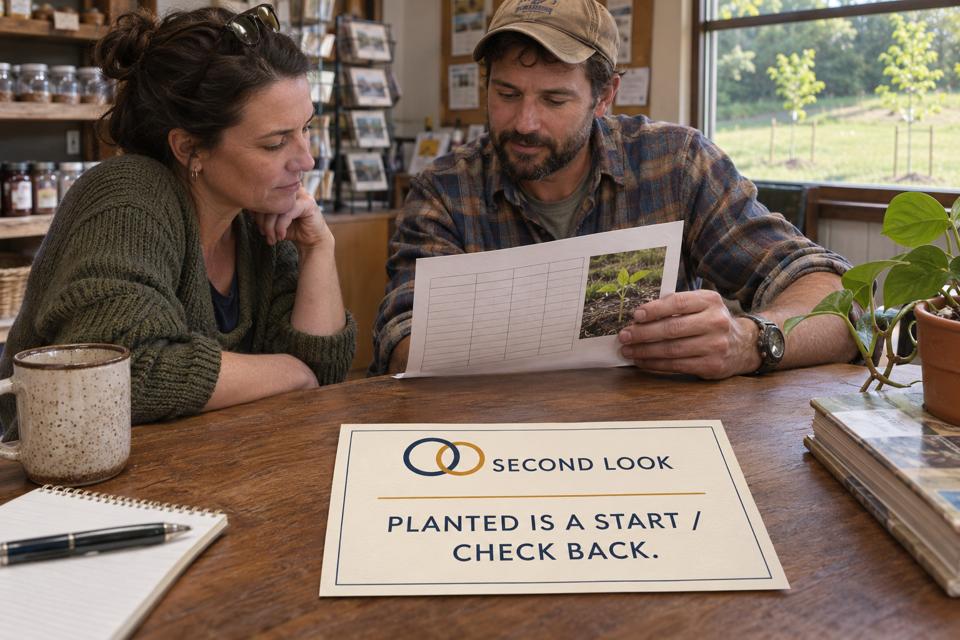
The fictional Second Look card says “Planted Is a Start / Check Back.” It is an AI artwork concept, not a monitoring tool or certification. Compare custom postcards for other community messages, and confirm the selected configuration and artwork with DecentCustom.