An announced plant sale is not a complete pickup instruction. Identify what is confirmed, what remains tentative and how an order holder will receive the final collection details.
Keep ordering, planning and collecting in different fields
Before a spring plant sale, an organizer may know the ordering period while still arranging the collection site. That is useful planning information when labelled accurately. It becomes misleading if a tentative date is presented as a final arrival instruction, or an office address is copied into a pickup field without confirmation.
| Stage | What the message can establish | What still needs its own confirmation |
|---|---|---|
| Sale announcement | The organizer’s stated ordering opportunity and current information route | Whether a particular order is accepted or ready |
| Tentative collection plan | A provisional date or range, clearly marked as tentative | The final place, time and any order-specific arrangements |
| Final collection instructions | The organizer’s confirmed instructions for the relevant order or group | Any later change communicated through the organizer’s current route |
A public announcement, an order confirmation and a pickup message can be separate records. Read the relevant one before telling a customer where to go. Do not turn an empty location field into a guess simply because a printed sheet would look more complete.
Preserve the uncertainty in the original notice
The University of Minnesota Extension’s 2027 Chisago County Master Gardener plant-sale notice, dated October 27, 2026, lists May 7 and 8, 2027 as tentative plant handout dates. It leaves the location to be determined and says a later postcard or email will confirm the location and pickup times. The same notice provides a mailing address for orders. That does not identify the collection site.
This is one organizer’s published example, not a pickup policy for every sale. Its value here is the clear separation between a preliminary plan and later confirmation. Before preparing your own message, check the current year, the relevant order record and which details your organizer has actually approved. Preserve words such as “tentative” when summarizing them.
Correct the missing field before approving the message
Fictional editing example: a garden club has an approved order acknowledgement, a provisional Saturday collection plan and no confirmed collection address. A volunteer drafts “Collect Saturday at our office,” using the return address from the order form. The draft supplies a place that the organizer has not approved.
The editor checks the actual planning record and removes the office address. The revised acknowledgement separates the accepted order from the provisional collection plan: “Order acknowledged. Collection is tentatively planned for Saturday; location and collection time remain unconfirmed. Follow the organizer’s final collection message before travelling.” The editor uses this wording only after the organizer approves it for the fictional example.
The completed correction leaves the unknown fields unresolved instead of inventing them. Once the organizer approves a site and time, the designated coordinator updates the collection message through the existing order communication route. If the plan changes again, they issue the actual revised details and identify the earlier version as superseded. None of these example statements confirms a real order or appointment.
Check the message as someone about to leave home
Can the reader distinguish a provisional plan from a confirmed instruction? Can they identify the correct organizer, year, order and communication route? Does an office, payment or return address appear in a pickup field without evidence? Resolve those questions against the organizer’s record before distributing the message.
Keep individual order details in the existing order communication, rather than putting customer names or order numbers on a general promotional card. A public information route may explain where updates appear, but it should not imply that every visitor has an accepted order. Collection timing also does not establish a suitable planting date; that is a separate gardening decision.
Give stable information a format that fits its role

A dry-counter collection-information card
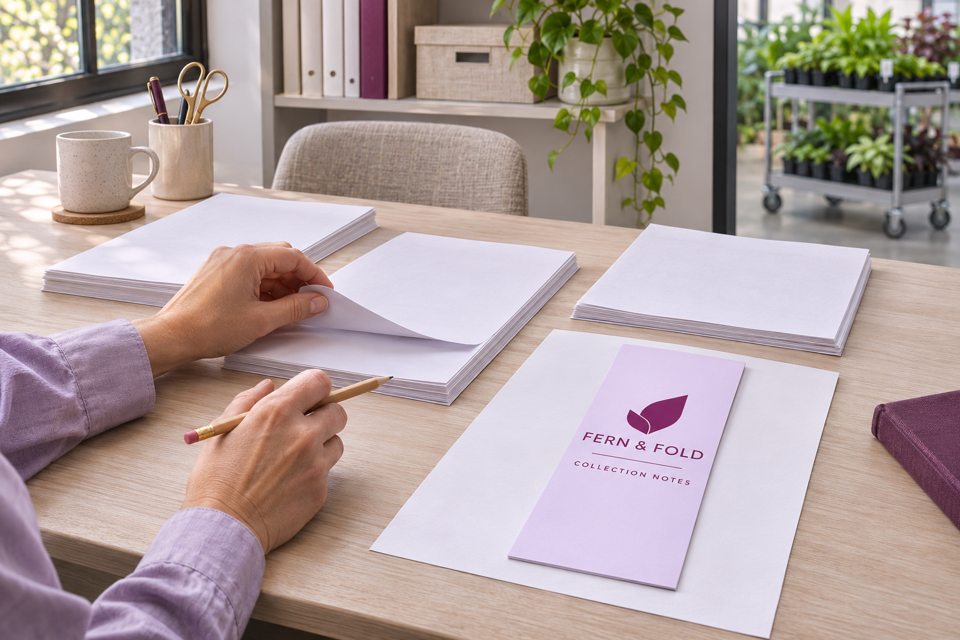
These custom rack cards for collection information are listed at 3.74 × 8.27 inches, with 14pt standard paper and glossy finish as defaults. The current minimum allowed quantity is 50. The image is an AI artwork concept.
Compare custom rack cards if a stable organizer identity and information route would help at a dry welcome desk. Prepare the actual approved artwork with DecentCustom. Ordinary paper is not a weatherproof plant label, order receipt or proof that plants are ready.
If an existing confirmation and current digital notice already guide order holders clearly, use them. Delay printing volatile collection details until they are approved, and buy a separate card only when it serves an actual information need.
Checked November 13, 2026: the linked 2027 county notice and current product listing. The message correction is fictional editorial work. No order was placed, no final collection details were obtained, and no attendance or business result was measured.