A pickup date in a message is a request until the shop confirms what it can prepare. Make the contact route and the next confirmation step clear before the customer travels.
Tell customers which route handles a same-day request, which handles a later date, what information to provide and how the shop will confirm the arrangement. Keep a request acknowledgment separate from a notice that the order is ready.
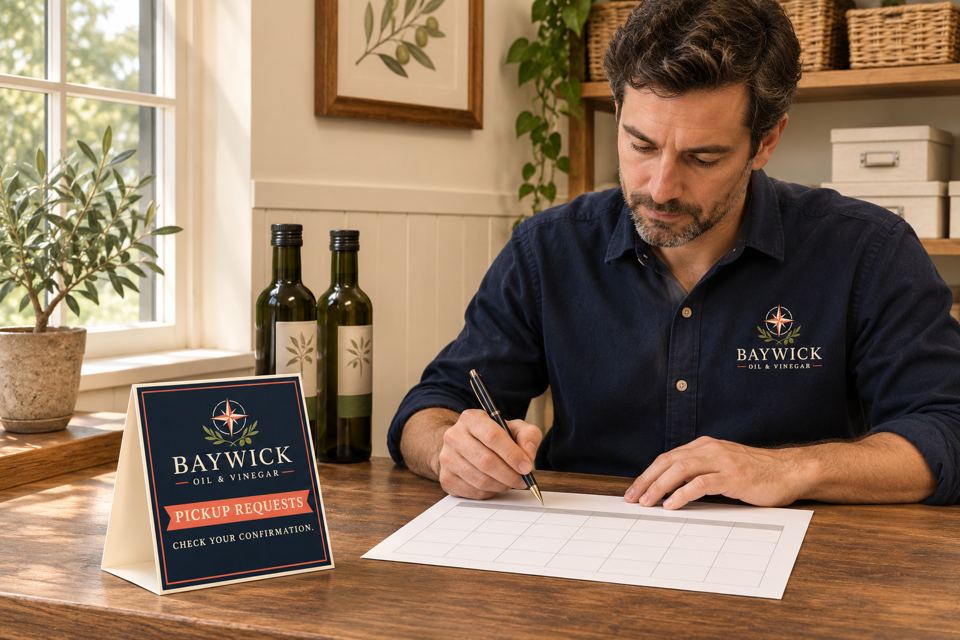
Give each pickup route a clear starting point
A customer planning next week’s collection has a different timing question from someone hoping to collect this afternoon. Explain which contact route your shop uses for each, instead of making people infer it from a list of phone numbers and email addresses.
The Olive This! Charlotte page provides a concrete example: it directs same-day curbside requests to the shop by phone during opening hours, and future-dated requests to email with the order, store, date and phone number. It also describes a shop callback on the requested morning for payment.
Those are that location’s published instructions. Your own guide should use your actual request channels, confirmation process and payment arrangement. Do not promise another retailer’s callback schedule or assume it applies at another location.
| Customer’s starting point | What your guide should make clear |
|---|---|
| “Can I collect today?” | The current same-day contact route and the need to confirm availability and arrangements. |
| “I would like to collect on a later date.” | Where to request it, the information needed and how a response will be communicated. |
| “I want to bring a bottle back.” | Whether this is a separate refill request with its own process. |
Keep bottle refill instructions separate from collection of new filled bottles unless your actual service explicitly connects them. A pickup request does not establish that a returned bottle can be accepted or refilled.
A request should identify the intended order and visit
For a later-date request, a useful message identifies the shop, products, quantities, requested day and a working reply route. State preferences as requests, especially when a product or time has not been confirmed.
A complete fictional customer request · P1515
“Hello Baywick team. I would like to request collection at the Baywick Market Street shop on December 18, 2026. My requested items are one 250 ml bottle of Meadow Oil and one 250 ml bottle of Orchard Vinegar. I am requesting new filled bottles, not a returned-bottle refill. Please confirm the exact products, availability and collection arrangements before I travel. If either item is unavailable, please ask me before substituting. Please reply through this message thread with the next step.”
Baywick, the shop location, products, date and reference P1515 are invented for this writing example. No stock or opening schedule is implied. A real customer should use the actual shop’s channel and provide the contact information it requests through that channel.
The example makes an intended purchase understandable without treating it as accepted. It also answers a useful operational question: whether a different item may be substituted. If the customer has not agreed, the shop should clarify rather than let a short product description stand in for that agreement.
Show the customer what each reply means
A received message is progress, but it does not tell the customer that the bottles have been prepared. Use wording that identifies the current state and the next action.
Fictional acknowledgment · still pending
“Baywick P1515: we have received your request for December 18. Product availability and collection arrangements are not yet confirmed. Please wait for our confirmation before making a collection trip. We will use this thread for the next update.”
Once the fictional shop has completed its checks and preparation, the message can change. The notice should identify the order, actual collection place, agreed timing and what to do on arrival. Here is a separate, fully fictional illustration:
Fictional ready notice · after preparation
“Baywick P1515 is ready: one 250 ml Meadow Oil and one 250 ml Orchard Vinegar, as confirmed in this thread. For this example, collect from the indoor counter at our fictional Market Street shop on December 18, 2026, between 2 and 4 p.m. Show reference P1515 to the counter team. If your plan changes, contact us in this thread before changing the collection arrangement.”
This example deliberately describes an indoor counter; it is not a claim that an actual retailer offers that process or time window. A real curbside notice needs the shop’s own confirmed arrival and handoff instructions. Payment status should be communicated through the actual order process, not guessed from the words “request received.”
Explain what to do when the reply has not arrived
A short line can prevent an unanswered request from turning into an assumed appointment: “If you have not received confirmation, contact the shop through its current request channel before traveling.” Use that only where it matches your actual service.
If the customer changes the date, products or collector, have the appropriate shop process confirm the revised arrangement. Keep the original reference so the team can identify which request is changing. Do not leave an old ready notice as the only visible instruction after agreeing to something different.
For staff handoff, record the confirmed items, request reference, location, agreed collection arrangement and the channel carrying the current confirmation. Assign responsibility for updating the customer when something changes. The useful result is a shared account of the arrangement, not another disconnected note.
Print the stable prompt, keep order details in the order
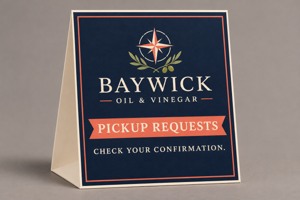
A reminder to check confirmation
The fictional Baywick display says “Pickup requests / Check your confirmation.” Consider custom table tents if a reminder is useful at the counter, or compare table tent formats. The image links to the paper display product.
The current listing describes a 5 × 7-inch paper tent with 14pt stock and finish choices. Check the actual counter position and reading distance. A display does not carry the customer’s latest order status, and it is not a bottle-support or food-contact product.
When preparing artwork with DecentCustom or another designer, keep changing dates, stock and individual readiness out of a general print run. Existing messages, a maintained pickup page or a clear staff reply may already do the job without new printing.
Can one guide cover same-day and future pickup?
Yes, if it clearly separates the starting routes and explains how confirmation follows each request.
Does no response mean the order is accepted?
No. Give the customer an appropriate way to follow up under your actual service process.
Source and boundaries
Reviewed November 8, 2026. The linked Charlotte page supplies a location-specific example. Baywick and all P1515 messages are fictional. No call, email, order, payment, inventory check, collection or business improvement was performed or verified.