A returning bottle is a request for a service, not proof that every container or product is eligible. Explain your own policy before customers make the trip.
Identify the store and service, the bottles your policy covers, the preparation instructions customers should obtain, and how they can confirm a product and visit. Keep the final acceptance decision with your actual process. Copying another retailer’s offer cannot establish your own policy.
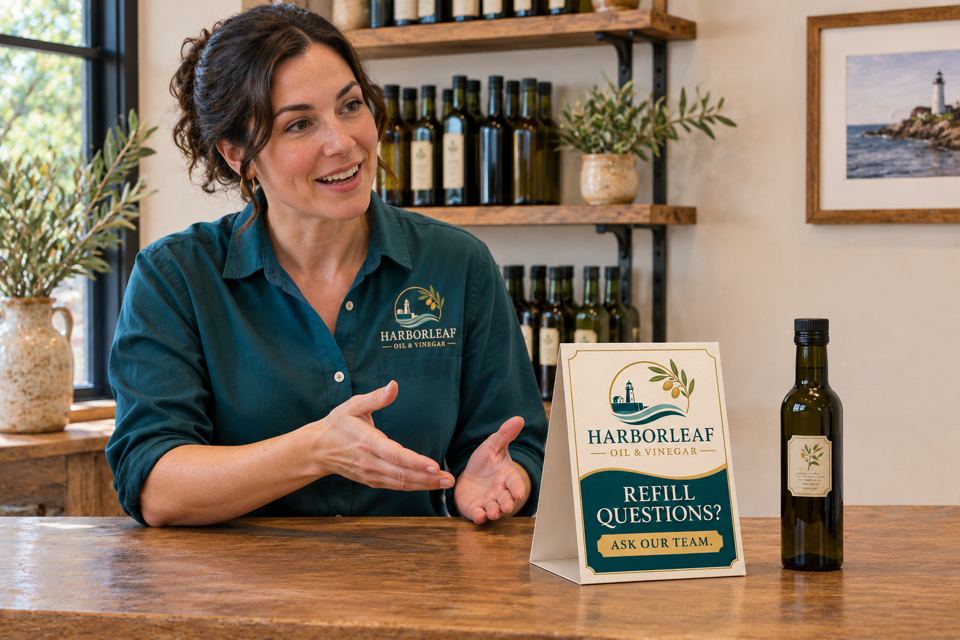
A published refill policy is useful context, not a universal procedure
Olive This!, a retailer in our oil-and-vinegar shop research, has a reuse-refill page describing the return of its bottles clean and dry for refilling. That establishes a specific retailer’s published offer. It does not mean any household container is acceptable at any oil shop.
For your own instructions, separate three decisions: what your service permits, what the customer needs to know before visiting, and what staff must confirm on arrival. A sign can communicate those decisions; it cannot create a bottle-handling procedure or validate a container.
This article addresses that communication task. It does not prescribe washing, sanitizing, drying, inspection or food-handling methods. Obtain the instructions appropriate to your actual service before telling customers how to prepare a bottle.
Answer five questions before asking for artwork
Write the decisions in plain language and name who can approve them. If one remains unresolved, resolve it before publishing a customer promise.
| Owner decision | What the customer needs to learn |
|---|---|
| Which location offers the service? | The specific participating shop, not a general brand-wide assumption. |
| Which bottles are considered? | Your actual eligibility rule, including how to ask about an unfamiliar bottle. |
| Where are preparation instructions available? | How to get the current instructions before coming in, without guessing from a short sign. |
| How are product and timing confirmed? | Whether to check in advance and what remains subject to confirmation. |
| Who decides at the counter? | The next step on arrival and what happens when a refill cannot proceed. |
Do not collapse those questions into “Bring any bottle for a refill.” That wording makes a much broader promise. Similarly, a bottle-return program does not by itself establish a discount, available variety, guaranteed waiting time or curbside refill service.
Ask whether the customer can find the answer before traveling. A counter sign is too late for a question that determines which bottle they should bring. Put that detail in a maintained service page or a response from the shop, and let the sign point to the correct next step.
A complete fictional policy message
The following Harborleaf example is invented to demonstrate writing structure. Its owner decisions are assumed for the exercise; they are not Olive This!’s rules or an actual Harborleaf service. A real shop must replace the assumptions with its approved policy.
Harborleaf Oil & Vinegar · Bottle refill questions
Our fictional shop considers bottles originally supplied by Harborleaf for its refill service. If your bottle came from another shop or you are unsure which bottle you have, ask our team before making a refill trip.
Before your visit, obtain our current bottle-preparation instructions and confirm the product you would like. Product availability and the suitability of the returned bottle must be confirmed through our service process; bringing a bottle does not guarantee a refill.
When you arrive, speak to the counter team before leaving a bottle for service. If the refill cannot proceed, ask what options are available before choosing a purchase. An order for a new filled bottle and a request to refill a returned bottle are separate requests.
The copy names its scope, gives the uncertain customer an action and avoids implying that a decorative label authorizes refilling. It deliberately does not invent a cleaning recipe or a discount.
What does this help a first-time visitor ask?
Suppose a customer has an unrecognized glass bottle. A useful pre-visit question is: “I have a bottle from another retailer. Does your current refill policy accept it? If not, what options should I consider before coming in?” No photo, purchase or journey has to be treated as acceptance.
For the shop, answer that question using the actual policy. If it cannot be answered immediately, say what still needs confirmation and how the customer should follow up. Do not turn an uncertain request into a confirmed service simply to keep the reply short.
Use a short counter prompt for the right job
A prompt to start a conversation
The fictional Harborleaf tent says “Refill questions? Ask our team.” Consider custom table tents if that prompt has a useful place at your counter. Compare table tent formats after deciding how much information needs to be read there.
The current listing specifies a 5 × 7-inch paper format and standard 14pt stock, with finish choices. It is an information display, not an oil-resistant work surface, a bottle carrier or proof of food-contact suitability. Check the actual position and reading distance. Keep it outside the task area if your operation requires that separation.
Do not squeeze the whole policy onto a small display in tiny type. Keep the counter prompt short and make detailed, current instructions available through the shop’s established channels. A working existing sign, service page or staff explanation may be enough; a new print order is optional.
Make changes in the service visible in the copy
Before preparing artwork with DecentCustom or your existing designer, approve the exact words and the fictional-or-real brand assets to be used. A designer needs the service decisions, not just a request to make “eco-friendly refill” look attractive.
Record the policy owner and the date of the last check. Review the wording when the accepted bottle types, location, preparation instructions, product range or request channel changes. Update the pre-visit information and counter prompt together if either would otherwise contradict the other.
For a simple editorial check, ask someone unfamiliar with the program to explain which bottle they would bring, what they would confirm first and what they would do on arrival. Record any unanswered question and revise the message. That exercise can reveal ambiguity; it does not establish that the service or its handling procedures are adequate.
Should we promise a refill discount on the tent?
Only if it is an approved current offer with clear conditions. Another retailer’s published promotion is not evidence of your price policy.
Does a pickup order include a returned-bottle refill?
Do not assume so. Confirm whether your service accepts that request and how the bottle would enter the process.
Can the existing bottle remain the main option?
Yes, where your actual program permits it. Clear instructions may be the useful improvement without selling a new bottle or adding printed materials.
Source and limits
Reviewed November 8, 2026. The linked Olive This! page is a retailer-specific source. The five-question framework and Harborleaf example are editorial tools. No actual refill request, bottle assessment, cleaning test, order, payment or improvement in sales was verified.