General-store workwear planning
Plan the change of task and the next clean garment before choosing a logo or multiplying the staff headcount.
Choose general-store workwear by mapping the tasks, the clothing changes they require and the time clean garments become available again. Stocking shelves, serving a café customer and handling food are different assignments. A coordinated shirt can identify the team; it cannot settle every clothing or hygiene requirement.
For a small team, the missing item may be a suitable spare in one employee’s size rather than a new shirt for everyone. Check the actual gap after fit, care and task requirements are resolved. Keep useful existing clothing in the plan.
A mixed store needs a task-change plan, not just a matching color
Saxapahaw General Store’s community page, reviewed November 5, 2026, describes staff preparing food, stocking shelves and placing orders. Its menu page presents distinct meal periods and notes that service can vary. This establishes a mixed retail-and-foodservice context at one North Carolina business. It does not tell us that every employee performs every task or disclose the store’s uniform policy.
For your own team, identify who actually changes tasks during a shift. Ask the person responsible for each work area what clothing, layers and change arrangements that assignment needs. A customer-service role involving sealed goods is not automatically the same assignment as preparing exposed food.
The FDA’s 2026 Food Code is a model offered for jurisdictional adoption, not a rule automatically binding every store. Its provisions distinguish clean outer clothing, hand hygiene and suitable clothing-storage areas. Check the applicable local requirements and your established foodservice procedures with the responsible manager. A logo, a fresh apron or a shirt change does not replace that process.
Filled planning example: stocking to café support
Fictional assignment: Nora stocks dry packaged goods in the morning and is scheduled for a café assignment later. Before that change, the shift lead checks the next task against the store’s established requirements, including the condition of Nora’s clothing and any required layer.
Clothing decision: if the required change is needed, a suitable clean garment in Nora’s accepted size must be available through the designated change arrangement. If it is missing, the lead resolves the assignment or obtains appropriate clothing before the task begins.
Keep separate: required hand hygiene, training and other foodservice controls remain in the operating procedure. “Put the branded polo on” is not the complete handoff instruction.
This is an allocation and responsibility example, not a food-handling protocol. It does not assume that every stockroom task requires a full change, or that a plain polo is sufficient for every café task. Record the actual decision for the actual assignment.
Resolve a care mismatch before counting an item as usable
A shirt is useful cover only if it fits the wearer, suits the assignment and can be cared for under an acceptable process. Confirm when washing finishes, when drying finishes and when the garment reaches the employee. “Laundry on Tuesday” is incomplete if the shirt returns after Tuesday’s shift.
The current polo described below lists washing below 30°C and no bleach. Suppose a store’s required clothing-care process uses conditions outside those instructions. The buying decision is to hold that candidate pending a suitable alternative or a properly resolved care arrangement. Do not lower an established requirement to make a catalog item fit the order.
Our guide to staff apparel fit and movement checks covers the wearer trial. Complete that step before counting existing garments or approving replacement sizes. An old shirt in the cupboard is not useful coverage for someone it does not fit.
Count by person through the next actual clean return
Fictional example: Hollow Oak issues clothing on Monday morning. Its next clean return is Tuesday evening, after the Tuesday shifts. Nora and Eli work Monday and Tuesday; Jo works Tuesday only. For this example only, the accepted plan uses one base shirt per workday and allocates an additional change to Nora and Jo. These allowances are planning choices, not a universal requirement or a claim about Saxapahaw.
| Wearer and accepted size | Base workdays before return | Additional planned change | Total needed | Usable assigned shirts | Gap |
|---|---|---|---|---|---|
| Nora · M | 2 | 1 | 3 | 1 | 2 |
| Eli · L | 2 | 0 | 2 | 2 | 0 |
| Jo · S | 1 | 1 | 2 | 2 | 0 |
The starting gap is two M shirts
Needed: (2 + 1) + (2 + 0) + (1 + 1) = 7 shirts.
Usable assigned inventory: 1 + 2 + 2 = 5 shirts.
Individual gaps: max(3 − 1, 0) + max(2 − 2, 0) + max(2 − 2, 0) = 2 shirts, both M.
The cupboard also contains a worn-out M shirt and an unassigned XL that none of these three wearers has accepted. Neither is included in the five usable shirts. The XL does not close Nora’s M gap merely because the total physical count looks sufficient. Retain the store’s normal process for unusable stock; this example does not call for discarding it.
Check availability by person before combining totals. If a shared spare is part of the plan, document who can use it and when; do not allocate the same shirt to two simultaneous needs. If Jo’s assigned stock has not been checked, mark it unknown and keep her gap pending instead of entering zero.
A late clean return changes the size mix as well as the total
Now suppose the clean return moves to Wednesday evening, after work, and all three employees also work Wednesday. Keep the example’s additional-change allowances unchanged. Each person needs one more base shirt before the return.
- Nora M: 3 base days + 1 change − 1 usable shirt = 3 more M.
- Eli L: 3 base days + 0 changes − 2 usable shirts = 1 more L.
- Jo S: 2 base days + 1 change − 2 usable shirts = 1 more S.
The revised need is 10 shirts, with five usable shirts already assigned, leaving a gap of five: 3 M + 1 L + 1 S. That is three more than the original two-shirt gap. It is a revised total gap, not five additional shirts on top of an order already placed.
If the original two M shirts have since arrived and passed the agreed checks, the remaining gap becomes 1 M + 1 L + 1 S. If they are merely ordered and will arrive too late, they do not cover the Wednesday requirement. Record that status rather than counting a purchase order as ready-to-wear stock.
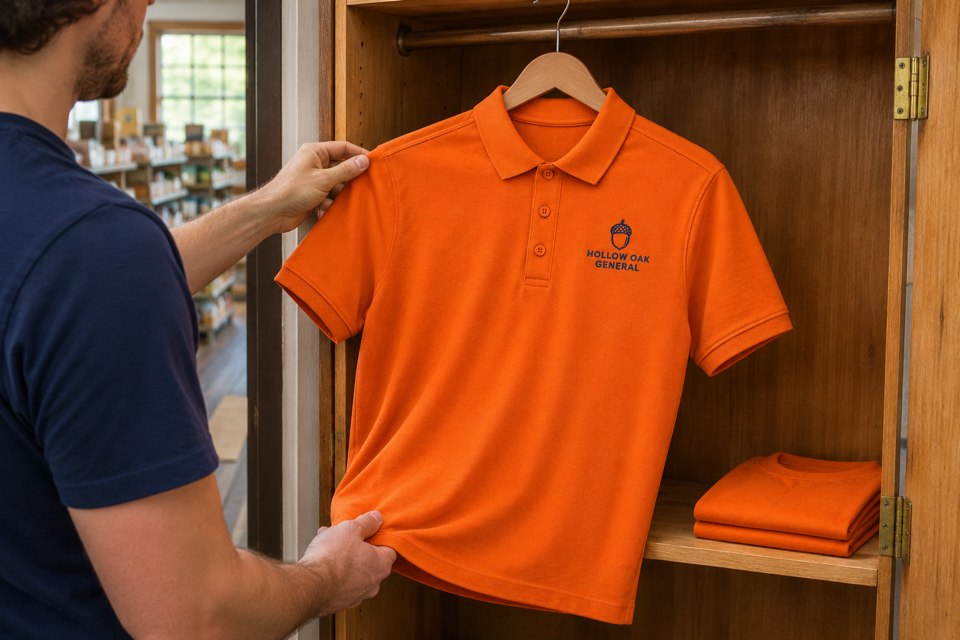
A late return may require a scheduling or laundry solution before a new order can arrive. Confirm the actual in-hand date; do not promise that printed apparel will solve tomorrow’s shortage. The illustrated cupboard is not a claim that this allocation has been tested in a working store.
Compare a polo after the task, fit and care decisions
Browse custom polo shirts when a collared short-sleeve garment suits the established assignment. Keep the accepted fit, care conditions, size gap and approved artwork together when reviewing a configuration with DecentCustom.
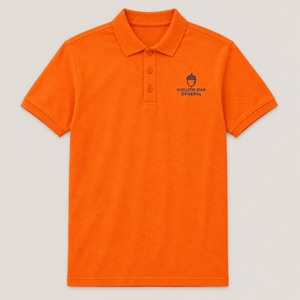
regular-fit cotton short-sleeve polo
The current SKU decentcustom-cl-000043 lists 220 GSM, XS–3XL options, a three-button placket and ribbed cuffs. The listed cotton composition has a 10% polyester exception for gray. Verify the selected color, size chart and allowed measurement variation; the listing allows variation up to 2 inches.
The displayed minimum is 2 shirts; the listed case pack of 36 is a separate figure. Confirm how a proposed size-and-color mix can be ordered. Neither number determines your staffing allocation.
Review the full current care notes, including washing below 30°C and restrictions on bleach, prolonged soaking, hot ironing and dry cleaning. This article does not establish wash-life, shrinkage, cooling, foodservice approval or protective performance.
AI artwork concept using the catalog’s orange polo form and a fictional navy Hollow Oak acorn mark, consistent with the scene. These images are not manufactured samples or proof that the garment has passed the store’s checks.
Before approving a purchase, make the decision readable: the chosen garment passes the actual task and care requirements; the individual sizes have been accepted; the gap uses verified usable stock and return times; the delivery date meets the need; and the artwork proof matches the approved store identity. Keep an unresolved item pending rather than letting a finished logo preview approve the whole plan.