Grocery store operating guide
Choose staff clothing by the work it must support, then check fit, care and replacement needs with the people who will wear it.
A grocery-store shirt has to work while someone reaches a shelf, bags a purchase, walks into a cooler or helps a customer outside. A logo can identify the team, but it does not answer whether the garment fits those movements or can return clean and ready for the next shift.
Start with the role, try the clothing through real movements, and agree on care before ordering the full team quantity. Keep service-counter tasks, checkout and stock work separate long enough to notice their different needs. One coordinated look may work; one identical clothing combination may not.
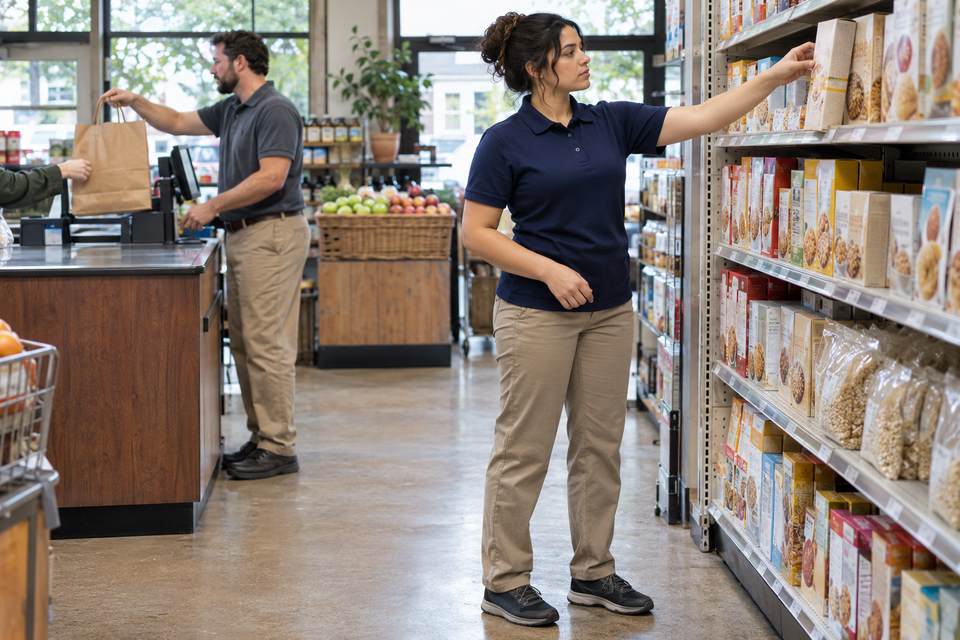
Write down the work before choosing the look
Store job descriptions provide a better starting point than a generic uniform photograph. Weaver Street Market's warehouse and driver role describes receiving, order preparation and stock movement. A separate customer-service listing includes checkout, bagging and pickup handoffs. These are examples from a food co-op, not evidence that every independent shop has the same staffing or job boundaries.
In a small shop, one person may do several of those jobs. Ask which tasks occur in the same shift and which involve a change of layer or garment. Use that answer to plan the clothing combination instead of assigning one just from a job title.
| Task to observe | Try while wearing the candidate | Record before approval |
|---|---|---|
| Stocking and receiving | Reach to the shelf, bend to a low carton and turn with a typical light item. | Shoulder movement, sleeve clearance and whether the hem needs repeated adjustment. |
| Checkout and bagging | Use the register, open a bag and move an order across the counter. | Where a badge, sleeve or extra layer contacts the work area. |
| Service and customer help | Walk the normal route, point out a product and handle the tools actually used. | Identification visibility, pocket access and the employee's fit preference. |
| Cold areas or outdoor handoffs | Try the usual approved layer combination through the actual route. | How layers fit together and where the employee changes them. |
Clothing used for ordinary staff identification does not establish suitability as protective equipment. Keep task-specific protective clothing and food-handling requirements in your store's own procedures; a printed polo is not a substitute for them.
Run a fit trial with the people doing the job
Ask employees to compare the size chart with a garment that already fits them. A label such as medium or unisex is a starting point, not a promise of fit. Check the supplier's measurement method and whether the dimensions describe a body or a finished garment. If the method is unclear, resolve it before approving the size breakdown.
Then trial the candidate through the work movements in the table. Ask specific questions: Did the sleeve pull while reaching? Did the hem ride up when bending? Can the employee use their usual pocket or carry the device without clothing getting in the way? A standing photograph will miss some of these problems.
Ask for a comparison, not just a yes or no
“Compared with your current work shirt, what was easier, what was harder, and what would you change?” gives the wearer room to describe a problem that the order approver may not notice.
An employee discussion about a grocery-team apron provides a useful counterexample: fit and neck adjustment, warmth, bending and name-badge placement did not all work equally well for the people commenting. That anonymous, chain-store discussion is not a test of the polo below. Its value here is the reminder to check the actual wearer and task rather than assuming an extra branded layer is automatically useful.
Keep the existing clothing arrangement in the comparison. A suitable plain shirt with an existing identification method may already cover the task. If you add printed apparel, be clear about the particular identification or presentation need it addresses. Do not use the order as a replacement for listening to employees about their work.
Agree on washing and replacement before setting quantities
The useful order quantity depends on when clean garments will be available, not just how many people are on the roster. Ask how many shifts each person needs to cover between washes, who handles cleaning, how drying fits into that routine and what happens if a garment needs to be changed during a shift.
Check that the proposed care routine fits the garment instructions and the store's requirements. If it does not, choose another garment or an appropriate service arrangement before printing. A claim that a fabric is cotton does not establish how a printed garment will behave under your particular washing and drying conditions.
A quantity example, using assumptions only
Suppose five employees each need two ready-to-wear shirts and one shirt in the wash cycle. The starting allocation would be 5 × (2 + 1) = 15 shirts, before any separately chosen replacements.
Five employees and three shirts per person are invented planning inputs, not a recommended allowance or information about any cited store. Build the real order by employee, size, shift pattern and wash turnaround. A different cleaning arrangement changes the result.
Record sizes individually rather than dividing the total evenly across a guessed size range. Decide who approves substitutions if a selected size or color changes, and who keeps the final artwork and reorder record. Keep spare quantities tied to an actual need; a lower unit price alone is not a reason to store garments that employees cannot use.
A polo to compare with your task checklist
Browse custom polo shirts when a collared short-sleeve option matches the role. Compare material, size information and care instructions as well as the design.
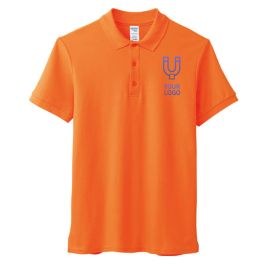
Regular-fit short-sleeve polo
A collared option to compare with your actual fit, movement and care checklist.
The linked listing specifies a 220 GSM fabric and unisex XS–3XL sizing. It describes the fabric as cotton, with a polyester exception for gray, and lists a turndown collar, button closure and ribbed cuffs. Check the exact selected color and size chart rather than applying one material description to every option.
Order check: the current minimum is two shirts. The listed case pack of 36 is separate from the minimum order and says nothing about your employee count. The page also warns that garment measurements may vary; a fit trial is more useful than assuming a close measurement match will produce an identical fit.
The listing's care notes call for washing below 30°C and place limits on bleaching, soaking, hot ironing and dry cleaning. Check the full current instructions and final printed configuration before approving your care plan. This guide does not claim a tested shrinkage rate, colorfastness, cooling effect or improvement in staff performance.
The product thumbnail shows sample artwork. The workplace scene is an AI illustration, not this polo being tested or a cited store wearing it. Specifications and minimum quantity were checked on November 2, 2026.
Give the approver a short apparel-order brief
- Work: actual roles, repeated movements and required layer combinations.
- Wearers: individual sizes, fit feedback and who has checked the size chart.
- Care: cleaning responsibility, instructions and clean-garment availability.
- Allocation: garments per person and size, plus any justified replacements.
- Design: approved store name, artwork placement, print method and final preview.
- Approval: the person checking fit, the person authorizing payment, final order total and needed-in-hand date.
Coordinate clothing with other routines only where it helps. Our guide to grocery bag packing and reorders uses the same approach: observe the person doing the work before deciding which supplies to order.
If several store materials need the same approved name or artwork, explore custom products from DecentCustom and keep one checked design record. Verify the available configuration and final total on each product; do not assume the same print area or options apply across them.
Staff apparel questions before ordering
Should every grocery-store employee wear the same garment?
Start with the work and existing procedures. You may be able to coordinate colors or identification while allowing different suitable layers for stocking, checkout and other tasks. Trial the combination with the employees who will wear it.
How many work shirts should I order per employee?
Use shift coverage, washing and drying turnaround, and replacement needs. The 15-shirt example above is hypothetical; it is not a universal three-shirt recommendation. Record the actual allocation by person and size.
Does a cotton polo automatically suit every store task?
No. Fit, movement, layering and care still need checking, and any task-specific protective requirements remain separate. The selected color can also affect the listed fabric composition.
Can we reorder the same design without another check?
Keep the approved artwork, but recheck spelling, current garment options, size requirements and the final preview. Staff needs and available configurations may have changed.