Before reordering frozen retail packaging, count the units that are usable and still available for the jobs ahead. Subtract stock already committed elsewhere, keep unsuitable units out of the available total, and compare the remaining shortfall with the supplier’s minimum—not with the number of bags visible on a shelf.
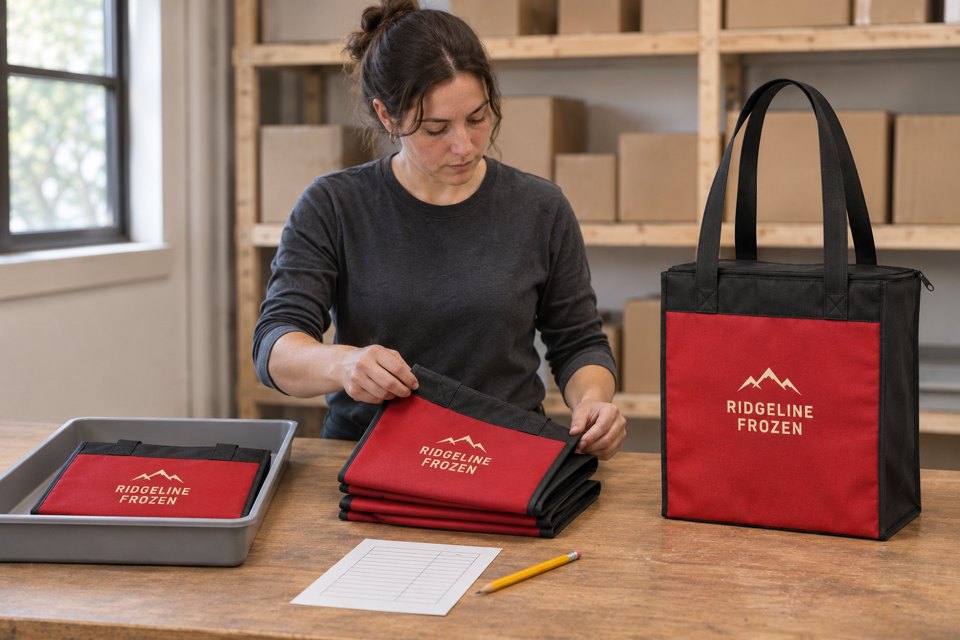
One stock line should represent one actual supply
A frozen shipping liner, a shipping carton, a label and an optional carryout tote do different jobs. Do not add them together as “packaging units.” Record the actual format and purchasing unit, then keep their balances separate. A carton of bags is not necessarily one bag; a sheet of labels is not necessarily one label.
For context, Wild Fork’s packaging FAQ, modified March 13, 2024, describes its own insulated liners and prepackaged dry ice. That description does not tell us an individual store’s stock, consumption or replenishment schedule. It also does not make a branded carryout tote a replacement for those supplies.
Decide which job you are planning before counting. Our guide to shipping packaging and carryout bags explains that distinction. The example below concerns optional carryout bags only; the original shipping system remains a separate decision.
A worked count: 44 on the shelf does not mean 44 available
All numbers, people and decisions below are fictional planning examples, not DecentCustom customer records or a test of a bag’s performance. Ridgeline Frozen is an invented store. Assume its team has separately established which existing carryout units are suitable for the assigned job; the arithmetic cannot establish that suitability.
At the close of Saturday, November 7, Avery physically counts 44 bags of one format. Eight are already set aside for a separate confirmed arrangement outside the upcoming plan. Six are unsuitable for that plan and held separately for review. These groups do not overlap.
| Stock line | Bags | Treatment |
|---|---|---|
| Physical count, same format | 44 | Starting count |
| Already allocated outside this plan | 8 | Keep reserved |
| Unsuitable for the planned use | 6 | Keep out of available stock |
| Usable and unallocated | 30 | 44 − 8 − 6 |
| Possible incoming stock | 20 | Arrival unconfirmed; not counted as available |
Keep the physical count and the available balance as separate fields. If the six held units are later cleared for this actual use, record that decision before adding them back. Do not silently change their status to make a reorder calculation look better.
The possible incoming 20 bags belong on a separate line with their status and expected date. In this example they cannot cover a job yet because arrival is unconfirmed. If a real count, condition or allocation is unknown, resolve it before calculating a definitive order; an empty field does not mean zero.
Calculate the gap for a defined set of future jobs
Avery’s remaining four-week plan calls for 12, 9, 7 and 10 bags respectively, totaling 38. These are invented, explicitly defined supply requirements, not a forecast inferred from website traffic. The eight already reserved bags above belong to other work and are excluded from these 38 uses, so they are not deducted twice.
The calculation in individual bags
Remaining planned use: 12 + 9 + 7 + 10 = 38
Chosen reserve for this example: 4
Total required: 38 + 4 = 42
Usable, unallocated stock: 30
Additional quantity needed: max(0, 42 − 30) = 12
The reserve of four is a management choice for this fictional exercise, not a recommended industry percentage. A real reserve needs a reason connected to the store’s usage, receiving uncertainty and service plan. It should not be a hidden extra added to every order.
This gives a quantity gap, not an order date. The team must also know when the first required units are needed and when suitable supplies can actually be received and checked. An advertised production estimate alone does not settle that timing.
A shortfall of 12 does not justify a minimum order of 50 by itself
If the team buys 50 compatible bags while the rest of the example stays unchanged, available stock becomes 30 + 50 = 80. After the 38 planned uses, 42 remain. Only four were the chosen reserve; the other 38 bags exceed the needs defined in this plan. They might support later work, but that later demand has not been established here.
Before accepting that extra stock, check whether a suitable existing supply can cover the gap, whether a smaller ordinary supply format is available, or whether the current carrying arrangement can continue. An alternative must still meet the actual job; do not substitute an optional tote for a required shipping component to reduce the count.
Fictional purchasing decision
“Avery has verified 30 usable, unallocated units. The remaining plan requires 38 uses plus a chosen reserve of four, leaving a gap of 12. Jules will check suitable existing alternatives and the unresolved incoming quantity before authorizing a purchase. We are holding the proposed custom order of 50 until suitability, timing, total cost and a reason for the additional stock are established. No order has been placed.”
Make the balance usable by the next shift
Keep one dated record that the stock counter, service team and purchasing decision-maker can all interpret. Separate the person counting from the person authorized to spend; a stock note is not purchasing approval.
The completed handoff for this example
Avery, stock counter: Recorded 44 physically counted; eight reserved outside the remaining plan; six held as unsuitable; 30 usable and unallocated. Left the reserved group separate and the held group clearly identified.
Jules, purchasing decision-maker: Owns the open gap of 12 and the check on possible incoming 20. Has not approved a custom order. Will update the decision when quantity, suitability and a workable receiving date are confirmed.
Next receiving shift: Count any actual arrival in individual bags, check the correct format and condition, then enter only accepted units into the available balance. Keep unresolved units out until reviewed. Update allocations and record the next count before relying on the old number.
When an order changes, update its supply allocation as well as the collection instructions. A cancelled or changed collection does not automatically release every associated supply; the responsible person needs to update the record.
Questions that change the reorder
Can expected deliveries count as stock?
Track them separately from stock already usable. Use a confirmed receiving arrangement when planning future coverage, and reconcile the actual accepted quantity when it arrives.
Should unsuitable units be deleted from the count?
Keep them visible in the physical record with their status. Exclude them from the available balance for the planned job until the responsible person resolves their suitability.
Is this a standard reorder-point formula?
It is a net-need calculation for a defined remaining plan. A repeatable reorder point also needs reliable consumption and replenishment information; those data have not been established for a real store here.
Take a verified quantity to the supplier
Bring the exact supply format, available balance, outstanding allocation, required receiving date and proposed quantity to DecentCustom for current options. Review the complete quote, including selected configuration, shipping and taxes, before deciding. If existing suitable supplies cover the job, record that decision and keep using them.