A frozen food collection message should answer five questions: is this order ready, who may collect it, where and when should they arrive, what must they bring, and whom should they contact if the plan changes? For a delivery to someone else, confirm that person can receive it before treating the delivery date as settled.
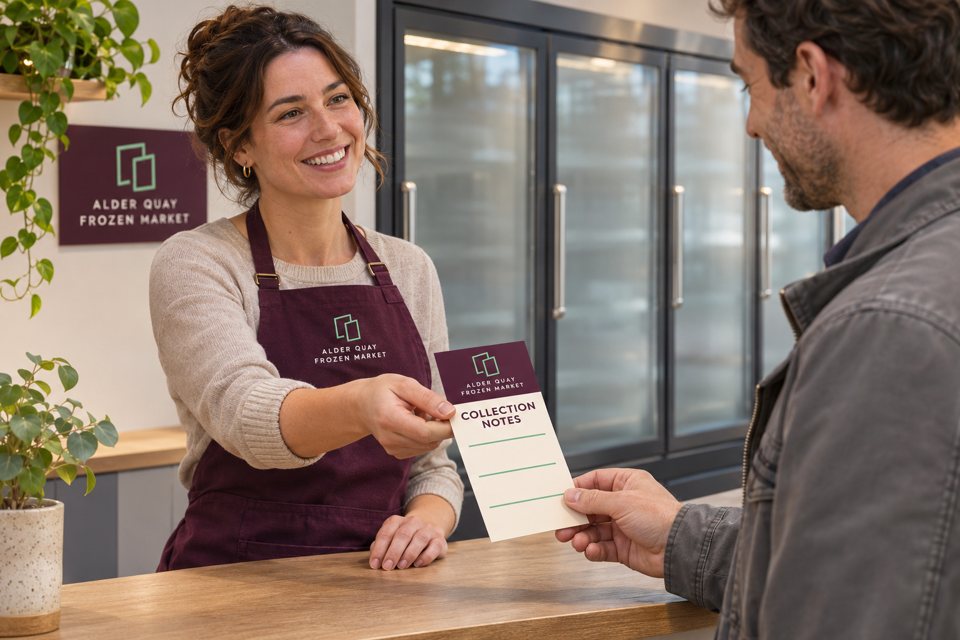
Order confirmation and collection readiness are different messages
A checkout receipt can confirm the order without saying it is ready to hand over. Label each message by its actual purpose. Send the collection instructions when the store has verified the order status and the applicable arrangement; do not let a generic thank-you card imply readiness.
First check delivery coverage and available pickup options. An address search, a selectable slot and a confirmed order are different steps. Then match the instructions to the selected route: collection at a particular counter, curbside collection if offered, or delivery to a recipient.
One current retailer example shows why details matter: Wild Fork’s delivery and pickup page states that pickup requires a valid driver’s license and an order name matching the ID. That is Wild Fork’s published rule, not a universal requirement for frozen food stores. Check the retailer’s current instructions rather than inventing an ID rule or assuming someone else can collect.
Example: a ready-for-collection email that stands on its own
The following is a fictional writing example for Alder Quay Frozen Market. The store, people, collection point and arrangement are invented. In this scenario, staff have checked readiness and confirmed that the named purchaser can collect using the order reference. A real store must replace these details with its verified policy.
Subject: Your Alder Quay order is ready for collection
Hi Devon,
Your order is ready for your confirmed collection on Tuesday, November 10, between 4:30 and 5:00 p.m., store local time. Please use the West service counter inside our store; this arrangement is for counter collection, not curbside service.
Bring your order confirmation and reference. This collection is recorded for Devon. If somebody else needs to collect, reply through this order conversation before they travel so our team can check and confirm the arrangement. Passing this message to another person does not itself authorize collection.
Please plan your onward journey and receiving arrangements before you arrive. Keep the retailer’s original packaging and follow the product and packaging instructions supplied with the order. Tell us before travelling if the collection time no longer works; we need to confirm any change with you.
If the counter location or the instructions are unclear, reply here for the collection team. Please wait for our response before relying on a different time, person or collection point.
Thank you,
Alder Quay collection team
This message gives Devon a usable next step without publishing an order reference, address or identity document on a public sign. It also separates the confirmed plan from a requested change. For a retailer with additional identification requirements, add the exact current requirement to the live message before sending.
When a friend or family member needs to collect
A last-minute change needs a decision, not just a forwarded email. Keep the request in the retailer’s existing order channel and ask what its current authorization process permits. Do not request identity documents through an improvised channel.
Fictional reply while a change remains unconfirmed
Hi Devon,
Thanks for telling us that Morgan may collect instead. We have received your request, but the collector change is not confirmed yet. Please keep Morgan from travelling on the assumption that forwarding your email is enough.
Our collection team will check the order and tell you through this conversation whether the change can be accepted and what the collector must bring. Until we confirm otherwise, the existing arrangement remains the one on the order. If the change cannot be made, we will discuss the options available for this order rather than promise a substitute handover.
Internally, assign the unresolved request to one person. In this example, Casey checks the request and records the decision; the counter team reads the updated order record before handover. “Customer asked” and “store confirmed” need separate status fields. Do not leave the only approval in a coworker’s memory or on an old printed list.
For a gift, check availability before promising a surprise arrival
The purchaser and the person receiving frozen food may have different schedules. A gift note can preserve a surprise; it cannot establish that somebody will be available to receive the parcel. Decide who will confirm the receiving arrangement before dispatch.
A complete fictional availability conversation
Buyer: “I’d like to send you a frozen food gift. Would Thursday afternoon work for you to receive it and follow the supplied storage instructions? I can check the retailer’s available delivery arrangements before placing the order. You don’t need to choose the food.”
Recipient: “I won’t be there Thursday. Friday afternoon may work, but please confirm the actual arrangement with me before you book it.”
Buyer’s next step: Check whether Friday is actually offered, then confirm the available arrangement with the recipient. Thursday remains unsuitable; Friday is still a possibility, not a booked delivery. If no workable option exists, postpone the gift or discuss another arrangement rather than select unattended delivery by default.
Use the seller’s actual product and packaging instructions for receiving and storage questions. Our separate guide explains the difference between original shipping packaging and carrying accessories. A printed card or a branded tote does not establish safe holding conditions.
Print the stable reminder; keep order details live
Keep dates, collection windows, order references, collector approval and current identification requirements in the live confirmation. A reusable counter card can instead explain where customers should look and what to do when their arrangement changes.
Example card copy
COLLECTION NOTES
Check your latest order message for the confirmed collection point, time and what to bring.
Need to change the time or collector? Contact the store through your order conversation before travelling.
Keep the original packaging and follow the instructions supplied with your order.
Keep this reminder with your order information.
Before printing, ask a staff member to find each answer using a sample order message. If the answer is missing, fix the message first. Compare rack card formats only after the stable copy and intended dry location are settled.
Questions before you send the instructions
Should every store ask customers to bring ID?
Use the specific retailer’s current policy. State an applicable requirement clearly in the live confirmation; do not copy another retailer’s rule automatically.
Can a printed card replace the collection email?
It can remind the customer to check it. It cannot carry changing readiness, time or authorization information reliably across different orders.
Who updates instructions after a change?
Name the person responsible for confirming the change and updating the shared order record. Give the counter team that current record rather than conflicting paper notes.
Prepare the message before the print order
Start with one confirmed collection route and one complete message. Resolve the missing details with the retailer, then decide whether a stable paper reminder adds anything. If it does, bring the finished wording, intended location and actual card quantity to DecentCustom to review the suitable format.