Keep full produce cases and small retail purchases as separate carrying jobs. Preserve suitable existing packaging for the full case; assess the actual packed small order before choosing an outer bag. A printed logo adds identity, but it does not establish fit, food-contact suitability or carrying capacity.
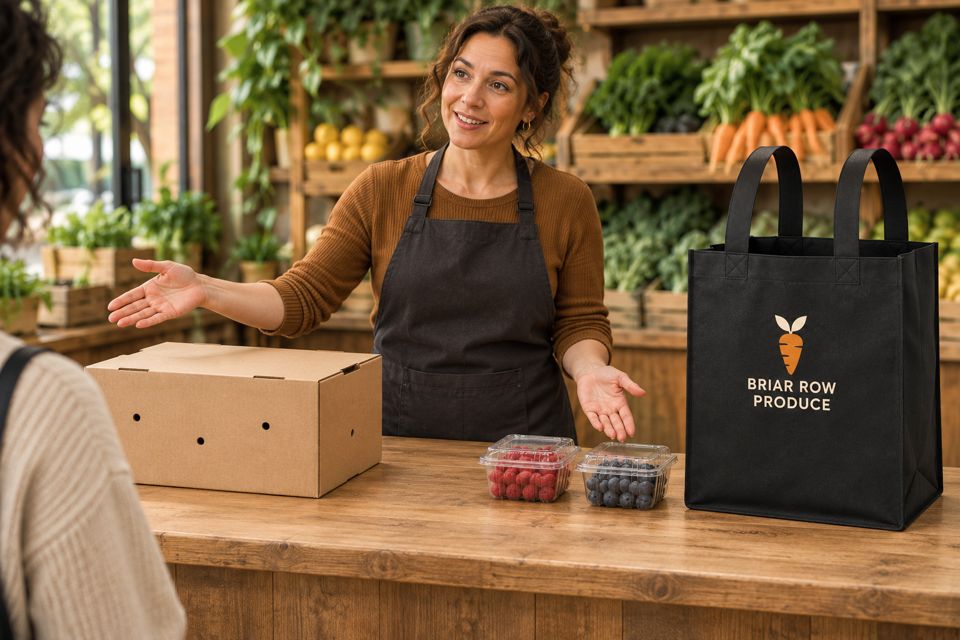
Ask what the customer is taking away
“Grocery bag” is too broad a starting point. A customer collecting a complete case may already have appropriate outer packaging. Someone buying a few retail packs may need a different arrangement, while loose produce raises a separate question about the packaging that actually touches the food.
A current Michigan example illustrates the range of orders. Joe Randazzo’s locations page describes four markets and says customers can request bulk case pricing and qualifying large-volume special orders. Its wholesale page asks businesses to explain their products, usual quantities and location so the team can discuss supply and delivery options. These are that operator’s services, not proof that every produce shop offers the same arrangements.
Use three opening questions at your own counter: Is this a complete case or a smaller purchase? What packaging is already around the produce? How will the customer move the order after the handoff? Do not assume every order needs a newly printed carrier.
Example one: keep a full case as its own packing decision
The following examples use invented people and the fictional Briar Row Produce store. They show a decision process, not actual customer transactions, packaging trials or product endorsements.
Maren collects a complete case
Maren has arranged to collect a full produce case for a kitchen. The team checks that the case is the agreed order and that its existing packaging remains appropriate for the planned handoff. Maren is collecting the case as supplied, rather than asking the team to split it into small retail orders.
Decision: Keep the appropriate original case. Do not transfer the contents into a promotional shopping bag just to display the store’s logo. If the case or carrying arrangement is unsuitable, resolve that issue with the responsible packing team before handoff; an extra outer bag is not an automatic repair.
Counter explanation: “This order is being collected as a complete case in its appropriate existing packaging. We have not verified that the display tote is suitable for carrying this case. Let’s keep the agreed case arrangement and confirm any change before repacking.”
Record the actual packed case dimensions, weight and intended handling method if another carrier is being considered. Do not infer them from the number of pieces of fruit, the produce price or a photograph. Keep any existing product or order information with the case when reviewing an alternative.
Example two: a few retail packs need their own review
Ellis buys two closed retail punnets
Ellis is buying two closed berry punnets, not a full case. Staff retain the suitable inner retail packaging and consider whether an outer carrier would help with the actual trip. The punnets’ size, combined packed weight, closure and condition matter; “only two packs” does not settle those questions.
Decision: Use the store’s existing appropriate carrying option for this purchase. Keep the new branded tote as a candidate until its usable opening, base, carrying suitability and intended conditions have been checked against the packed order. Do not move loose berries into the printed bag or treat the illustrated arrangement as a completed trial.
Counter explanation: “We’ll keep these retail packs closed and use the suitable carrier we already have for this order. The new bag design is still a proposal; its logo does not confirm the fit or the carrying conditions.”
If your store sells loose produce, assess the food-contact packaging separately from the outer carrier. If moisture, sharp edges, delicate packs or a longer carry are involved, include those actual conditions in the review. A dry-looking product image cannot answer them.
Compare bag candidates against the packed purchase
Use a representative order in its intended inner packaging. Record its external dimensions and weight, explain the carrying method, and confirm what the proposed carrier’s specifications actually mean. Where suitability is unresolved, keep the current appropriate method rather than treating an unverified sample arrangement as ready for customers.
For size, check the opening as well as the base and overall shape. A tall bag can still have an unsuitable opening; a flat front measurement is not the same as usable internal space. For handling, confirm the intended load and conditions with the supplier rather than interpreting material thickness or reinforced handles as a tested load rating.
Browse custom grocery bags after identifying the actual carrying job. Compare the appropriate format, verified conditions and complete quote; do not select a bag only because its front looks good with a logo.
A supplier brief that preserves the unanswered questions
Here is the completed inquiry text Briar Row could prepare for the proposed small-order carrier. It is fictional and has not been sent. The missing measurements are deliberately identified rather than filled with invented values.
Proposed use: outer carrier for small retail purchases
“We are evaluating your non-woven grocery tote, decentcustom-to-000131, for an outer carrying role at a produce counter. The initial example is two closed retail punnets; the suitable inner packaging would remain in place. We are not proposing this bag for a full produce case or as direct-contact packaging for loose food.
“We still need to record the actual packed dimensions, weight, expected moisture conditions and carrying method. Please confirm what the third figure in 13W × 15H × 10 describes, the usable opening and base information available, and the evidence relevant to the intended carrying conditions. Please do not substitute a general product photograph for that confirmation.
“We understand the current minimum is 12 individual bags and the listed case pack is 100. Please confirm the quantity unit, selected configuration and full quotation, including shipping and taxes. We have not established the order quantity or required receiving date yet.
“Our proposed front artwork is the Briar Row Produce name and carrot emblem. Please check it against the applicable print area and confirm the actual configuration. We will decide whether to proceed after reviewing suitability, quantity, artwork and a workable receiving date.”
A useful reply should address those actual questions. If it only repeats a generic material description, the carrying decision is still open. A written specification and a suitable practical review for the intended job serve different purposes; neither should be invented after the fact.
Questions before you order
Does a full case need a branded outer bag?
Only consider one if there is a defined carrying need and the complete arrangement is appropriate. Keeping a suitable original case can be the better decision.
Does the sample bag image prove two punnets will fit?
No. Check the actual packed order against the proposed carrier. The AI scene keeps the items separate and is not a packing trial.
Is the supplier’s case pack the same as a customer’s produce case?
No. One describes how the bag supplier packs its product; the other describes the produce order. Keep both distinct from the minimum purchasing quantity.
Settle the carrying job before the artwork order
Start with one representative small purchase and one full-case arrangement. Keep suitable existing packaging, document the actual conditions, and resolve the gaps before choosing a print quantity. Bring that brief and the proposed artwork to DecentCustom when a custom carrier has a justified role. If the current arrangement already works, keep it.