Farmers market vendor guide
Let shoppers identify your business and understand exactly what the displayed price buys. Keep stable farm identity separate from the prices and availability that change.
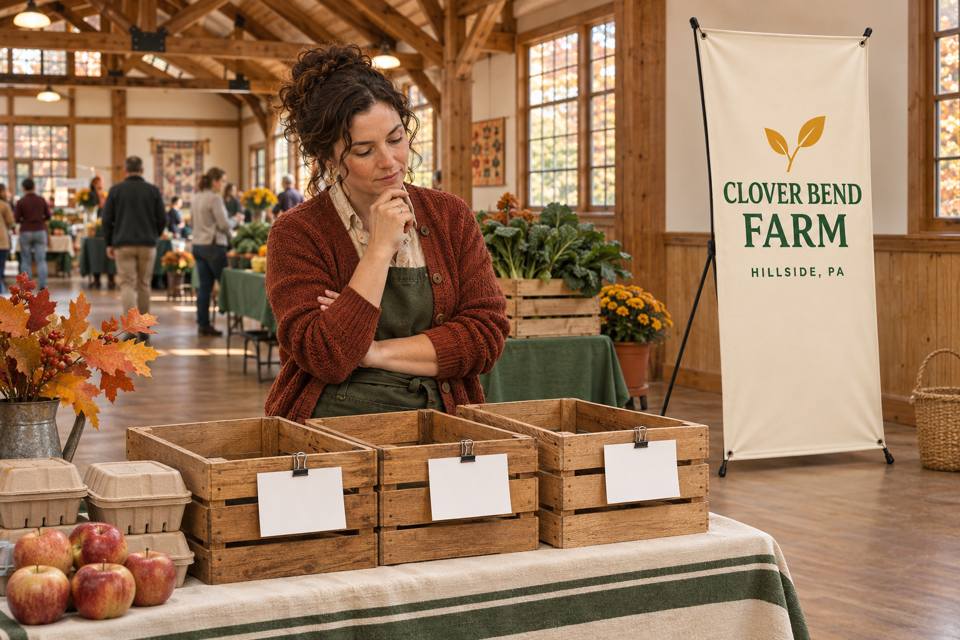
What should a farmers market business sign say?
Start with the business or farm name and the location information your market requires. Put the product, price and selling unit where shoppers can connect them to the correct item. A stable identity sign and separate replaceable price cards usually serve these two jobs more clearly than one permanently printed price list.
Check the current handbook for the specific market. Portland Farmers Market’s 2026 handbook, page 17, specifies business identity and location, sign dimensions and price legibility. Those are that operator’s requirements, not a nationwide design standard. The Food Trust’s 2026 handbook, page 16, also distinguishes identity and price signs and says signs must not obstruct foot traffic.
Before designing, record which market and event the sign is for, the approved business name, the actual location wording, the display position and who confirms the market’s conditions. Do not copy another farm’s certification, growing-method claim or market affiliation into your artwork.
A completed identity brief
Fictional vendor: Clover Bend Farm.
Location wording: Hillside, PA, used only as an example.
Display task: identify the vendor in a dry indoor market hall.
Stable artwork: business name, location and the farm’s approved two-leaf mark.
Keep changeable: today’s products, prices, available quantities and sold-out items.
Approval owner: the vendor owner checks the name and location; the actual market operator confirms placement conditions.
Purchasing decision: retain an existing approved identity sign if it already serves the task.
This brief does not grant permission for the pictured banner or establish that its lettering meets any market’s dimensions. Match the final artwork and installed position to the actual requirements.
Write price cards that identify the offer
A price alone leaves the customer guessing what they will receive. Write the product or variety, the price and the unit together. Put the card beside the matching item, not between two products that could both fit the description.
The following are fictional offers for demonstrating wording, not current market prices or a recommended pricing strategy:
Gala apples
$3.50 per lb
Sold by weight. The price is not per apple or per basket.
Carrots
$4 per bunch
The prepared bunch is the selling unit. Keep a loose-carrot offer separately identified if one is also sold.
Cherry tomatoes
$5 per prepared pint container
This example offers one prepared container, not a customer-filled container of an unspecified size.
Use the selling unit you actually offer and meet the applicable measurement and product-labeling requirements separately. A readable sales card does not replace required package information or establish the suitability of a scale or container.
Fix an ambiguous card before opening
Suppose the apples originally have a card reading “Apples $3.50.” The owner’s actual offer within this example is Gala apples sold by the pound. The correction is “Gala apples — $3.50 per lb,” placed only with those apples. Changing the lettering size without adding the unit would leave the main ambiguity unresolved.
Keep discount conditions next to the offer they qualify. If there is a genuine multi-item offer, state which products qualify and what quantity the displayed total buys. Do not add a savings claim unless the comparison is accurate and supportable.
Run an opening check from the shopper’s side
The person who wrote the cards already knows the intended offers. Ask another team member to read the actual display from the customer approach, then beside each product. This is a practical proposed check; the article has not tested a particular font size or shopping distance.
- Identify the vendor. Ask the reader to find the business name and required location without moving stock or stepping into the stall.
- Match each card to its item. Ask “Which apples does this describe?” Move or duplicate a card if the answer is uncertain.
- Say what the price buys. Have the reader explain whether the item is sold by weight, bunch or prepared container. Correct missing units rather than relying on a spoken explanation at checkout.
- Compare the current offers. The person taking payment checks the cards against the owner’s current offer record. Remove old cards before presenting the new offer.
- Check the real placement. Confirm that products, crates and other displays do not hide essential wording and that the layout follows the market’s space conditions.
Finish when the intended reader can identify the vendor and explain each displayed offer correctly, and the responsible person has checked the market’s conditions. If the text remains unclear, simplify the wording or placement and repeat that part. More decoration does not answer a missing unit.
Give one person ownership of price and availability changes
In the Clover Bend example, Mira prepares the cards and Jon takes payment. Before trading, Jon reads each current offer back to Mira. During the session, Mira changes the display and tells Jon what changed before the new offer is used.
Completed sold-out update: when the example’s cherry tomatoes sell out, Mira removes the “$5 per prepared pint container” card from the selling position and replaces it with “Cherry tomatoes — sold out for today.” Jon confirms the same answer at the counter. The farm identity sign remains in place.
If a central board and an individual card both show an offer, update or remove both together. If a new price has not been confirmed, take the stale offer out of use while the owner resolves it; do not leave two conflicting prices and expect the customer to choose. Actual disagreements and transaction obligations need the store’s applicable policy and local requirements.
For the separate task of updating websites or earlier announcements, see how to keep availability information current. A harvest plan or old message should not be treated as confirmation of stock on the table.
Consider a printed display after the information plan is settled
Plain replaceable cards and an existing approved identity sign may be enough. Browse custom marketing materials only if a defined display gap remains. Keep daily prices off a permanent identity graphic when those prices change.
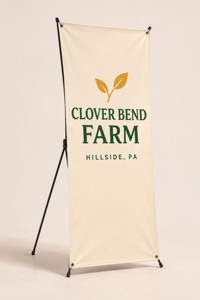
custom X-frame banner
The current page lists 24 × 63, 24 × 70 and 32 × 71 inch graphic options and a minimum of one piece. It describes a banner, stand and carry bag package.
The specifications identify indoor advertising, although other page copy mentions outdoors. This guide treats it as an indoor candidate only. Confirm the chosen graphic, full support footprint, allowed position and artwork before ordering. The listing does not establish an outdoor wind rating or approval for your stall.
AI artwork concept based on the listed X-frame form, with the same fictional identity as the scene. Click the small image for the exact product. Neither picture proves printed color, lettering dimensions, installed stability or visibility.
Prepare the brief before ordering
Keep the identity brief, the actual market’s requirements and the current item-price-unit list as separate records. If a new printed display is justified, use the confirmed configuration and approved artwork with DecentCustom to review the design preview and current order conditions. Continue using suitable existing materials when they already do the job.