Farmers market table planning
Measure the table you will actually use, then choose the required overhang and access. “Six-foot table” names the length; it does not settle the cover’s finished size.
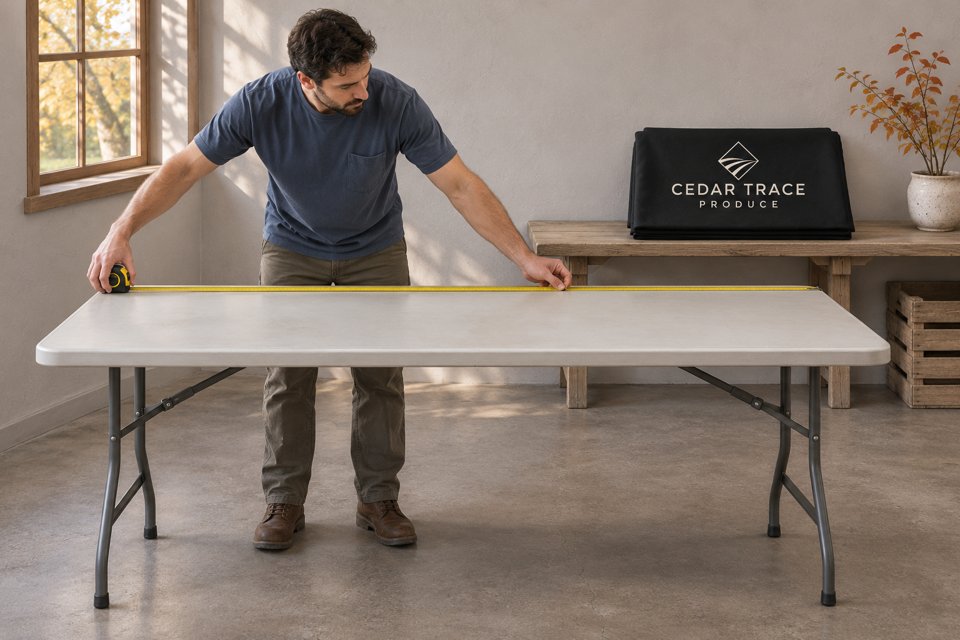
Measure length, width and height before choosing the cover
For a loose rectangular table throw, record the actual tabletop length and width, the height from the top to the floor, and the intended drop on each side. Specify whether the rear should be covered or left accessible. Then compare the required finished cloth dimensions with the supplier’s confirmed configuration.
Do this with the table fully opened and at the height you will use. Measure the long top edge end to end, then the short top edge front to back. Measure height from the tabletop to the floor; note an uneven surface or adjustable leg setting separately. Keep all measurements in one unit and label which edge is which.
Decide what the cover must allow staff to reach behind the table. A four-sided cover and an open-back format serve different access needs. Do not assume that moving a standard cloth off center provides the same result as a separately specified open-back design.
Check the actual market’s placement conditions too. The Food Trust’s 2026 handbook, page 15, keeps vendor tables and displays within the stall boundary. That rule does not prescribe a universal tablecloth size or certify a particular cover.
A complete worked example: 72 × 30 × 29 inches
Fictional planning record: Cedar Trace Produce is preparing an indoor market table. Its example measurements and preferred drop are assumptions for the calculation, not measurements of a retailer or of the product pictured.
Tabletop length: 72 inches.
Tabletop width: 30 inches.
Table height: 29 inches.
Desired drop: 26 inches at both ends, the front and the back.
Desired clearance: 29 − 26 = 3 inches above a level floor.
Rear access choice: four-sided coverage is acceptable for this example; no regular access beneath the table is planned.
For an ideal centered rectangle, add the two drops to the corresponding tabletop measurement:
Finished cloth length = table length + left-end drop + right-end drop.
72 + 26 + 26 = 124 inches.
Finished cloth width = table width + front drop + back drop.
30 + 26 + 26 = 82 inches.
Planning rectangle: 124 inches along the table’s long direction × 82 inches across its short direction.
The three-inch clearance is this fictional vendor’s chosen target, not a required safety standard. Real corners, seams, fabric behavior and floor conditions can change the installed result. These are finished-dimension estimates, not a cutting pattern or a verified fit guarantee.
For your actual table, use your own measurements and agreed drop on every side. If front and rear drops differ, add those different values rather than doubling one number. Ask the supplier how the final construction and artwork template correspond to those dimensions.
Why two “six-foot” covers can hang differently
The current product page below contains two different size descriptions. To explain their geometric consequences, the following calculations assume that each stated size describes a finished rectangular cloth, with its longer dimension running along the 72-inch table. That orientation and meaning have not been confirmed for the SKU.
Assumed rectangle A: 132 × 90 inches
End drop = (132 − 72) ÷ 2 = 30 inches.
Front and back drop = (90 − 30) ÷ 2 = 30 inches.
Against a 29-inch-high table, each ideal drop is 1 inch longer than the height. It would reach past floor level in this simplified model, rather than give the chosen three-inch clearance.
Assumed rectangle B: 125 × 65 inches
End drop = (125 − 72) ÷ 2 = 26.5 inches.
Front and back drop = (65 − 30) ÷ 2 = 17.5 inches.
Ideal clearance is 2.5 inches at the ends and 11.5 inches at the front and back. That differs from the example’s chosen 26-inch drop on every side.
Neither calculation tells us which size the supplier will produce. It also does not show how corners will fold. The useful conclusion is to pause and resolve the product dimensions, rather than choose whichever description appears to fit the desired result.
Use a complete clarification brief before artwork approval
The example vendor can now make a specific request instead of asking only whether the cover fits a six-foot table:
“Our table is 72 inches long × 30 inches wide × 29 inches high. We want a loose four-sided cover with an intended 26-inch drop on every side, giving a planning rectangle of 124 × 82 inches. The page shows both 90 × 132 inches and 65 × 125 inches. Please confirm the finished dimensions and orientation for the actual configuration, the construction, and whether a suitable option is available. Please also provide the corresponding artwork template and front print position before we approve the design.”
This is ready-to-adapt example wording; no inquiry or order has been sent. The requested size is a target, not a claim that this exact custom dimension is available. The supplier’s answer must identify the actual configuration and finished size, not simply repeat “six-foot.”
Completed decision: Cedar Trace holds the new printed-cover order until that answer is clear. In this fictional example, an existing suitable plain cover and separately approved business sign remain available for the event. Buying a printed replacement is not necessary to keep the information task covered.
Current product details to verify
Compare custom marketing materials after the table, information task and space are defined. A table throw is one possible display surface, not a substitute for the market’s required identity wording.
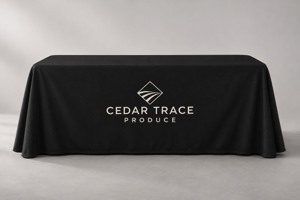
printed cover listed for six-foot tables
The current page describes polyester, four-sided coverage and hand washing. Its feature section states 90 H × 132 W inches; its item-size specification states 65 H × 125 W inches. This conflict remains unresolved. The current minimum/default quantity is two covers.
The listed maximum logo size is 22 H × 50 W inches. Confirm the actual template and visible front position; that maximum is not proof that every placement remains visible after draping. The picture is an artwork concept, not evidence of either finished size.
AI concept with the same black cloth and ivory Cedar Trace diamond-and-furrow identity as the scene. Click the small image for the exact listing. No fire, weather, food-contact, cleaning-process or installed-fit performance has been verified here.
Keep the identity task separate from a cover purchase
If the reason for printing is simply to identify the vendor, first plan business identity and daily price cards. An existing approved sign may already cover the stable name and location while changeable cards handle current offers.
Approve the actual configuration and preview together
Take the labeled table measurements, intended drops, access requirement and confirmed finished size into the design review with DecentCustom. Check the artwork’s orientation and print position against that configuration, then review the current quantity and full order conditions. Keep the order on hold when a dimension or construction answer remains unclear.